


We use cookies to give you the best digital experience. By continuing to browse this site, you give consent for cookies to be used. To learn more information about the use of cookies, please visit our cookie policy.
A global brand entering China faces a problem most marketing teams do not anticipate: the brand's existing reputation counts for very little. Years of international recognition, awards, and customer loyalty do not cross the border. Chinese consumers evaluate overseas brands from scratch — using different signals, relying on different sources of trust. KOL marketing is the most direct way to bridge that gap. But it only works if you are prepared to run it differently from any influencer program you have managed before.
Global Brands Enter China with a Trust Deficit — Here's Why It Matters
In most markets, a well-known international brand carries a built-in credibility advantage. In China, that advantage largely disappears for brands without local market history.
Why the trust deficit exists:
- Brand awareness ≠ brand trust. Chinese consumers may recognize a global name but treat it as unproven in the local context — unfamiliar with local culture, unrelated to how Chinese people live and shop. Analysis of the BrandZ China rankings consistently shows that foreign brands score lower on "Meaningful" and "Different" dimensions with Chinese consumers than domestic equivalents, even when global awareness is high. [1]
- Western communication styles land differently. Campaigns built on global aspiration, performance claims, or overseas celebrity association often feel distant or irrelevant to Chinese audiences.
- Purchase decisions rely on community signals. Chinese consumer culture places significant weight on peer recommendations, KOL endorsements, and social proof from within trusted communities. [2] Brand-to-consumer communication alone rarely closes the trust gap. Nielsen's research on advertising trust consistently finds that recommendations from people and consumer opinions posted online rank among the most trusted forms of communication globally — a pattern particularly pronounced in Asian markets. [3]
The result:
Brands that enter China relying on their global equity and running standard paid media campaigns typically see weak engagement, low conversion, and a slow start. Building trust from zero requires a fundamentally different approach.
Why KOL Marketing Closes the Trust Gap Faster Than Any Other Channel
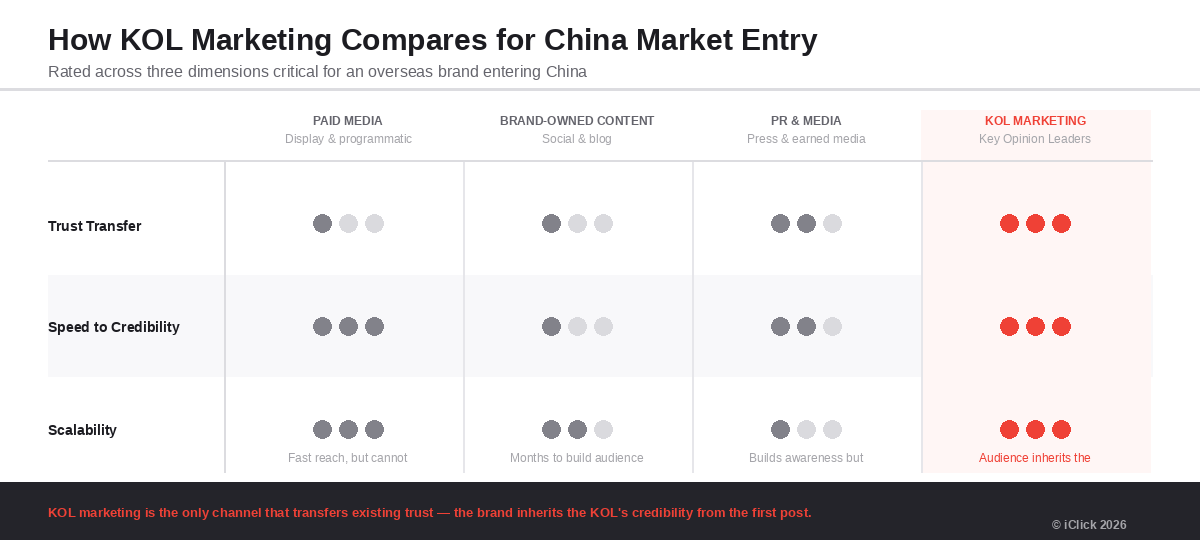
Trust is earned, not bought — but KOL marketing is the closest thing to a shortcut, because it borrows trust rather than building it from scratch.
How trust transfer works:
A KOL has built credibility with their audience over months or years. When they introduce your brand, they are lending that credibility to you. For an overseas brand with no China market history, this is the fastest available path to establishing that Chinese consumers should pay attention.
The speed advantage in practice:
A well-structured KOL campaign can move a brand from unknown to considered within a single campaign cycle — something that takes years through organic brand-building alone. As of December 2024, China had 974 million online shoppers — 87.9% of all internet users — operating within an ecosystem where content discovery and commerce are tightly integrated on the same platforms. [4] For brands with a specific entry window (product launch, seasonal moment, partnership timeline), KOL marketing compresses the credibility timeline in a way no other channel can match.
The Catch: KOL Marketing Only Works When You Give Up Creative Control
This is where most global brand KOL campaigns fail — not in the strategy, but in the execution.
Global brands are accustomed to tightly governed marketing: brand guidelines, legal approval, message consistency across markets. These are legitimate disciplines. Applied to China KOL marketing, they systematically destroy the very thing that makes KOL content effective: authenticity.
Why over-control kills the campaign:
- A KOL's audience trusts them because their content feels like their own voice. The moment a post reads like a brand script, that trust evaporates.
- Chinese platform audiences are highly sensitive to sponsored content that feels inauthentic. They disengage quickly from posts that are too polished, too controlled, or too different from the KOL's usual content.
- Brands that over-script KOL content consistently see lower engagement, lower comment quality, and weaker results compared to brands that allow genuine creative latitude.
The mindset shift:
Think of KOL marketing less as a media placement and more as a brand partnership. You are briefing a trusted community voice to introduce your brand in a way that resonates with their audience — not producing an ad through a third-party creator. Brands that make this shift consistently report better content quality, stronger audience response, and more effective campaigns.
Choosing the Right KOL Partner When You Are New to the Market
For a first-time China entrant, partner selection is higher stakes than for an established market player. A poorly chosen KOL in your first campaign creates a brand association that is difficult to walk back.
What to prioritize when you have no market history:
- Audience-brand alignment over reach — A smaller audience that precisely matches your target segment will outperform a large KOL with broad, unaligned reach. For market entry, relevance matters more than scale.
- Category credibility — Does the KOL have a track record in your product category? Audiences trust recommendations within a KOL's established area of expertise. Out-of-category placements feel transactional and unconvincing.
- Engagement quality, not quantity — Read the comment section. Genuine trust produces specific, detailed audience reactions. Inflated engagement produces generic, repetitive comments. For first-time entrants, working with partners with clean, authentic engagement is non-negotiable.
- Compliance and disclosure record — Under the Measures for the Administration of Internet Advertising (2023) issued by China's State Administration for Market Regulation (SAMR), paid KOL partnerships must be clearly labeled as advertisements. [5] A KOL with a history of non-compliance creates regulatory and reputational risk — especially for a new entrant that cannot afford a controversy.
- Management transparency — Know whether the KOL is independently managed or represented by a Multi-Channel Network (MCN). Understand the approval workflow before committing. A well-organized MCN can provide structure that makes the campaign easier to manage for a first-time market entrant.
What not to prioritize:
- Follower count as a primary criterion
- Familiarity to your home-market team (not a relevant signal in China)
- Lowest cost per post — false economy where wrong partner choices are costly to reverse
How to Structure Your First China KOL Campaign
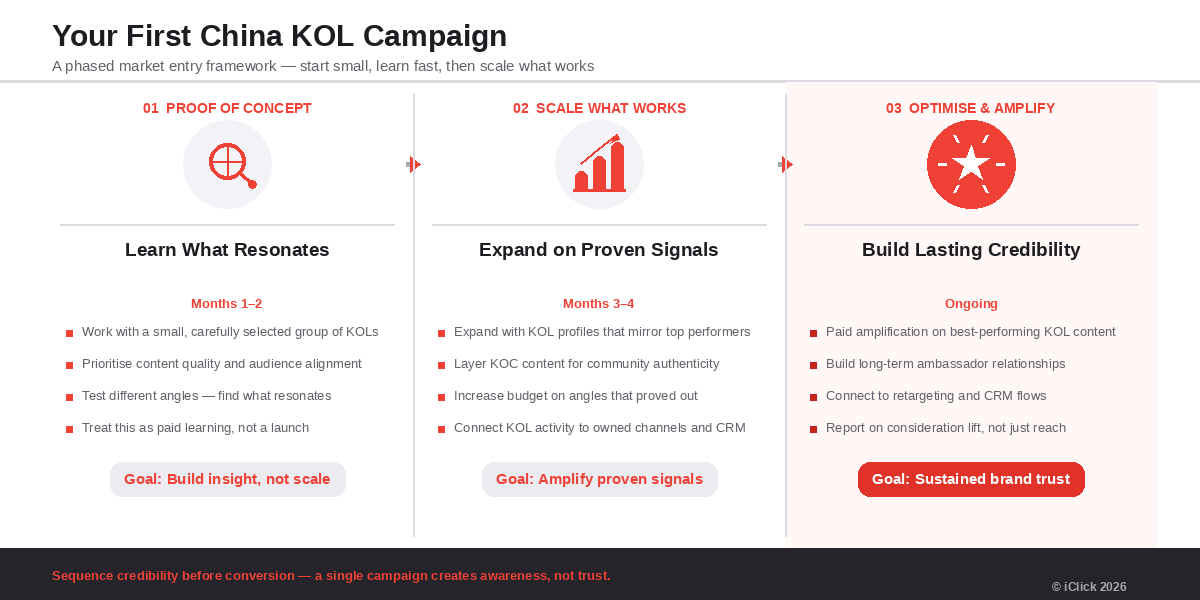
First-time China KOL campaigns benefit from a calibration-first approach. The goal is not to maximize scale immediately — it is to learn what resonates, then scale what works.
Budget mindset for new entrants:
- Allocate a meaningful share to Phase 1, even at small scale — this is where you build the insight that makes the rest of the program work.
- Avoid spending the entire budget on one high-profile KOL. Diversified early campaigns generate more learning and reduce risk.
Common Mistakes Global Brands Make in Their First KOL Campaign
- Assuming global brand equity transfers — Briefing as if Chinese consumers already know and trust the brand. They don't. Start from zero.
- Over-governing the creative — Applying Western brand governance to KOL content and stripping out the authenticity that makes it effective.
- Choosing KOLs by follower count — Prioritizing scale over audience relevance and engagement quality.
- Setting the wrong KPIs — Measuring impressions and reach when the real indicators for a market-entry campaign are consideration signals and audience quality.
- Expecting immediate sales return — China KOL market entry is a credibility investment. Brands that expect direct conversion from a first campaign consistently undervalue the trust-building that actually happened.
- Running one campaign and stopping — A single campaign creates awareness, not credibility. Sustained presence across multiple cycles is what converts initial exposure into brand trust.
FAQ: KOL Marketing for Global Brands Entering China
Is KOL marketing suitable for all product categories?
It is effective across most consumer-facing categories — beauty, lifestyle, food and beverage, fashion, health, and technology. B2B brands can also use KOL-style thought leadership content, though the mechanics differ. Suitability depends more on finding the right KOL niche than on the product category itself.
How do I know which KOL audience matches my target segment?
Reputable KOL partners and agencies can share audience demographic and geographic data before contracts are signed. For market entry, treat this data as a non-negotiable part of the selection process — not a nice-to-have.
How long does it take to see results?
Credibility-building through KOL marketing typically requires two to three campaign cycles before meaningful trust signals are visible. Brands that treat the first campaign as a learning phase — rather than expecting immediate conversion — are consistently better positioned by month six.
Should we work with one KOL or many?
For market entry, a diversified approach — several mid-tier KOLs rather than one large-name placement — generates more insight and reduces the risk of a single underperforming post defining your brand's early China impression.
How iClick Helps Global Brands Build China Credibility Through KOL Marketing
As a leading digital marketing partner in China, iClick combines proprietary data intelligence with a managed KOL program capability to help international brands build credibility from the start of their China market entry.
Whether you are designing your first KOL campaign or refining a program that has not yet delivered the trust signals you need, our team manages partner identification, audience data verification, content governance, and end-to-end campaign measurement.
Ready to build your China market credibility through KOL marketing? Speak with iClick to design the right strategy for your brand's entry.
Read More
- Influencer Marketing Guide: Types, Benefits & Strategy
- KOC行銷是什麼?KOC KOL差別、合作流程&成功案例分享
- 海外品牌中国数字营销常见误区与避坑指南
Sources
[1] Kantar. (2025). *BrandZ Top 100 Most Valuable Chinese Brands 2025*. Kantar Group. https://www.kantar.com/campaigns/brandz/china
[2] McKinsey & Company. (2024). *China Consumer Report 2024*. McKinsey China Center. https://www.mckinsey.com/cn/our-insights
[3] Nielsen. (2021). *Global Trust in Advertising*. Nielsen Holdings. https://www.nielsen.com/insights/2021/global-trust-in-advertising-2021/
[4] China Internet Network Information Center (CNNIC). (January 2025). *第55次《中国互联网络发展状况统计报告》[55th Statistical Report on China's Internet Development]*. https://www.cnnic.cn/n4/2025/0117/c88-11229.html
[5] State Administration for Market Regulation (SAMR), People's Republic of China. (February 2023). *互联网广告管理办法 [Measures for the Administration of Internet Advertising]*. Effective 1 May 2023. https://www.samr.gov.cn/