


We use cookies to give you the best digital experience. By continuing to browse this site, you give consent for cookies to be used. To learn more information about the use of cookies, please visit our cookie policy.
Most guides to the social media used in China stop at the introductions — here is WeChat, here is Douyin, here is what each one does. That platform map matters, and we cover it in depth in our China Social Media Marketing 2026 platform strategy guide. But knowing the platforms exist is not a strategy. The question that actually decides whether a China launch succeeds is different: given your specific goal, budget, and stage of market entry, which platforms do you commit to, in what order, and how do you know it is working? This playbook answers that question with a decision framework built for brands entering or scaling in China in 2026 — not another platform encyclopedia.
Start With the Goal, Not the Platform
The single most common — and most expensive — mistake international brands make is selecting a China platform by its headline user number. WeChat's 1.4 billion monthly active users (Tencent Q1 2025 Earnings Report) is an impressive figure, but it tells you nothing about whether WeChat is the right first move for your brand. A platform is only as valuable as its fit with the specific outcome you are trying to achieve this quarter.
Before evaluating any platform, force a decision on the primary objective. Are you trying to build credibility with a Chinese audience that has never heard of you? Drive measurable first-sale conversion? Retain and deepen relationships with buyers you already have? Each of these goals points to a different platform — and, just as importantly, rules others out. The platform decision is downstream of the goal decision, and reversing that order is where budgets get wasted.
The China Social Media Decision Matrix
Use the matrix below as a starting point. It maps the most common market-entry objectives to a primary platform and a realistic supporting role, based on how the social media used in China actually functions in 2026. For a fuller platform-by-platform breakdown of user numbers and content culture, see our platform strategy guide.
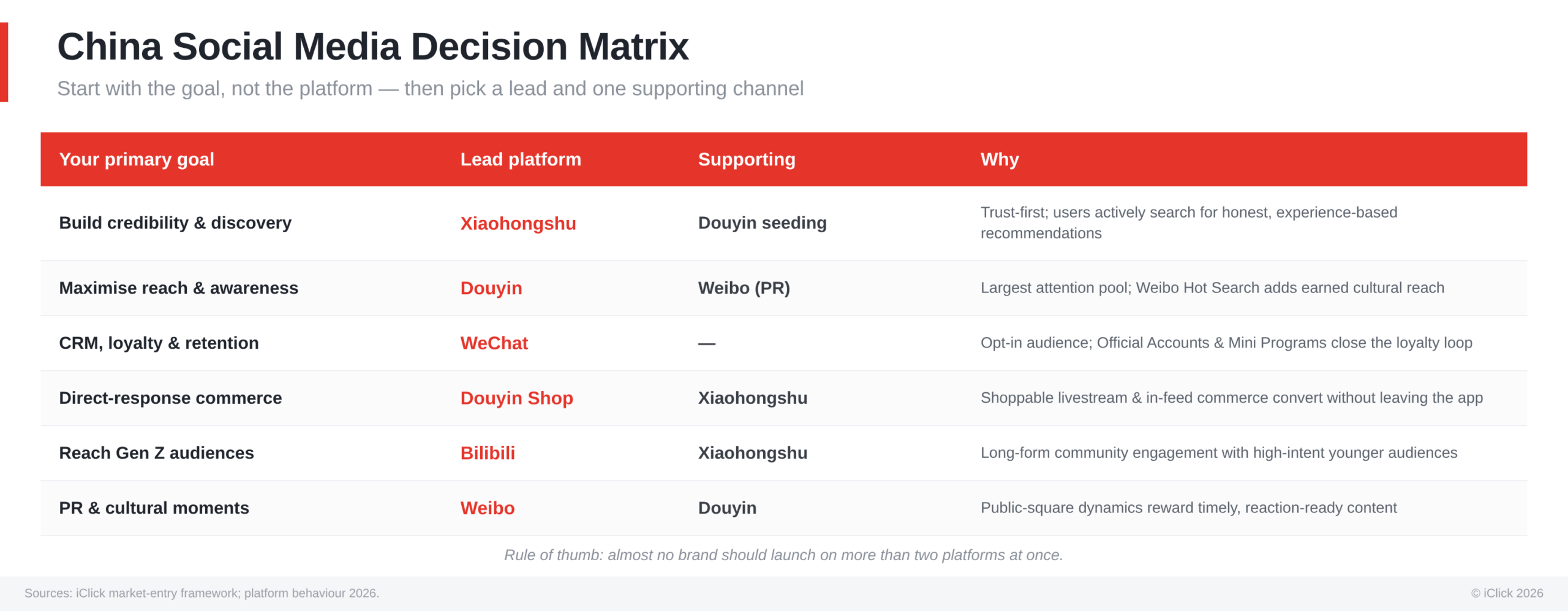
Two rules make this matrix work in practice. First, almost no brand should launch on more than two platforms at once — spreading a first-year budget across five channels produces five weak presences instead of two strong ones. Second, the supporting platform is a deliberate second priority, not an equal investment; it amplifies the lead platform once that channel is validated.
Sequencing Your Entry: Which Platform First
Platform selection answers 'which'; sequencing answers 'when'. Getting the order wrong — for example, pouring budget into paid Douyin reach before any credible Xiaohongshu presence exists to catch that demand — is one of the quietest causes of disappointing China launches. The following three-phase sequence reflects how successful overseas brands typically build presence in China.
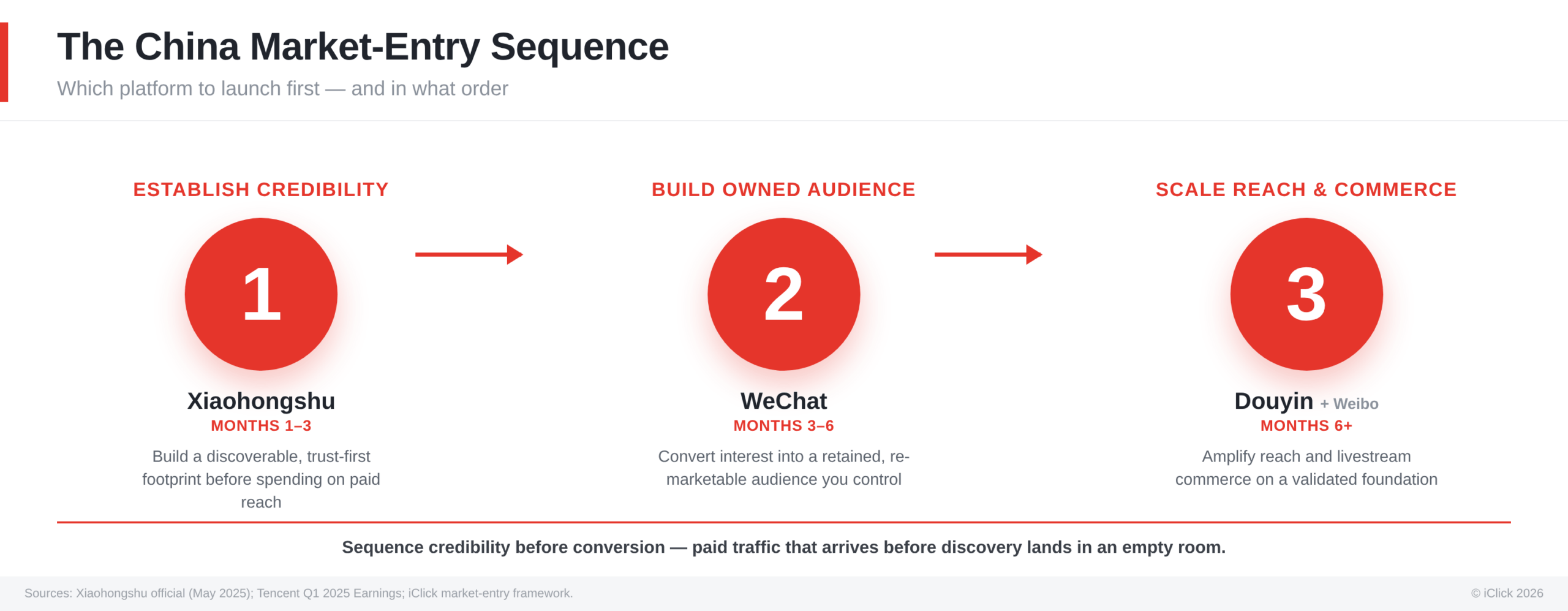
Phase 1 — Establish Credibility (Months 1–3)
Begin where Chinese consumers go to verify a brand they are considering: Xiaohongshu. With daily search volume exceeding 1 billion as of May 2025 (Xiaohongshu official), it functions as a primary first-search destination for consumer decisions. The goal in this phase is not sales volume but a credible, discoverable footprint — a base of honest, detail-rich content and early KOC seeding that a searching consumer will actually find. Attempting to drive conversion before this credibility layer exists means paid traffic arrives at an empty room.
Phase 2 — Build an Owned Audience (Months 3–6)
Once discovery content is compounding, add WeChat to convert interest into a relationship you control. An Official Account plus a Mini Program storefront turns one-time discoverers into a retained, re-marketable audience — the asset that makes every subsequent campaign cheaper. This is the phase where social media strategy and CRM stop being separate workstreams.
Phase 3 — Scale Reach and Commerce (Months 6+)
With credibility and an owned audience in place, Douyin amplifies reach and commerce at scale. Short-video and livestream commerce now land on a foundation of validated content formats and existing brand recognition, which materially improves conversion economics compared with launching cold on Douyin. Weibo enters here too, for the cultural and PR moments that extend earned reach beyond your follower base.
Budgeting and Resourcing a China Entry
A realistic China social media budget accounts for three cost centres that Western-market plans routinely underestimate. First, always-on content production: unlike a campaign burst, platforms such as Xiaohongshu reward consistent, long-term seeding, so budget must cover ongoing creator and content output, not a single flight. Second, creator partnerships: consumer trust in KOL and KOC content is substantially higher in China than trust in brand-owned messaging, so an influencer and community line item is not optional. Third, platform access and compliance: several platforms require a verified Chinese business entity or a licensed agent for official accounts and paid media.
The practical implication is that a credible two-platform entry with sustained content and creator investment is a very different budget from a Western single-campaign launch. Brands that size their China budget as a one-off campaign — rather than a sustained programme across a launch year — consistently under-resource the exact activities the platforms reward.
Localisation Beyond Translation
Effective China localisation is not translated copy — it is platform-native creative. Each platform has an unwritten content culture, and content that reads as repurposed from a global campaign underperforms regardless of budget. WeChat rewards editorial depth for an opt-in audience; Xiaohongshu rewards specific, honest notes that prioritise detail over polish; Douyin rewards a decisive first three seconds; Weibo rewards public, reaction-ready content that invites a crowd in. Localisation also means market nuance within China: what resonates in Hong Kong can differ substantially from Tier 1 and Tier 2 mainland audiences. Our platform strategy guide breaks down what winning content looks like on each channel in detail.
Measuring Success: KPIs by Funnel Stage
Because each phase has a different job, each is measured differently — and applying a single blanket KPI (usually short-term ROI) across the whole programme is how promising China entries get cut prematurely. Match the metric to the phase:
- Credibility / discovery (Xiaohongshu): saves and shares, search-result presence for your category terms, and note engagement depth — not immediate sales.
- Owned audience (WeChat): follower growth quality, Official Account open rates, and Mini Program repeat engagement.
- Reach & commerce (Douyin): video completion rate, livestream conversion, and blended cost per acquisition once presence is established.
- Cross-platform: assisted-discovery signals — how often audiences who convert on WeChat or Douyin first encountered the brand on Xiaohongshu.
The compounding nature of China social media means the most important early metric is often momentum, not return: is discoverable content accumulating, and is the owned audience growing? Those leading indicators predict the conversion economics that appear later.
Common Market-Entry Mistakes to Avoid
Beyond selecting platforms by headline user numbers, three entry-stage errors recur. Launching on too many platforms at once, which dilutes budget into several weak presences. Expecting rapid results on Xiaohongshu, whose compounding community effect rewards sustained seeding over short bursts. And underinvesting in creator partnerships while over-allocating to brand-owned accounts and paid display — the reverse of how Chinese consumer trust actually distributes. Each of these is a sequencing or resourcing failure more than a creative one, which is why a deliberate entry playbook matters more than any single campaign.
How iClick Helps Brands Enter China Social Media
As a leading digital marketing partner in China, iClick combines proprietary data intelligence with execution expertise across WeChat, Xiaohongshu, Douyin, Weibo and the wider China platform landscape. For brands at the market-entry stage, that means translating your business objective into a concrete platform choice, a realistic entry sequence, and a budget scaled to the activities each platform rewards — grounded in audience data and real market signals rather than headline user counts.
Ready to plan your China entry? Talk to iClick about which platforms are right for your brand, your goals, and your launch timeline.
FAQ: Entering China Through Social Platforms
What social media is used in China?
The main social media used in China in 2026 are WeChat, Douyin, Weibo, Xiaohongshu and Bilibili. These domestic platforms replace Western equivalents — Facebook, Instagram, YouTube and X — which are inaccessible in mainland China. For a full platform-by-platform breakdown, see our China social media platform strategy guide.
Which China social media platform should a brand launch on first?
For most brands new to the market, Xiaohongshu is the strongest first move: it builds the credibility and discoverability that later paid reach depends on. WeChat is typically added next to convert interest into an owned audience, with Douyin scaling reach and commerce once the brand's presence is validated.
How many platforms should we start with?
Almost no brand should launch on more than two platforms at once. A common entry configuration is Xiaohongshu for discovery paired with WeChat for owned-audience management, adding Douyin for scale once formats are proven.
Do I need a Chinese business entity to advertise on Chinese social platforms?
Many platforms require a verified Chinese business entity or a licensed agent for official brand accounts and paid advertising. Working with a registered China marketing partner such as iClick removes these access barriers and ensures campaigns comply with local platform regulations.
How should we measure a China social media launch?
Measure by phase, not by a single blanket ROI figure. Early credibility work is measured by saves, shares and search presence; owned-audience building by follower quality and repeat engagement; and reach/commerce by completion rate, livestream conversion and blended cost per acquisition once presence is established.
Sources
- Tencent Q1 2025 Earnings Report — WeChat 1.4B MAU — prnewswire.com/apac/news-releases/tencent-announces-2025-first-quarter-results-302455231.html (14 May 2025)
- Xiaohongshu official — 1B daily searches — marketingtochina.com/xiaohongshu-statistics-and-trends (May 2025)