


We use cookies to give you the best digital experience. By continuing to browse this site, you give consent for cookies to be used. To learn more information about the use of cookies, please visit our cookie policy.
The search bar is no longer the primary interface through which Chinese consumers access brand information. Increasingly, it is the AI answer — and for international brands operating in China, that shift changes everything. With 602 million generative AI users now active in China as of December 2025, representing over 43% of the country's population and more than half of all internet users [1], and 65% of those users actively relying on AI to support purchasing and brand decisions [2], the mechanism by which consumers discover, evaluate, and choose brands has fundamentally transformed.
This is the landscape that Baidu GEO — Generative Engine Optimization — has been designed to address. For international brands with China ambitions, understanding it is not a strategic preference. It is an operational priority.
Why China's AI Search Landscape Demands a GEO Response?
The scale of China's AI adoption is unambiguous. According to QuestMobile and CNNIC's 55th Statistical Report on Internet Development in China [1], China had 602 million generative AI users as of December 2025 [1]. Among the country's 1.125 billion total internet users [1], AI is now an active participant in the majority of high-consideration purchase journeys. Year-on-year AI adoption growth is concentrated in the 25–44 age cohort — the primary demographic for most international brands operating in China — making this a shift that demands immediate response rather than extended observation.
In this environment, the consumer experience of brand discovery has changed at a structural level. Consumers are no longer reading multiple pages of search results and assembling their own conclusions. They are reading a single, structured, AI-generated answer — and the brands that appear in that answer, with the right description and at the right moment, shape perception before any competitor has been considered.
Why Baidu AI Leads China's AI Decision-Making Landscape
Several major AI platforms compete for Chinese consumers' attention, including Doubao (ByteDance), DeepSeek, Tencent Yuanbao, and KIMI. But for the scenarios that matter most to brand marketers — information inquiry, product research, and purchase decision-making — Baidu AI commands the market by a decisive margin.
Baidu AI search currently records 365 million monthly active users, representing 30.4% year-on-year growth and maintaining the number-one position across all AI applications in China. [2] When consumers were asked which AI platform they trust for information inquiry, 62% named Baidu AI — compared to 31% for Doubao and 29% for DeepSeek [3]. This is not conventional market share. It is cognitive authority. Baidu's two-decade positioning as China's authoritative, factual search engine means consumers instinctively bring high-stakes questions to Baidu AI: Is this medical treatment effective? Which hotel is best for a family trip? How does this skincare brand compare with its competitors?
For international brands operating in healthcare, consumer products, travel, financial services, and luxury retail — categories where trust and information quality are decisive — this dynamic makes Baidu AI the single most critical platform for managing brand presence in China's AI era.
How AI Has Reshaped the Four Stages of Consumer Decision-Making
Traditional search placed the burden of synthesis on the consumer. A user entered a query, received a list of results, navigated multiple pages, and assembled their own understanding. SEO determined how prominently a brand's pages appeared in that list.
AI search has disrupted this model entirely. The AI now performs the synthesis — reading multiple sources, evaluating authority and freshness, and generating a structured answer as the immediate response to the user's query. A brand's first encounter with a potential customer is now shaped by what the AI says about the brand, not by what the brand says about itself on its own website.
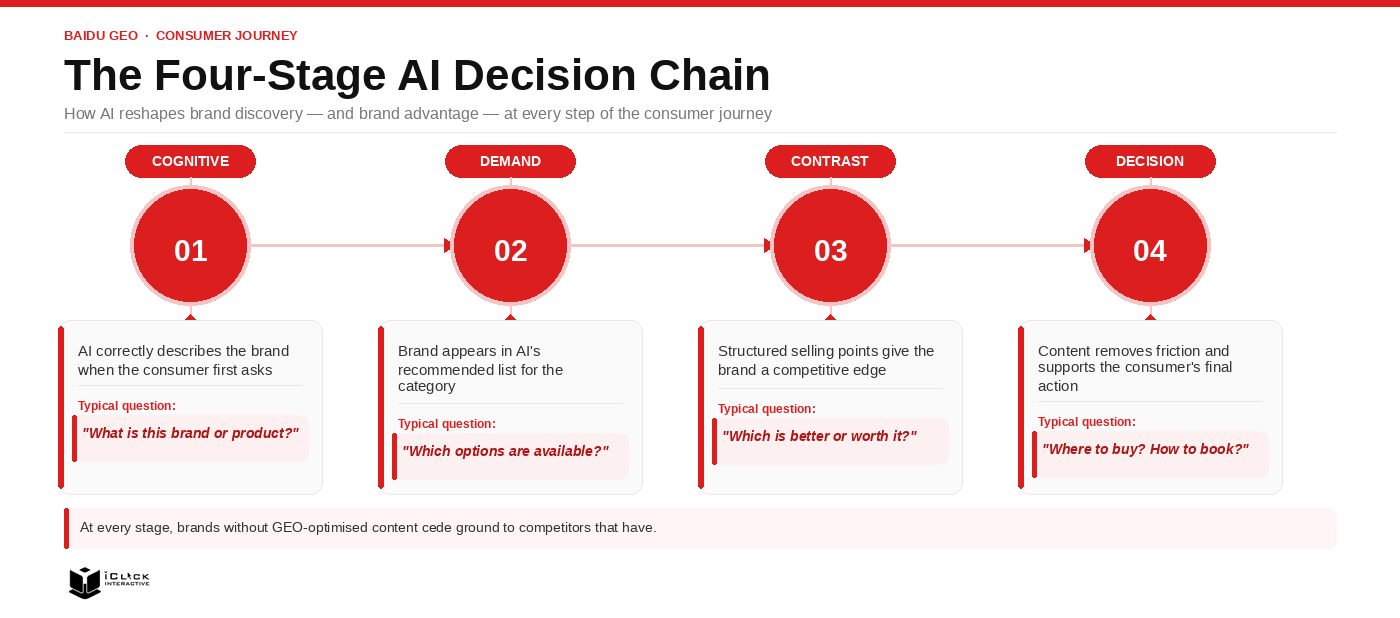
Baidu's framework maps this AI-driven journey across four sequential stages:
-
- Cognitive: Does the AI correctly describe and understand the brand when a consumer asks "What is this brand or product?"
-
- Demand: Is the brand included in the AI's recommended list when a consumer asks which options are available in a category?
-
- Contrast: Do the brand's structured selling points give it a competitive advantage when the AI compares options on features, price, and experience?
-
- Decision: Does the available content remove friction and support the consumer's final action — purchase, booking, or enquiry?
At every stage, brands that have not actively structured their content for AI understanding cede ground to those that have.
GEO Versus SEO: Understanding the Strategic Distinction
Generative Engine Optimization (GEO) is the practice of structuring brand content so that it is accurately understood, cited, and recommended by AI-powered answer systems. It is related to, but meaningfully distinct from, traditional Search Engine Optimization.
Where SEO seeks to rank a webpage on a results page — competing with multiple other links for a user's click — GEO seeks to embed brand information within the AI answer itself. The commercial distinction is material. An SEO result competes for attention on a crowded list. A GEO citation becomes the answer, shaping consumer understanding and brand perception before any competitor has been considered.
As Baidu's own framework articulates it: "The answer is the advertisement." This is not a metaphor. It is a precise description of how brand decisions are now formed in China's AI search environment. The objective has shifted from driving clicks to enabling direct AI recommendation.
DuXingxuan: The Infrastructure Powering Baidu GEO
Baidu's content matching platform, DuXingxuan (度星选), is the infrastructure through which brands manage their representation within Baidu's AI answer systems — and simultaneously across China's broader AI ecosystem. A single optimized content asset distributed through DuXingxuan can be cited and recommended not only by Baidu's own Wenxin Yiyan AI assistant, but also across DeepSeek, Doubao, Yuanbao, and KIMI simultaneously. [2]
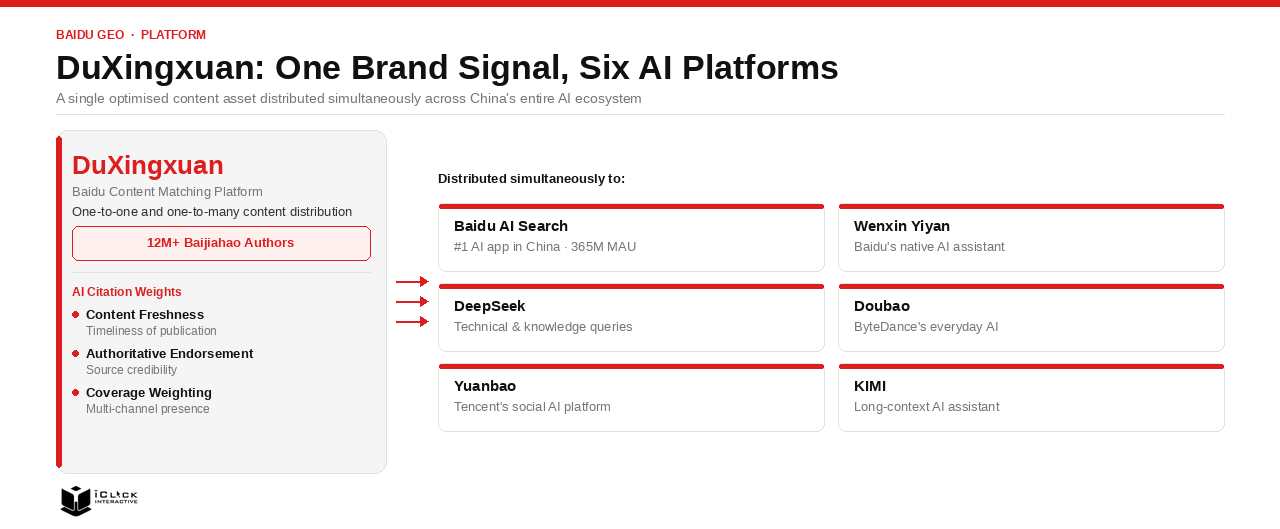
The platform is powered by more than 12 million Baijiahao authors [2] — China's largest content creator network — producing authoritative content across every consumer decision-making category. This ecosystem delivers the three qualities that AI models weight most heavily when selecting citation sources: content freshness (recency of publication), authoritative endorsement (source credibility), and coverage weighting (the number of distinct channels on which the same information appears). DuXingxuan is engineered to optimize all three simultaneously, giving brands a systematic approach to building durable AI visibility rather than relying on chance inclusion.
The Q&A Business List: SEO and GEO in One Integrated Solution
Baidu's Q&A Business List product combines traditional SEO (search results ranking) with GEO (AI-powered answer generation and citation) in a single integrated solution. [2] Rather than keyword density optimization, the Q&A Business List is structured around the actual questions consumers bring to AI platforms:
-
- *Who is this brand's product suitable for?*
-
- *How does it compare with competing options?*
-
- *Is it worth the price?*
-
- *Where can I buy or book it?*
Content built to answer these questions accurately and authoritatively is the content that AI systems cite, recommend, and use to shape consumer perception at the precise moment of decision.
Four Keyword Categories for Effective GEO Content
Effective Baidu GEO requires content structured across four keyword categories — one aligned to each stage of the consumer decision journey. Building coverage across all four demands a systematic approach: most brands enter the China market with significant gaps at the Contrast and Decision stages, precisely where purchase intent is highest.
Mapping, prioritising, and executing across these categories is the core of iClick's Baidu GEO engagement — and the area where specialist platform knowledge delivers the most measurable difference in outcome.
Two Execution Modes
DuXingxuan offers two execution modes to suit different campaign objectives. Precision Targeting enables brands to provide core keywords while Baidu's MCN ecosystem executes focused optimization on designated platforms. Long-tail Coverage expands a small number of primary keywords to 2,000 or more related terms for full semantic coverage across the complete range of consumer questions — a more comprehensive approach suited to categories with high decision complexity.
Why Authenticity Is the Foundation of Durable Baidu GEO
A defining feature of Baidu's GEO framework is its explicit commitment to accuracy and authenticity. Content submitted through the Q&A Business List must be grounded in verifiable facts, accurate brand claims, and standardised expression [2]. Fabricated statistics, manufactured user testimonials, and exaggerated positioning are both non-compliant and strategically counterproductive.
AI models are increasingly sophisticated in identifying and downweighting content that does not meet accuracy standards. GEO strategies built on genuine content quality — accurate product descriptions, verified performance claims, and consistently maintained brand information — are the strategies that deliver durable presence as AI systems continue to evolve. Authenticity is not only the ethical baseline; it is the sustainable competitive advantage.
Four Use Cases Where Baidu GEO Delivers Measurable Impact
Baidu AI Q&A Marketing delivers the greatest commercial return in four primary scenarios:
-
- Brand education: Establishing a clear, accurate "standard answer" so that AI correctly describes the brand when consumers ask about it — particularly valuable for international brands entering the China market without established local recognition
-
- New product launches: Embedding key selling points within AI answers before competitive brand awareness has formed, capturing consideration at the earliest stage of the decision cycle
-
- Reputation management: Correcting inaccurate, outdated, or competitively distorted brand information within AI answer systems
-
- Decision transformation: Shortening the purchase journey by ensuring the information a consumer needs to commit — pricing, suitability, comparison data — is immediately available within the AI answer, reducing friction to conversion
Work with iClick to Build Your China GEO Strategy
iClick Interactive is a certified partner of Baidu's International Advertising Unit, with direct access to DuXingxuan's content matching platform and the full spectrum of Baidu AI Q&A Marketing solutions. Our China media team combines deep Baidu platform expertise with the broader data intelligence and cross-channel targeting capabilities required to build a GEO strategy that delivers measurable, sustainable brand presence within China's AI answer ecosystem.
With 602 million Chinese consumers already using AI to make purchasing decisions [1] — and 65% relying on AI answers to determine which brands to consider [2]— appearing in AI answers is not an emerging ambition. It is the current competitive landscape. The brands that appear in AI answers are winning China's decision-making chain.
Connect with iClick to explore how Baidu GEO can help your brand become the answer Chinese consumers receive at the moment of decision.
Sources
-
- [1] QuestMobile / CNNIC 55th Statistical Report on Internet Development in China
-
- [2] Baidu IAU Partner Material, July 2026
-
- [3] iResearch 2025 China AI Search User Behavior Research Report