


We use cookies to give you the best digital experience. By continuing to browse this site, you give consent for cookies to be used. To learn more information about the use of cookies, please visit our cookie policy.
Understanding KOL, Wang Hong, and Bo Zhu in China’s Influencer Ecosystem
If you have started planning a market entry in China, you have almost certainly come across the term KOL. It appears in agency briefs, platform playbooks, and budget discussions — yet many international marketers still ask what KOL means and how the concept differs from influencer marketing they already know. China's creator ecosystem has its own taxonomy — one that includes terms such as Wang Hong, Bo Zhu, and Zhu Bo — and understanding the distinctions will shape how you select partners, structure campaigns, and set expectations. This guide maps the full picture.
What Does KOL Mean in China Marketing?
KOL stands for Key Opinion Leader. In China's digital marketing landscape, a KOL is an individual — a creator, expert, or public figure — who has built a credible, engaged following on one or more Chinese social media platforms and whose opinions or product endorsements meaningfully influence the purchasing decisions of that audience.
The term took root in China before "influencer" became a global marketing standard. Unlike a celebrity endorser whose value is primarily reach, a KOL in China is expected to carry topical authority. A beauty KOL is trusted because their audience believes they understand skincare formulas. A tech KOL commands attention because their product comparisons are considered informed and honest. Authority and trust are the product — reach is a byproduct.
For Chinese-speaking audiences, KOL意思 (the meaning of KOL) and KOL是什么意思 (what does KOL mean) are frequently searched terms — KOL is not insider jargon; it is the language Chinese consumers use when they describe who they follow and why they buy.
Wang Hong (网红): The Internet Celebrity
Wang Hong (网红, wǎng hóng) literally means "internet famous." It refers to an individual who gained significant online fame through their personality, appearance, lifestyle, or viral content, and who monetises that fame through brand partnerships, sponsored posts, e-commerce storefronts, and live-stream selling.
The key distinction from a KOL is the basis of influence. Wang Hong are followed because they are entertaining, aspirational, or culturally resonant. KOLs are followed because their audience trusts their judgment in a specific field. As China Skinny's Mark Tanner has noted: "Celebrities aren't always KOLs — they may be very well-known, but what they say may not hold a huge amount of clout." A Wang Hong with millions of followers may move product at volume but carry limited credibility in a category that demands expertise.[2]
Wang Hong gave rise to the Wang Hong Economy (网红经济) — a full commercial ecosystem spanning content creation, fan engagement, live-stream selling, and branded merchandise, supported by MCN agencies that manage talent, content production, and platform operations at scale. China's live-stream e-commerce GMV reached approximately USD 807 billion in 2024, underscoring how deeply this model has become embedded in everyday consumer behavior. [6]
Bo Zhu (博主 / 播主): The Content Creator and the Broadcaster
The term "Bo Zhu" in Chinese marketing refers to two closely related but distinct roles, distinguished by a single character — and a meaningful difference in function.
博主 (Bózhǔ — Blogger / Content Creator). 博主 combines 博 ("blog" or "broad knowledge") and 主 ("host" or "master"), and is the general Chinese umbrella term for any online content creator — bloggers, vloggers, short-video creators, and social media personalities. It is a neutral, descriptive label that carries no inherent implication of fame, follower count, or commercial orientation. All KOLs and Wang Hong are technically 博主, but not every 博主 is a KOL or Wang Hong: the label covers the full spectrum from niche hobbyist creators to mega-influencers.
For brands, the distinction matters when briefing agencies or evaluating creator lists. A 博主 with 50,000 followers and deep engagement in a specialist community may deliver stronger results for a targeted campaign than a high-profile Wang Hong whose audience breadth dilutes category relevance.
播主 (Bōzhǔ — Broadcaster / Streaming Host). 播主 — sometimes written as 主播 (Zhǔbō, meaning "main broadcaster") — refers specifically to a live-streaming host: someone who broadcasts in real time, interacts with a live audience, and integrates product selling directly into the stream. The role sits at the intersection of entertainment, community, and commerce.
Live-streaming hosts (播主 / 主播) power China's social commerce engine. Platforms such as Taobao Live, Douyin, and JD Live are built around this format. Li Jiaqi — the "Lipstick King" — became so prominent that his Baidu search volume surpassed major pop idols at his peak. Viya, another top 播主, sold 15,000 units of a KKW fragrance for Kim Kardashian in a single live session — illustrating the direct-conversion power this format can deliver for international brands.[7]
Where a KOL builds trust over time through content authority, and a Wang Hong drives aspiration-led awareness, a 播主 is optimised for real-time conversion: the session is the sales floor, and the audience comes prepared to buy. This makes 播主 partnerships particularly effective for product launches, promotional events, and campaigns where measurable short-term sales are the primary objective.
China's Creator Taxonomy: The Full Picture
These five terms represent the core vocabulary of China's creator ecosystem. Understanding how they relate — and where they overlap — is the foundation of any serious China influencer strategy.
Term
Basis of influence
Content style
Best platform(s)
Best suited for
KOL
Domain expertise and audience trust
Authoritative, evidence-backed
Weibo, Bilibili, Xiaohongshu, Douyin
Awareness, trust-building, consideration
Wang Hong (网红)
Internet fame and personality
Entertaining, aspirational, lifestyle
Douyin, Taobao Live, Xiaohongshu
Mass awareness, live-commerce, product seeding
Bo Zhu (博主)
Consistent content creation (general)
Varies — blogs, video, image, text
WeChat, Weibo, Xiaohongshu, Bilibili
Niche community reach, targeted engagement
Bo Zhu (播主)
Live broadcast presence and interaction
Real-time selling, entertainment, Q&A
Taobao Live, Douyin, JD Live
Direct conversion, product launches, flash sales
KOC
Peer-level authenticity
Personal reviews, everyday experiences
Xiaohongshu, WeChat
Conversion, community trust, repeat purchase
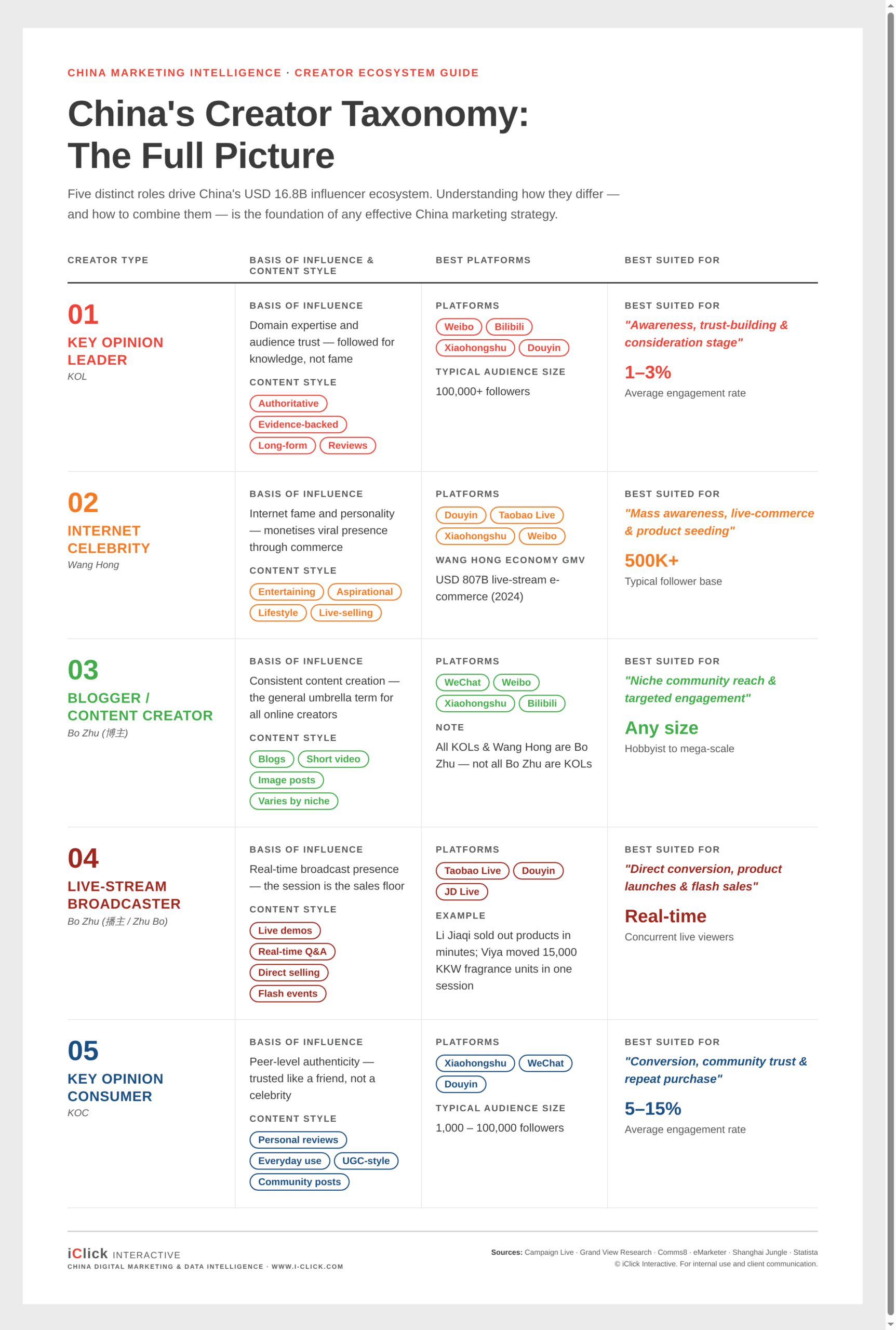
A well-structured China campaign typically layers these roles. A typical launch sequence might run: KOL content to build category credibility → Wang Hong seeding for broad awareness → 播主 live sessions to drive conversion at launch → KOC reviews to sustain peer-level advocacy in the weeks that follow.
Why KOLs Matter for Trust and Conversion
Across all these creator types, KOLs remain the primary vehicle for building durable brand trust in China. Research consistently identifies credibility and expertise as the characteristics that most strongly drive purchase intent — above price, promotion, or algorithmic placement. China's influencer and KOL marketing market is valued at approximately USD 16.8 billion, with the platform segment forecast to grow at a CAGR of around 22% through 2030.[1][3]
In a consumer environment where McKinsey projects consumption growth at 2.3% [4], and PwC describes trust as "the new currency,"[5] the brands that invest in credible KOL partnerships hold a structural advantage over those relying on paid media alone. Research by eMarketer found that 78% of Chinese social media users are receptive to celebrity brand recommendations, and 63% respond to online celebrity recommendations — both figures among the highest globally surveyed.[2]
Which Industries Benefit Most?
KOL and Wang Hong investment concentrates most heavily in:
- Beauty and personal care — approximately 25.4% of influencer investment in China. KOLs drive formulation trust; Wang Hong drives live-stream product discovery and impulse purchase. [9]
- Food and beverage — recipe content, taste reviews, and lifestyle association on Douyin and Xiaohongshu.
- Consumer electronics — credible comparison content favours KOL authority; product unboxing and live-demo formats suit 播主 and Wang Hong.
- Sportswear and lifestyle — community identity and cultural association through both KOL and Wang Hong channels.
- Luxury, travel, finance, and education — where KOL credibility and trust carry more weight than Wang Hong reach.
What Overseas Brands Often Misunderstand
Conflating Wang Hong with KOL. They serve different campaign functions. A Wang Hong can drive mass awareness; a KOL builds category credibility. Mixing up the two creates a partner mismatch that will underperform against the brief.
Overlooking 播主 as a conversion channel. Many international brands default to KOL-only strategies and miss the direct-sales potential of live-streaming partnerships. For product launches with a clear commercial target, a top-tier 播主 session can outperform weeks of content-led KOL activity in measurable revenue terms.
Treating 博主 as a lesser category. A 博主 with a highly engaged niche community can deliver stronger brand recall and purchase intent than a large-following Wang Hong whose audience lacks category relevance.
Selecting by follower count alone. Audience relevance, category credibility, and engagement quality matter more than the headline number. A highly followed account with low category authority will underdeliver against brief.
Assuming pricing transparency. Research has found a gap of up to 15% between listed and actual KOL and Wang Hong pricing in China. In 2025, KOL listed prices rose 11.6% while actual prices paid by advertisers fell 3.4%. Without verified local market intelligence, international brands routinely overpay or select partners whose real audience metrics do not support the brief.[1]
When to Partner with a China Marketing Agency?
The breadth of China's creator taxonomy — KOL, Wang Hong, 博主, 播主, KOC — makes creator selection considerably more complex than in most other markets. A specialist agency partner closes the gaps that are difficult to address from outside: access to verified creator networks across all five categories, platform compliance knowledge, live-stream campaign management, and measurement frameworks that connect creator activity to commercial outcomes.
iClick works with international brands to design and execute strategies across the full spectrum of China's creator ecosystem — from KOL authority campaigns to Wang Hong awareness, 播主 live-commerce sessions, and KOC advocacy programmes. Whether you are entering China for the first time or looking to improve an existing influencer programme, our team can help you build the right approach for your category, platform mix, and growth goals.
Read More
- KOL Marketing in China: Earn Trust Faster by Letting Go — https://www.i-click.com/resources/kol-marketing-in-china-earn-trust-faster-by-letting-go/
- KOC行銷是什麼?KOC KOL差別、合作流程&成功案例分享 — https://www.i-click.com/resources/koc-marketing/
- Influencer Marketing Guide: Types, Benefits & Strategy — https://www.i-click.com/resources/influencer-marketing/
Sources
[1] Campaign Live — Hidden costs emerge in China's $16.8 billion influencer market https://www.campaignlive.com/article/hidden-costs-emerge-chinas-168-billion-influencer-market/1945038
[2] eMarketer — What's the Difference Between a KOL and a Wanghong? https://www.emarketer.com/content/what-s-the-difference-between-a-kol-and-a-wanghong
[3] Grand View Research — China Influencer Marketing Platform Market Size & Outlook https://www.grandviewresearch.com/horizon/outlook/influencer-marketing-platform-market/china
[4] McKinsey — Chinese consumption amid the new reality, 2025 https://www.mckinsey.com/cn/our-insights/our-insights/chinese-consumption-amid-the-new-reality
[5] PwC China — Voice of the Consumer 2025 https://www.pwccn.com/en/retail-and-consumer/voice-of-consumers-china-report-dec2025.pdf
[6] Comms8 — KOL Marketing in China: The Complete Brand Guide for 2026 https://www.comms8.com/blog/2026/kol-marketing-in-china-the-complete-brand-guide-for-2026
[7] WeChat Agency — China's Huge Influencer/KOL Live-Streaming (網紅直播) Economy https://www.wechatagency.com/news/chinas-huge-influencer-kol-live-streaming-wang-hong-zhi-bo-economy
[8] Shanghai Jungle — KOL vs KOC in China: differences in reach, cost, credibility, and conversion https://www.shanghaijungle.com/blog/kol-vs-koc-china-comparison
[9] Statista — Influencer/KOL marketing in China: statistics & facts https://www.statista.com/topics/9579/influencer-marketing-in-china
[10] iClick —KOL Marketing in China: Earn Trust Faster by Letting Go https://www.i-click.com/resources/kol-marketing-in-china-earn-trust-faster-by-letting-go/