


We use cookies to give you the best digital experience. By continuing to browse this site, you give consent for cookies to be used. To learn more information about the use of cookies, please visit our cookie policy.
A paradox is reshaping China's consumer economy. On the mainland, retail contracted 0.6% year-on-year in May 2026 — the first decline since the pandemic [1]. Yet in the same period, cross-border e-commerce reached CNY 1.32 trillion, up 5.7% year-on-year across the first five months of the year [2]. Chinese consumers are not spending less. They are redirecting where they spend — and increasingly, that redirection points outward. For travel retail operators, luxury brands with international distribution, duty-free concessionaires, and destination marketers, this divergence between domestic caution and outbound generosity represents one of the most compelling commercial opportunities of 2026.
The Domestic-Abroad Spending Divide: What the Data Shows
The 0.6% year-on-year contraction in mainland retail in May 2026 was the first such decline since the COVID-era lockdowns and represents a genuine inflection point in consumer behaviour [1]. Multiple structural factors are at play: cautious sentiment around residential property values, elevated youth unemployment in certain urban cohorts, and a broader recalibration of discretionary spending priorities among China's urban middle class.
Yet these same consumers are spending freely when they cross a border. Trip.com Group reports that outbound family travel bookings more than doubled year-on-year this summer [3]. Airbnb's 2026 data shows robust growth in premium accommodation bookings across Southeast and Northeast Asia. The spending is happening — it is simply happening in Bangkok, Seoul, Tokyo, and Hong Kong rather than Shanghai, Beijing, or Chengdu.
Cross-Border Commerce: CNY 1.32 Trillion and Growing
China's cross-border commerce market reached CNY 1.32 trillion in the first five months of 2026, representing 5.7% year-on-year growth according to Ministry of Commerce data [2]. This figure encompasses both inbound cross-border purchases — Chinese consumers buying overseas goods through bonded warehouse programmes and international platforms — and outbound Chinese spending on foreign e-commerce platforms and travel retail.
The sustained growth of cross-border commerce in a period of domestic retail contraction underlines the structural nature of the shift. Chinese consumers are not reducing overall spending; they are finding new channels — travel retail, duty-free, and international e-commerce — to access international brands, premium products, and goods that carry greater perceived value or are priced differently outside the mainland market.
The Airport as the New Retail Frontier
The most actionable insight for travel retail brands comes from one number: 66.5% of Chinese outbound travellers intend to shop at their destination airport [2]. This is not aspirational behaviour — it is planned. Chinese travellers research destination duty-free offerings before departure, shortlist specific products, and arrive at airports with purchasing intent already formed and product lists in their phones.
For duty-free concessionaires and brands with airport retail presence, this pre-departure planning behaviour creates a critical window for digital marketing intervention. A Chinese traveller who has encountered a targeted Xiaohongshu post about a specific fragrance or skincare product available in a Seoul or Bangkok duty-free outlet is dramatically more likely to purchase on arrival than a traveller who encounters the brand for the first time at the shelf. The conversion is won online; the transaction is completed at the airport.
Who Is the Outbound Chinese Shopper? — Segment Breakdown
- Family travellers — Premium accommodation, experiences, luxury gifting; highest-volume segment this summer [3]
- High-net-worth individuals — Watches, jewellery, fashion; highest per-transaction value
- Corporate incentive groups — Organised retail visits to flagships; predictable booking patterns
- Young independent travellers — International shopping as a core travel activity; beauty and streetwear
Common thread: all segments are digital-native discoverers — researching products via Xiaohongshu, Douyin, Ctrip, and Baidu before arrival.
Across age groups and income brackets, Chinese outbound travellers research destinations, shortlist products, and compare prices primarily through Chinese-language platforms — Xiaohongshu, Douyin, WeChat, Ctrip, and Baidu. Brands without meaningful presence on these platforms are functionally invisible to this consumer segment before they board the plane.
What They Buy — and Why They Buy Abroad
The categories that overindex in outbound travel retail reveal a consistent logic: Chinese consumers purchase abroad what they cannot access at home at equivalent quality or price, or what carries cultural significance by virtue of its international provenance [2].
- Beauty & Skincare — Lead in volume; Seoul duty-free flagship stores see peak Chinese tourist revenue on summer weekends
- Fashion, Watches & Jewellery — Lead in value; HK and Paris capture gifting budgets migrating from mainland
- Specialty Food & Collectibles — Growing; limited-edition and regional products unavailable in China command strong premiums
Summer Peak Season and Golden Week: The Twin Capture Windows
Two commercial windows define the outbound travel retail calendar for the remainder of 2026. The current summer peak — running through August and into early September — represents the highest-volume period for outbound travel, driven by school holidays, family travel, and the broader normalisation of international tourism among China's middle-class families [3].
Golden Week (1–10 October) represents the highest-value window. Golden Week travellers tend to have higher disposable income, shorter planning windows, and a stronger inclination to make significant purchases as part of a celebratory travel experience. The summer-to-Golden-Week pipeline is well established: travellers who research destinations in August book Golden Week trips in September. Brands that invest in summer-season Chinese digital marketing are effectively seeding Golden Week purchase intent at the optimal moment in the consumer's planning journey [3].
Activating the Travel Retail Opportunity
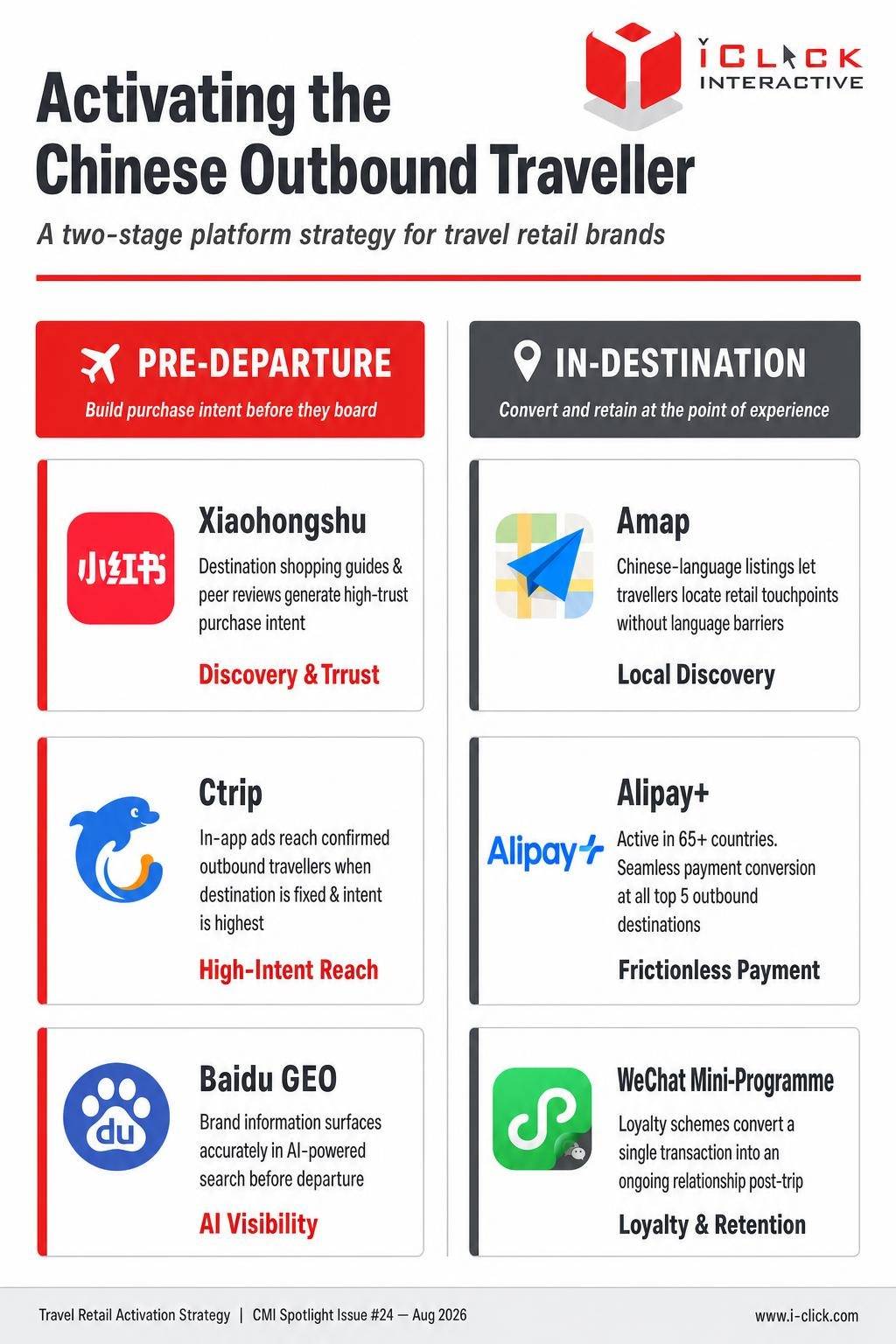
The most effective activation strategies for travel retail brands targeting Chinese outbound consumers combine pre-departure digital presence with in-destination experience that reinforces the digital narrative.
Pre-departure: Xiaohongshu content programmes featuring authentic destination shopping guides and peer reviews generate high-trust purchase intent among the platform's core demographic. Ctrip in-app advertising reaches confirmed outbound travellers once their destination is fixed and purchase intent is at its highest. Baidu GEO content ensures that brand information appears accurately and prominently when Chinese consumers search through AI-powered interfaces for product or destination information.
In-destination: Amap listings optimised for Chinese-language search allow outbound travellers to locate retail touchpoints without language barriers. Alipay+, now active in 65 countries including all five of China's top outbound destinations, provides the payment infrastructure that enables seamless in-destination retail conversion. WeChat mini-programme loyalty schemes enable brands to convert a single in-destination transaction into an ongoing relationship that persists after the traveller returns home.
Conclusion
The divergence between China's domestic retail caution and outbound spending generosity is not a contradiction — it is a signal [1]. Chinese consumers are concentrating premium discretionary spending in the channels and contexts they perceive as offering superior value, authenticity, and experience. Travel retail, duty-free, and in-destination luxury represent exactly those contexts. For brands positioned at the intersection of outbound Chinese travel and premium retail, the Summer Peak Season and Golden Week 2026 opportunity is substantial, time-limited, and directly addressable through targeted Chinese digital marketing investment.
References
- [1] Bloomberg, Jun 16 2026
- [2] Ministry of Commerce, Jun 2026
- [3] Trip.com Group PR, Jul 2026