


We use cookies to give you the best digital experience. By continuing to browse this site, you give consent for cookies to be used. To learn more information about the use of cookies, please visit our cookie policy.
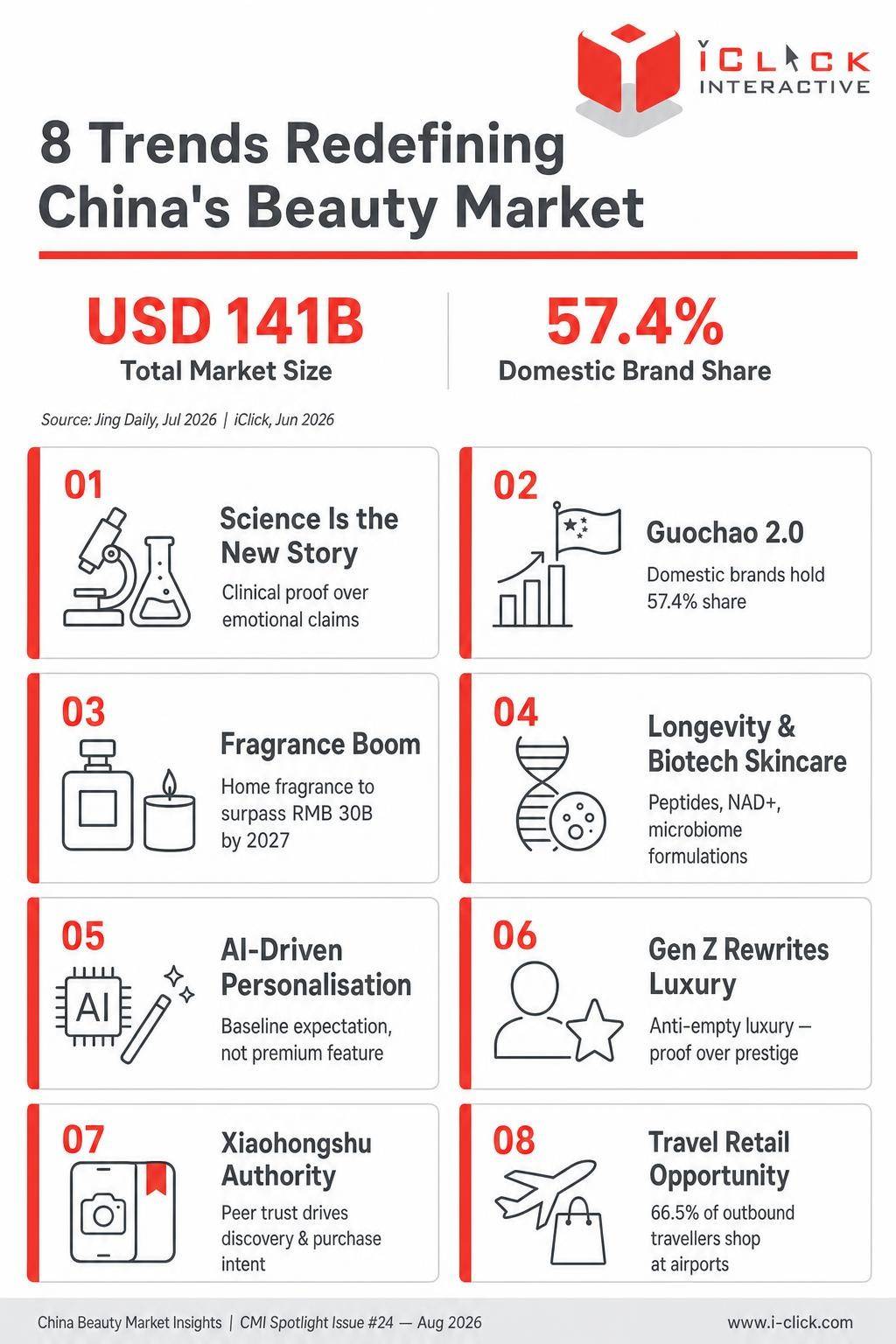
China's beauty market has crossed a threshold that demands a fundamental rethink of how international brands position, communicate, and distribute their products in Greater China. Domestic brands now hold 57.4% of a market valued at approximately USD 141 billion [1] — and they are not holding that position through pricing alone. They are winning on science, localisation, and a depth of consumer understanding that many Western brands have yet to match. Eight trends are driving this transformation — and for any brand with China ambitions, understanding them is no longer optional.
Trend 1: Science Is the New Story
For the previous decade, emotional storytelling dominated China's premium beauty marketing. Heritage narratives, aspirational lifestyle imagery, and luxury association commanded premium positioning. That era is ending. Gen Z Chinese consumers — who now represent the largest growing segment of beauty purchasers — are demanding clinical evidence, dermatological endorsement, and ingredient transparency as prerequisites for consideration [1]. Brands that lead with mechanism of action, clinical trial data, and dermatologist-approved formulations are significantly outperforming those relying on aspirational narratives alone.
Trend 2: The Guochao Wave Matures — Domestic Brands Consolidate at 57.4%
Domestic Chinese beauty brands now command 57.4% of the total market [1]. Brands such as Proya, Florasis, and Winona have built strong authority in categories including anti-ageing, traditional botanicals, and sensitive skin — addressing specific consumer concerns at price points and with communication styles that resonate deeply. This is not a temporary nationalist moment: domestic brands are investing in research and development, filing international patents, and building formulation capabilities that are increasingly competitive with global peers [2]. The implication for international brands is not retreat, but repositioning towards areas of genuinely defensible differentiation.
Trend 3: Fragrance — China's Next Billion-Dollar Category
Home fragrance is projected to surpass RMB 30 billion in market value by 2027, making it one of the fastest-growing sub-categories in Chinese beauty retail [1]. Personal fragrance is on a parallel growth trajectory, driven by a younger generation of consumers approaching scent as self-expression and identity signalling rather than a functional product. International fragrance houses with established China distribution are well positioned to benefit, but the window for brand-building in this category is compressing as domestic fragrance brands invest aggressively in Chinese olfactory storytelling and community-building on Xiaohongshu.
Trend 4: Longevity and Biotech Skincare
Chinese consumers are increasingly sophisticated in their understanding of skin biology, and this sophistication is driving rapid growth in longevity skincare — products that target the cellular mechanisms of ageing rather than its surface symptoms [1]. Categories including NAD+ boosters, peptide serums, growth factor treatments, and microbiome-focused formulations are seeing strong growth, particularly among consumers aged 35 and above. Biotechnology credentials — clinical trial data, peer-reviewed research, and scientific advisory boards — are powerful purchase drivers in this segment. Brands that bridge credible science communication with luxury positioning are capturing share in one of the highest-value segments of the Chinese beauty market.
Trend 5: AI-Driven Personalisation
Personalisation is no longer a premium feature in China — it is a baseline consumer expectation [2]. Brands that offer AI-powered skin analysis tools, whether embedded in a WeChat mini-programme, a live commerce session, or a brand's own digital ecosystem, are creating engagement and loyalty loops that generic product ranges cannot replicate. Platforms including Tmall and JD.com are investing in AI skin assessment technology that enables brands to serve personalised product recommendations at scale. For international brands, investment in AI-driven personalisation is now a near-term strategic priority rather than a future aspiration.
Trend 6: Gen Z Rewrites the Rules of Luxury Beauty
Chinese Gen Z consumers — born between 1997 and 2012 — are the most consequential beauty purchasing cohort of the next decade [1]. They are highly informed, deeply sceptical of marketing claims, and fiercely loyal to brands that earn trust through authenticity and consistency. They discover beauty products almost exclusively through digital channels: Xiaohongshu for peer review, Douyin for live commerce, and AI search for ingredient verification. Importantly, they are not anti-luxury — they are anti-empty luxury. A premium price is entirely acceptable if supported by genuine product superiority, transparent ingredient sourcing, and a brand story grounded in verifiable truth.
Trend 7: Multi-Platform Discovery — Xiaohongshu as the Beauty Authority
Xiaohongshu has become the definitive discovery platform for beauty in China, functioning simultaneously as a product review aggregator, a skincare education resource, and a purchase intent generator [2]. A product that builds genuine organic traction on Xiaohongshu — through authentic KOC reviews, dermatologist-authored content, and ingredient education guides — creates a level of consumer trust that paid advertising cannot replicate in isolation. Douyin remains indispensable for conversion, with beauty consistently ranking as the top-performing category in live commerce. The most effective beauty brands in China operate a coordinated dual-platform strategy: awareness and trust-building on Xiaohongshu, real-time conversion on Douyin, and loyalty management within WeChat's mini-programme ecosystem.
Trend 8: The Travel Retail Opportunity — Beauty Abroad
The final trend is geographic: as Chinese consumers travel abroad in growing numbers this summer and into Golden Week, the travel retail channel is emerging as a critical touchpoint for beauty brand discovery and high-value purchase [2]. Data shows that 66.5% of Chinese outbound travellers intend to shop at their destination airport. For beauty brands with duty-free presence in Seoul, Bangkok, Hong Kong, Tokyo, and Taipei — the top five destinations for Chinese family travel this summer — pre-departure digital marketing via Xiaohongshu and Ctrip is the most effective way to generate purchase intent before the consumer reaches the terminal.
Conclusion
China's beauty market is not simply large — it is sophisticated, segmented, and moving at pace. Domestic brands have claimed majority share not by accident, but by building genuine consumer understanding and scientific credibility in the categories that matter most to Chinese consumers today [1]. For international brands, the path to sustained competitive position runs through science-backed communication, AI-integrated consumer experience, and multi-platform digital infrastructure that meets Chinese consumers at every stage of their discovery and purchase journey.
References
- [1] Jing Daily, Jul 2026
- [2] iClick, Jun 2026