


We use cookies to give you the best digital experience. By continuing to browse this site, you give consent for cookies to be used. To learn more information about the use of cookies, please visit our cookie policy.
China's 618 festival has always been a bellwether for the broader e-commerce calendar. But the 2026 edition was something categorically different. For the first time in the history of Chinese e-commerce, artificial intelligence was not merely a feature of the festival — it was the infrastructure. From discovery and product search to personalised recommendations and post-sale service, AI ran through every stage of the consumer journey. The result: CNY 934 billion in total online GMV, approximately USD 138 billion [1], setting a record that has established the playbook for what will become an even larger event — Double 11.
The Numbers That Redefined the Festival Calendar
Syntun's 2026 618 Promotion Report places total online GMV at CNY 934 billion across the full promotion window running from 13 May to 18 June 2026 [1]. This figure encompasses all major platforms including Alibaba's Tmall and Taobao, JD.com, Douyin e-commerce, and Pinduoduo. To contextualise this figure: CNY 934 billion is approximately USD 138 billion — a sum that exceeds the annual retail revenue of many European nations.
JD.com alone reported CNY 379.3 billion in transaction volume during the festival, representing 10.3% year-on-year growth [1]. This growth rate is notable precisely because it came against an already substantial 2025 base and in an environment where China's domestic retail market has faced headwinds from more cautious consumer sentiment on the mainland.
The First AI-Native Shopping Festival
What made the 2026 edition of 618 genuinely historic was not the GMV figure alone, but the mechanism behind it. Alibaba, JD.com, and Douyin each deployed large language model tools at scale across their platforms [2] — embedding AI assistants into product search, generating personalised landing pages, powering conversational shopping advisers, and automating post-purchase customer service interactions in real time.
Alibaba's AI shopping assistant handled millions of simultaneous customer enquiries, reducing response latency and improving conversion rates on high-consideration categories including premium beauty, electronics, and home goods [2]. JD.com's AI-powered recommendation engine drove increases in average order value by surfacing contextually relevant product pairings based on purchase history and browsing behaviour. Douyin's LLM-enhanced live commerce streams enabled hosts to respond to audience questions at scale, without breaking the entertainment flow that defines the platform's shopping culture.
The consequence of this AI integration is not simply operational efficiency — it is a fundamental shift in how purchase decisions are formed. The consumer who searched for a moisturiser during 618 was not browsing a product catalogue. They were having a conversation with an AI that understood their skin type, budget, and brand preferences and was generating a recommendation ranked by relevance to their specific context. This is the new baseline.
Xiaohongshu and Douyin: The Discovery-to-Purchase Pipeline
Two platforms sit at the heart of the modern Chinese e-commerce funnel, and both performed strongly during 618. Xiaohongshu functions as China's most trusted product discovery engine — a platform where over 300 million monthly active users seek genuine peer reviews, skincare tutorials, fashion inspiration, and purchasing guidance [2]. Content published on Xiaohongshu in the weeks before 618 generated significant traffic to platform storefronts, with beauty, fragrance, and apparel brands reporting meaningful uplift from KOL-seeded campaigns that launched in early May.
Douyin drove real-time conversion at a scale that no other platform matched. The 618 festival saw record-breaking live commerce sessions across beauty, electronics, food, and apparel — with AI-enhanced hosting tools enabling longer, more responsive, and more commercially effective streams [2]. Brands without a Douyin live commerce strategy in place by mid-May found themselves effectively absent from the platform's peak traffic window.
What 618 Reveals About the Modern Chinese Consumer
Several behaviour patterns that emerged from 618 have direct implications for any international brand's Double 11 strategy. First, Chinese consumers are not simply bargain hunters. Across premium categories — luxury beauty, high-end electronics, designer fashion — conversion rates held strong or improved during 618, indicating that intent to purchase is not purely price-driven [2]. Brands that invested in authoritative, AI-readable content rather than discount-first promotional mechanics often outperformed on brand equity metrics over the medium term.
Second, the mobile-first nature of Chinese e-commerce is now so deeply embedded that desktop performance is largely irrelevant to commercial outcomes. Over 90% of 618 transactions were completed on mobile devices, with the majority flowing through integrated super-app ecosystems [1]. For international brands, mobile-optimised Chinese-language content is not optional — it is a prerequisite for participation.
The Double 11 Countdown Has Already Begun
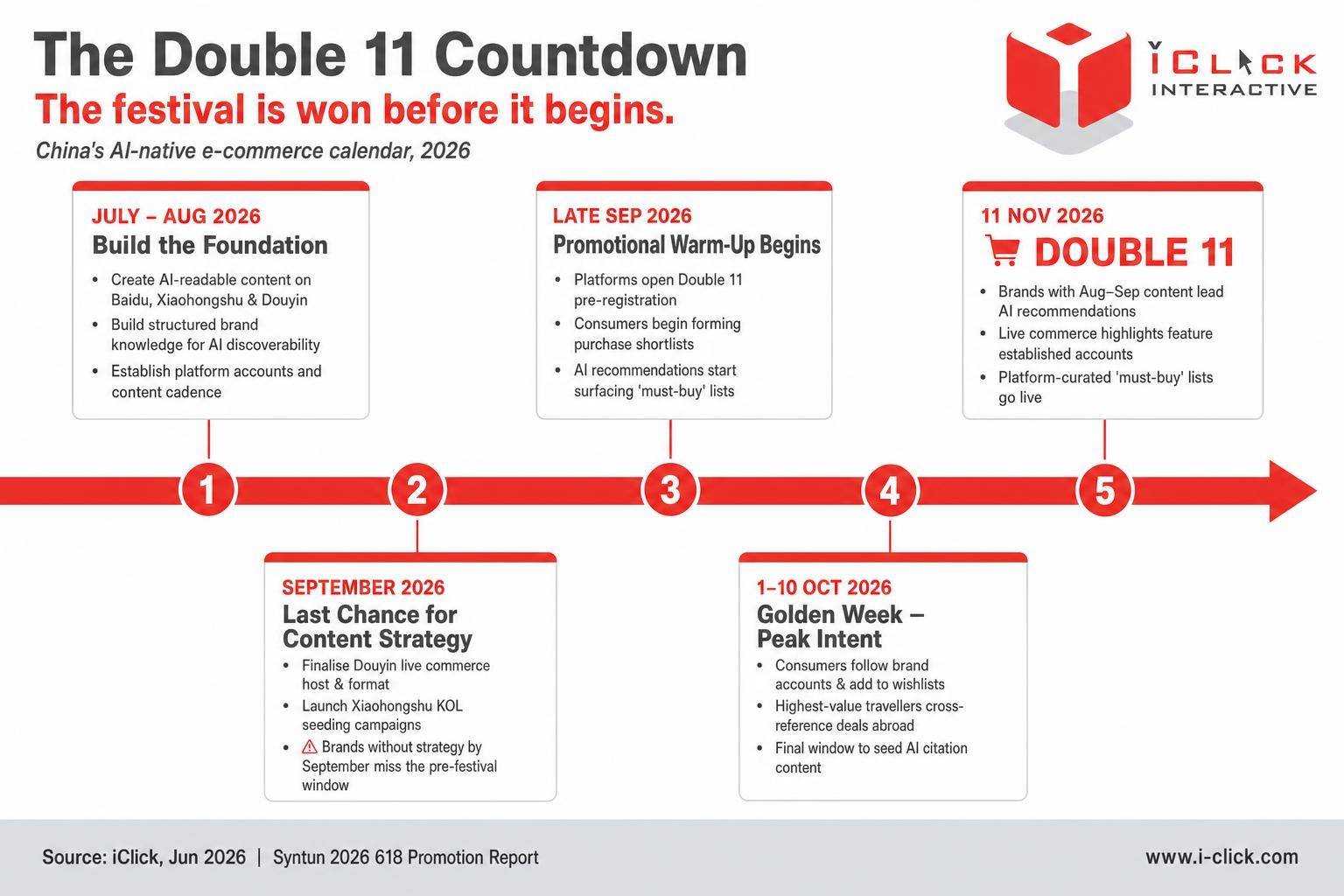
Double 11, China's largest annual shopping festival, will begin its promotional warm-up phase in late September 2026. Brands that have not established their Douyin and Xiaohongshu content strategies by September will miss the critical pre-festival brand-building window — a period in which consumers form their purchasing shortlists, follow brand accounts, and begin adding products to wishlists ahead of the main promotional window opening [2].
The lesson from 618 is clear: in China's AI-native e-commerce environment, the festival is won before it begins. Content authority, AI discoverability, and platform relationships built in August and September determine which brands appear in AI recommendations, live commerce highlights, and platform-curated 'Double 11 must-buy' features when November arrives [2].
Three Priorities for International Brands
- 1. AI content infrastructure — Create structured, authoritative content that AI recommendation engines can cite and surface
- 2. Live commerce readiness — Douyin live commerce brands that built audience in August–September consistently outperform in November
- 3. Platform store optimisation — AI-assisted discovery now drives a significant proportion of Tmall and JD traffic; store content must be AI-readable, not just visually polished
Conclusion
At CNY 934 billion, the 2026 618 festival was more than a commercial milestone — it was a proof of concept for AI-native retail in China [1]. The playbook it has written — AI-powered discovery, platform-native live commerce, structured content for recommendation engines, and mobile-first conversion infrastructure — will define Double 11 and every major Chinese shopping event that follows. For international brands, the question is not whether to adapt to this environment, but how quickly.
References
- [1] Syntun 2026 618 Promotion Report, Jun 2026
- [2] iClick, Jun 2026