


We use cookies to give you the best digital experience. By continuing to browse this site, you give consent for cookies to be used. To learn more information about the use of cookies, please visit our cookie policy.

B2B Has a Social Commerce Problem — and a Social Commerce Opportunity
For most international B2B brands, China's social media platforms still read as a consumer story: young shoppers buying beauty products, fashion, and electronics through live streams and influencer reviews. The result is a widespread strategic blind spot.
Chinese business decision-makers — procurement officers, operations directors, IT leads, CFOs — use the same platforms. They scroll Douyin. They research on Xiaohongshu. And increasingly, they are discovering, evaluating, and shortlisting B2B vendors through social channels before a first meeting is ever requested.
The brands that recognise this early are building pipeline through social content. Those that dismiss it as a B2C channel are watching competitors develop relationships with their potential clients before they even enter the conversation.
This article covers what B2B brands need to know about social commerce on Douyin and Xiaohongshu in 2026 — the audiences, the content formats, the lead generation mechanics, and the metrics that matter.
Why B2B Brands Can't Ignore Chinese Social Commerce
China's social commerce infrastructure was built for consumer transactions, but its audiences are not exclusively consumer. Douyin's 700 million daily active users[1] span every demographic and professional segment in the country, including management and procurement teams that make business purchasing decisions. Xiaohongshu's 300 million monthly active users[2] increasingly include young urban professionals who use the platform to research products, services, and vendors across both personal and professional categories.
What has changed in 2026 is the intent signal. Professionally-oriented content on both platforms — covering enterprise software, manufacturing technology, supply chain solutions, and professional services — is generating meaningful engagement from verified business audiences. The discovery mechanism is the same as for B2C: algorithm-driven distribution on Douyin, peer-review-driven search on Xiaohongshu. What differs is the purchase journey length and the decision-maker profile.
For B2B brands, this is not a direct-to-checkout play. It is a brand authority and top-of-funnel lead generation play — and in a market where in-person networking and trade shows have limited reach, social channels have become the primary discovery layer for the decision-makers B2B brands most need to reach.
Douyin for B2B: Reaching Decision-Makers at Scale
The Audience You Can Actually Reach
Douyin's algorithm distributes content based on engagement signals, not follower counts. This means a B2B brand with zero followers can reach a precisely relevant audience — manufacturing plant managers, procurement directors, logistics executives — if its content generates strong early engagement from that segment.
Douyin for Business reports that content in professional categories — industrial equipment, SaaS solutions, supply chain services, professional training — consistently reaches audiences with demonstrated purchasing authority, based on the platform's behavioural and professional identity data.[1]
What B2B Content Works on Douyin
The mistake B2B brands consistently make on Douyin is producing content that looks like a corporate presentation. The platform rewards content that feels native — educational, demonstrative, and problem-framed — that earns engagement within the first three seconds.
Formats that perform well for B2B on Douyin:
- Product demonstration videos: Show equipment, software interfaces, or processes in real operational contexts — factory floor footage, live software walkthroughs, before-and-after process comparisons. These generate strong completion rates from professional audiences.
- Expert commentary short videos: A senior technical or industry expert addressing a specific business problem (cost reduction, efficiency gain, regulatory compliance) positions the brand as an authority and drives follow and save actions.
- Case study mini-films: A 60–90 second narrative of a client challenge and outcome, structured as a story rather than a testimonial, is one of the highest-performing B2B formats on the platform.
- Behind-the-scenes production content: For manufacturing and industrial brands, footage of production processes — quality control, scale of operation, technical precision — builds credibility signals that procurement teams specifically value.
Lead Generation on Douyin
Douyin's B2B lead generation mechanics operate differently from B2C purchase funnels. The conversion path typically runs through:
- Video content → profile follow → DM or enquiry submission via the business profile
- Video content → Douyin's in-platform lead form (available for business accounts) → CRM capture
- Live stream → direct consultation booking or product enquiry
- Content → landing page visit via profile link → off-platform CRM
For high-consideration B2B purchases, live-stream has emerged as a particularly effective channel. A technical expert hosting a regular Douyin live session — answering operational questions, demonstrating product features, and opening the floor to procurement enquiries — creates a high-trust, low-friction first contact point that is difficult to replicate through traditional outbound sales.
Xiaohongshu for B2B: Building Credibility with Buyers
Why Xiaohongshu Has a B2B Audience
Xiaohongshu's identity as a consumer platform obscures a growing professional use pattern. Young Chinese business professionals — particularly those in their 20s and early 30s in mid-management and specialist roles — use Xiaohongshu as a research tool with the same intent they bring to consumer purchases: finding peer-validated information before making a recommendation or commitment.
Queries on Xiaohongshu for topics including enterprise software, office equipment, professional certifications, business travel services, and B2B SaaS categories have grown year-on-year.[2] The platform's review architecture — which elevates authentic, experience-based notes over promotional content — makes it a trusted research environment for professional decisions.
Content Formats That Work for B2B Brands on Xiaohongshu
The content principles that govern B2C success on Xiaohongshu apply equally to B2B: authenticity, specificity, and peer-level tone outperform promotional or corporate-register content.
Most effective B2B content approaches on Xiaohongshu:
- Problem-solution notes: A post opening with a specific, recognised pain point (e.g. 'Why cross-border compliance is costing your team three days per quarter') and presenting a practical solution — with real process detail — performs significantly better than feature-led product descriptions.
- User and client experience content: Notes authored by actual clients, describing their experience in their own voice, function as the B2B equivalent of a reference call. The platform's trust architecture makes this content carry weight with professionals researching the same category.
- Employee expert notes: Professional notes authored by a company's own technical experts — under their personal Xiaohongshu accounts, not the brand account — generate higher trust and engagement than branded content on the same topic.
- Category education content: Long-form notes explaining an industry concept, regulatory change, or market development — without directly selling — establish category authority and drive saves from professional audiences early in their research journey.
Using Xiaohongshu as a Research and Decision Tool
A B2B brand's Xiaohongshu presence increasingly influences procurement teams who use the platform to validate vendor credibility before engaging. This makes content continuity and review volume strategically important: a brand with an active, substantive Xiaohongshu presence signals operational credibility in a way that a static corporate website does not.
The practical implication is that B2B brands should treat Xiaohongshu as a credibility infrastructure investment — seeding the platform with accurate, expert-toned, experience-based content that procurement researchers will encounter when evaluating the category.
The B2B Social Commerce Funnel: Awareness to Pipeline
B2B social commerce on Douyin and Xiaohongshu does not replace the sales cycle. It shortens the front end — the awareness and consideration stages that traditionally required trade shows, cold outreach, and long relationship-building timelines.
Awareness: Douyin's algorithm distributes educational and demonstrative content to professional audiences who have not yet encountered the brand. This establishes presence and first-contact credibility before any sales motion begins.
Research and validation: A decision-maker who encounters the brand on Douyin searches Xiaohongshu for peer reviews, expert commentary, and category context. A well-seeded Xiaohongshu presence converts this research stage into qualified interest rather than inconclusive browsing.
Direct engagement: Douyin live sessions, DM enquiries, and Xiaohongshu comment interactions create the first human touchpoints in the buyer relationship — with lower friction than a cold call and higher intent than a trade show encounter.
Pipeline conversion: Warm leads captured through social channels enter the sales CRM with established brand familiarity, reducing the qualification and trust-building overhead in the sales process.
Key Differences Between B2B and B2C Social Commerce in China
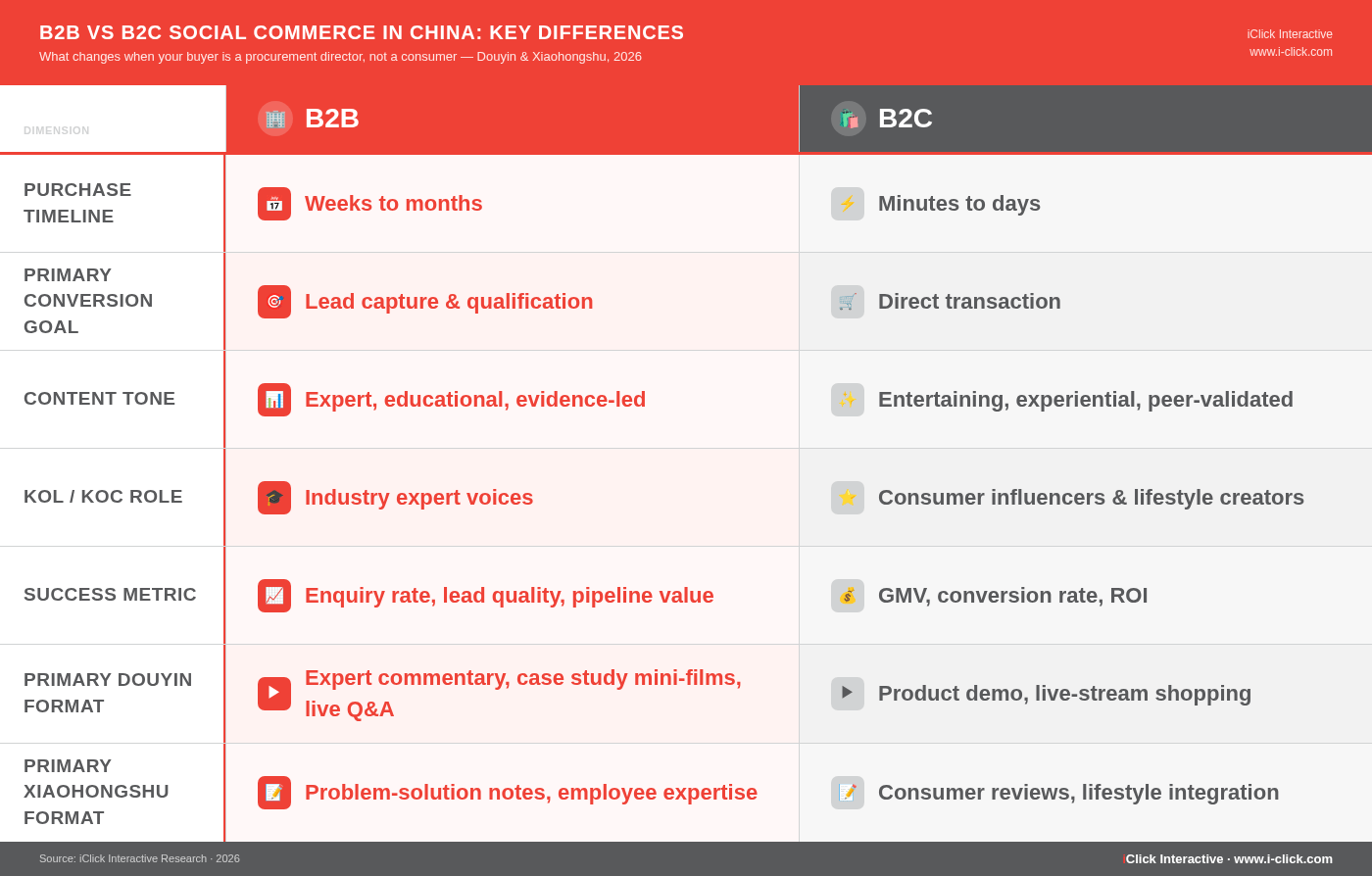
| B2B | B2C | |
| Purchase timeline | Weeks to months | Minutes to days |
| Primary conversion goal | Lead capture and qualification | Direct transaction |
| Content tone | Expert, educational, evidence-led | Entertaining, experiential, peer-validated |
| KOL/KOC role | Industry expert voices | Consumer influencers and lifestyle creators |
| Success metric | Enquiry rate, lead quality, pipeline value | GMV, conversion rate, ROI |
| Primary Douyin format | Expert commentary, case studies, live Q&A | Product demo, live-stream shopping |
| Primary Xiaohongshu format | Problem-solution notes, employee expertise | Consumer reviews, lifestyle integration |
Strategies for International B2B Brands Entering Chinese Social Commerce
Lead with education, not product
B2B buyers in China are sophisticated and research-driven. Content that educates — on industry trends, regulatory developments, operational best practices, or market dynamics — earns professional audience trust before a product conversation begins. Reserve direct product content for mid-funnel formats (live demos, case studies) rather than top-of-funnel discovery content.
Build a professional content engine, not a campaign
B2C social commerce can deliver results from a single campaign burst. B2B social commerce requires sustained content output over months — because the purchase cycles are longer and the credibility signals that influence procurement decisions accumulate over time. Treat Douyin and Xiaohongshu B2B content as an editorial programme, not a promotional event.
Invest in employee and expert voices
The most credible B2B content on both platforms comes from individual people — technical experts, operations leads, sector specialists — not from brand accounts. Building a content programme that empowers company experts to publish on Xiaohongshu and appear in Douyin video series delivers higher trust signals than branded content at the same publishing frequency.
Localise the value proposition for Chinese market context
An international B2B brand's global messaging — built around market positioning in Europe or North America — rarely translates directly to the Chinese B2B buyer's specific priorities. Localise the value proposition around the operational, compliance, and cost challenges that are specific to Chinese business contexts.
What Metrics Tell You It's Working
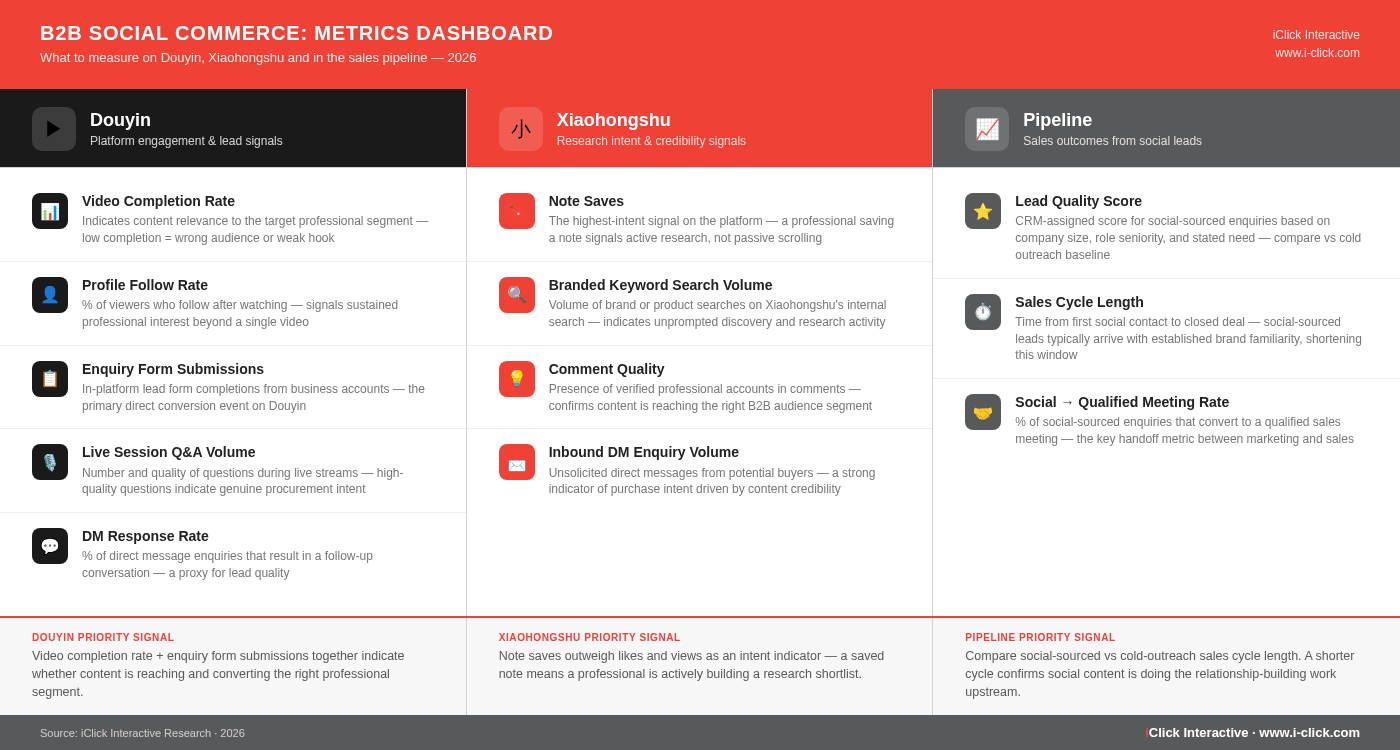
Douyin B2B metrics: Video completion rate (indicates content relevance to the target professional segment), profile follow rate from relevant videos, enquiry form submissions, live session Q&A volume, DM response rate.
Xiaohongshu B2B metrics: Note saves (the primary high-intent signal — a professional saving a note signals genuine research intent), branded keyword search volume on the platform's internal search, comment quality from verified professionals, inbound DM enquiry volume.
Pipeline metrics: Lead quality score from social-sourced enquiries, sales cycle length for social-sourced vs cold-outreach leads, conversion rate from first social contact to qualified sales meeting.
How iClick Helps B2B Brands Navigate Chinese Social Commerce
Executing a B2B social commerce strategy on Douyin and Xiaohongshu requires platform expertise, content localisation capability, and access to the data infrastructure that connects social engagement to sales pipeline.
iClick Interactive works with international B2B brands to build structured social presence on Chinese platforms — from content strategy and account management through to lead capture integration and performance reporting. Our team understands both the platform mechanics and the Chinese B2B buyer journey, enabling brands to build credibility and generate pipeline simultaneously.
Central to iClick's approach is the Mia AI Agent, which enables data-driven research and selection of industry KOLs and expert voices on Douyin and Xiaohongshu. Rather than relying on reach metrics alone, Mia provides structured visibility into expert creator profiles, audience professional demographics, category fit, and engagement quality — ensuring that B2B influencer and content investments are grounded in commercial relevance.
For international B2B brands entering the Chinese market, iClick offers market entry consulting that maps the social commerce funnel to specific pipeline objectives. For brands already active in China, iClick provides channel performance audits and optimisation across the full Douyin and Xiaohongshu stack.
Conclusion: B2B Social Commerce in China Is Not Optional
The decision-makers B2B brands need to reach in China are active on Douyin and Xiaohongshu. They are using these platforms to discover, research, and validate vendors — often before a first outreach arrives. Brands that have built a substantive, credible presence on these channels are entering sales conversations with a significant relationship head start over those that have not.
The B2B social commerce opportunity on Douyin and Xiaohongshu is not a future trend. It is the current operating reality of the Chinese B2B market. The question for international brands in 2026 is not whether to invest — it is how to build the right content engine to make that investment compound.
Read More
- China Creator Economy Explained: KOL, Wang Hong, Bo Zhu & Live-Streaming Hosts — https://www.i-click.com/resources/china-creator-economy-explained-kol-wang-hong-bo-zhu-live-streaming-hosts/
- Influencer Marketing Guide: Types, Benefits & Strategy — https://www.i-click.com/resources/influencer-marketing/
- China Social Commerce 2026: How WeChat, Douyin & Xiaohongshu Turn Browsers into Buyers — https://www.i-click.com/resources/
Sources
- [1] Douyin for Business, Official Platform Insights 2026 — https://www.douyinec.com/
- [2] Hashmeta, Xiaohongshu E-commerce Integration: Complete Shop Setup Guide (2026) — https://hashmeta.com/blog/xiaohongshu-e-commerce-integration-complete-shop-setup-guide-for-brands
- [3] Amra & Elma, Top 20 Social Commerce Statistics 2026 — https://www.amraandelma.com/social-commerce-statistics
- [4] Ashley Dudarenok, What Is Social Commerce and How China Is Shaping the Future of Shopping — https://ashleydudarenok.com/social-commerce