


We use cookies to give you the best digital experience. By continuing to browse this site, you give consent for cookies to be used. To learn more information about the use of cookies, please visit our cookie policy.
618's Triple Showdown: How China's Biggest Shopping Festival Is Changing the Rules for International Brands
For the first time ever, Douyin, Tmall, and WeChat are running simultaneous mega-sales in June 2026. Here's what every international marketer targeting Chinese consumers needs to know — and do — right now.
The 618 Landscape Has Changed Permanently
China's 618 shopping festival has always been significant. But June 2026 marks a structural turning point: for the first time in the event's history, three platforms are running full-scale, month-long mega-promotions simultaneously — all competing for the same Chinese consumer wallet from May 15 to June 18.
-
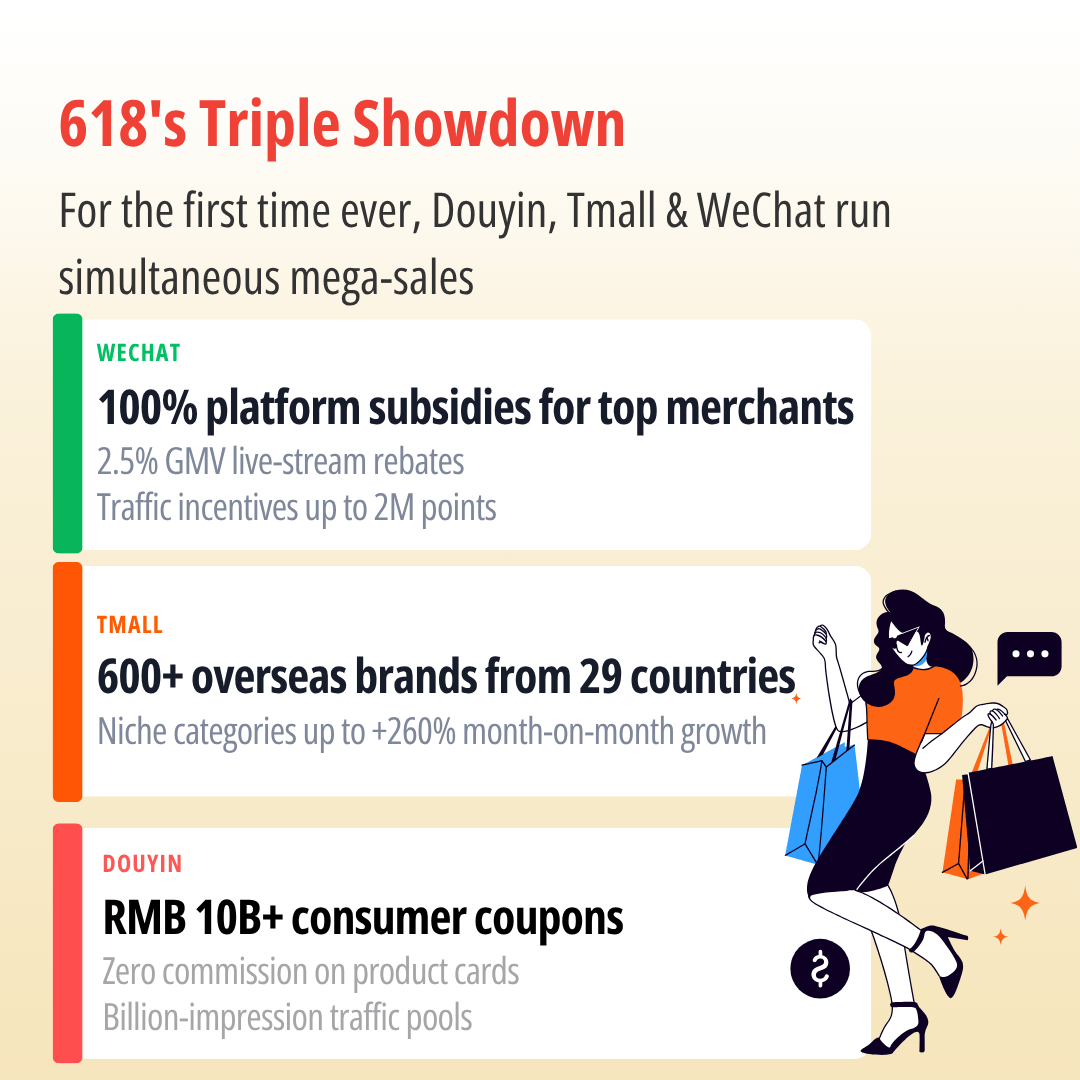
- Douyin launched its largest-ever 618 with RMB 10 billion+ in consumer coupons, zero commission on product cards, billion-impression traffic pools, and expanded developer tools
-
- Tmall (Alibaba) activated 600+ new overseas brands from 29 countries — the highest international participation in a China commerce event ever recorded — with niche brands in select categories reporting up to +260% month-on-month growth
-
- WeChat Mini Store launched its most aggressive promotion to date: top merchants eligible for 100% platform subsidies, live-stream rebates at 2.5% of GMV, and traffic incentive ceilings raised from 600,000 to 2 million points
The result is not just a larger sale. It is a month-long consumer attention event across every major touchpoint in the Chinese digital ecosystem — and it fundamentally changes the strategic calculus for brands operating outside China but targeting Chinese consumers.
Why 618 Matters to Marketers Outside China
For senior marketers in Hong Kong, Singapore, or Malaysia, the instinct might be to view 618 as a domestic China retail event. That instinct is wrong — for three reasons.
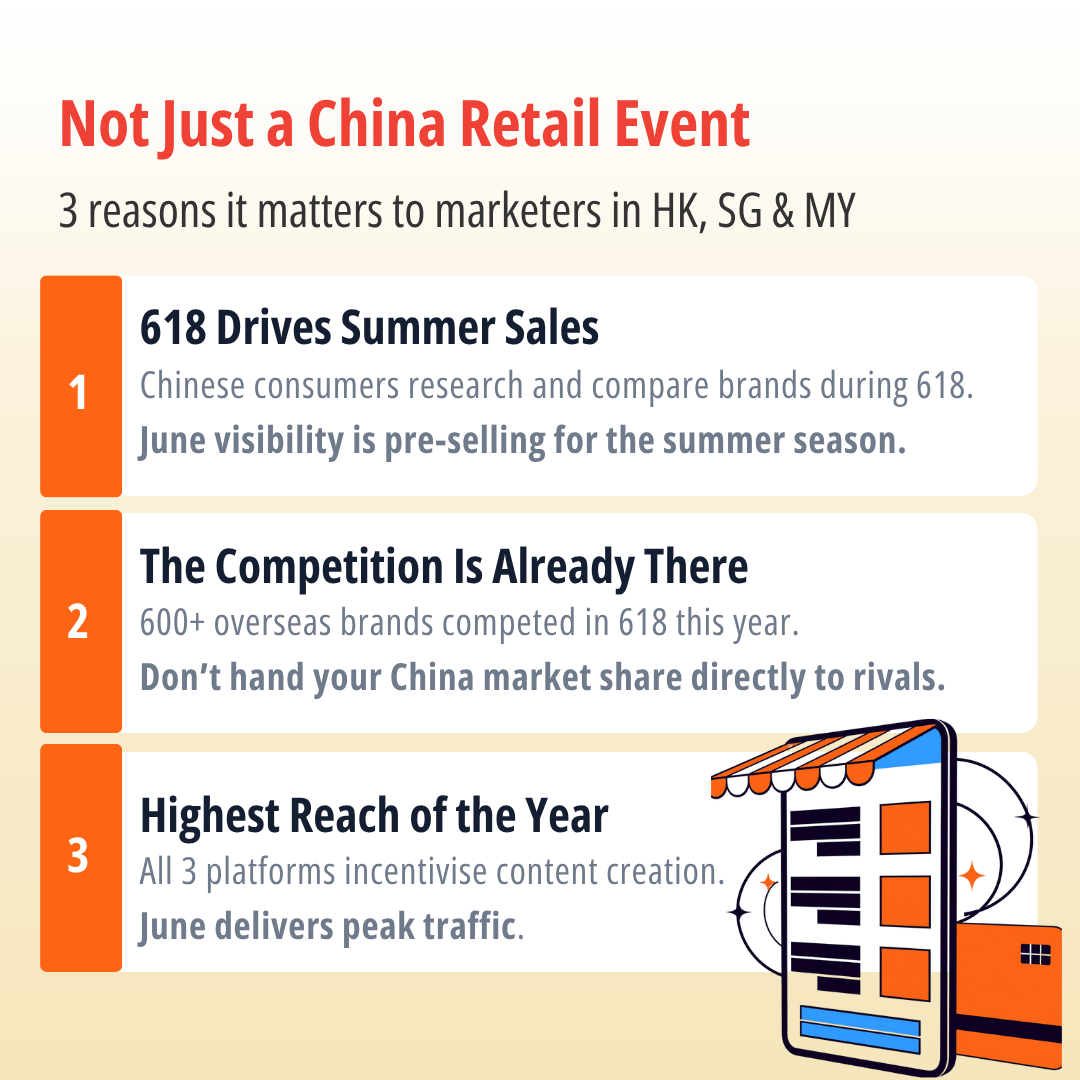
1. Consumer mindset travels with the consumer.
During 618, Chinese consumers enter a sustained period of active brand discovery — researching categories, comparing international options, and building consideration lists across XHS, Douyin, and Tmall. A luxury retailer in Hong Kong or a beauty brand in Singapore that shows up in a Chinese consumer's 618 research will be top of mind when that consumer travels outbound this summer or shops cross-border. Visibility during 618 is pre-selling for the summer travel season.
2. International brand participation has never been more accessible — or more competitive.
Tmall's 618 pre-sale drew 600+ overseas brands from 29 countries, led by the US, South Korea, Japan, France, and Australia. Pet supplies, beauty, health, and lifestyle categories are seeing the strongest growth. The opportunity is real. So is the competition. Brands that are present and active during 618 compound their China brand equity; those that are absent cede that ground to competitors.
3. The three-platform battle creates the largest content amplification window of the year.
With Douyin, Tmall, and WeChat all incentivising content creation simultaneously, organic and paid reach for branded content is at its annual peak during June. Brands running China social campaigns this month benefit from inflated platform traffic, higher consumer engagement rates, and — for smart buyers — relatively efficient CPMs as platforms compete for advertiser spend.
The Platform Breakdown: What Each Battle Means for Your Brand
Douyin — Live Commerce Is the Default Sales Channel
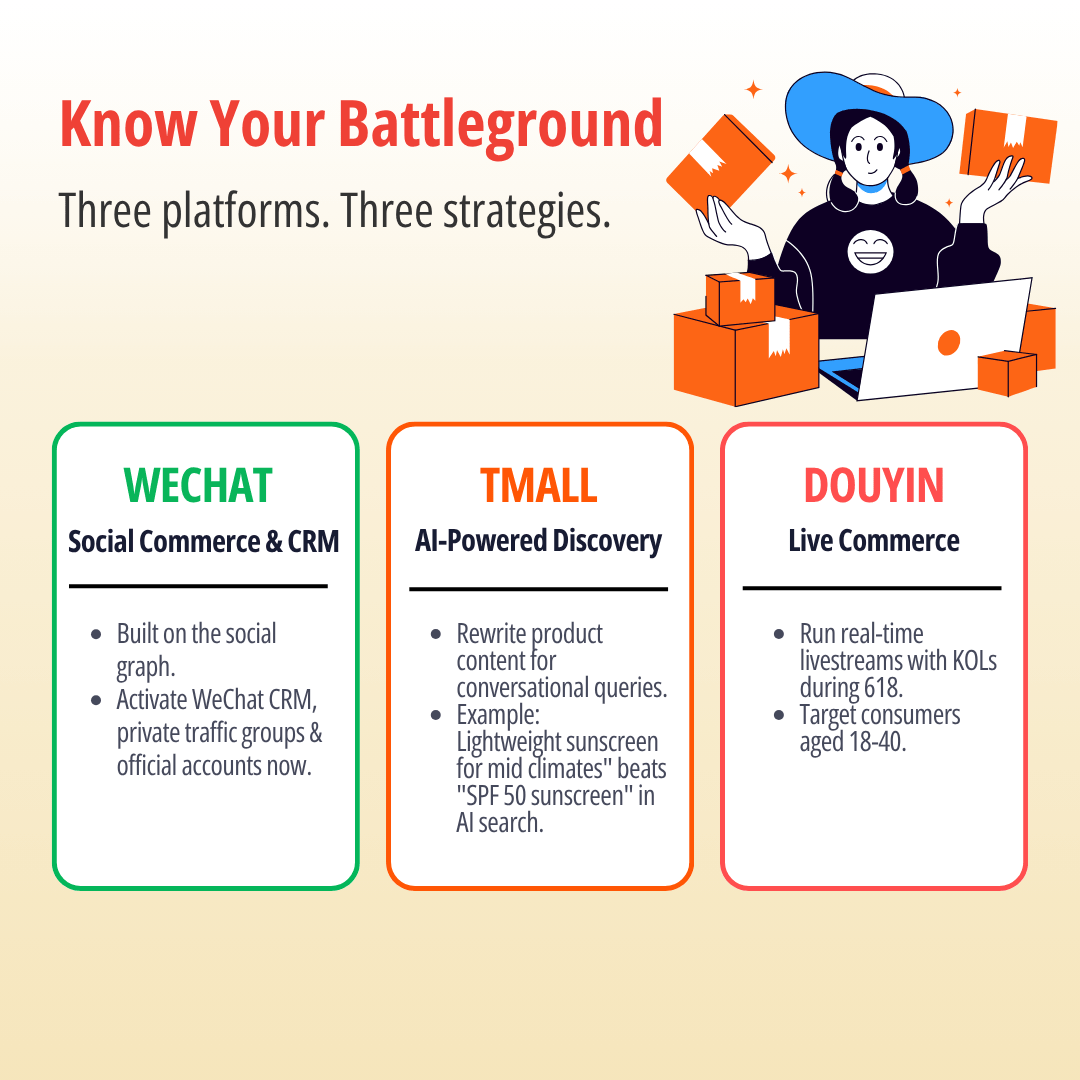
Douyin's 618 is the largest and most complex of the three. With 1 billion monthly active users and live commerce now accounting for 63% of platform GMV, Douyin's 618 is powered primarily by real-time live-streaming from brands, KOLs, and platform-backed hosts. For international brands targeting Chinese consumers aged 18–40, Douyin live-streaming during 618 is the single most effective channel to drive trial, consideration, and direct purchase in a concentrated window.
One additional compliance point: from April 2026, Douyin mandates that all AI-generated video content carry a prominent disclosure label within the first 5 seconds. Brands using AI-assisted creative production must ensure all 618 campaign assets are compliant.
Tmall — Global Brand Discovery at Scale, Now Powered by AI
Tmall's 618 matters for a different reason: it is now the primary channel through which Chinese consumers discover international brands. More importantly, Alibaba has fully embedded its Qwen AI large language model into Taobao, replacing the traditional keyword search bar with natural-language conversation across 4 billion SKUs — including AI virtual try-on for fashion and beauty products.
This changes the game for brand content strategy. Products optimised for keyword search are no longer sufficient. Brands need titles, descriptions, and content that answer conversational queries — "a lightweight sunscreen that won't clog pores for humid climates" will outperform "SPF50 sunscreen" in the new AI-native search environment.
WeChat Mini Store — The Social Commerce and CRM Play
WeChat's 618 is the youngest but fastest-growing of the three platforms. Its competitive advantage is not raw traffic volume — it is the social graph. WeChat's peer-recommendation mechanics, combined with 100% merchant subsidies and live-stream rebates of 2.5% GMV, make it the optimal channel for brands with an existing Chinese consumer base looking to drive repeat purchase and social word-of-mouth during the 618 window.
For brands that have invested in WeChat CRM, private traffic groups, or official accounts, June is the activation moment to redeploy those assets.
Four Actions for Brands Right Now
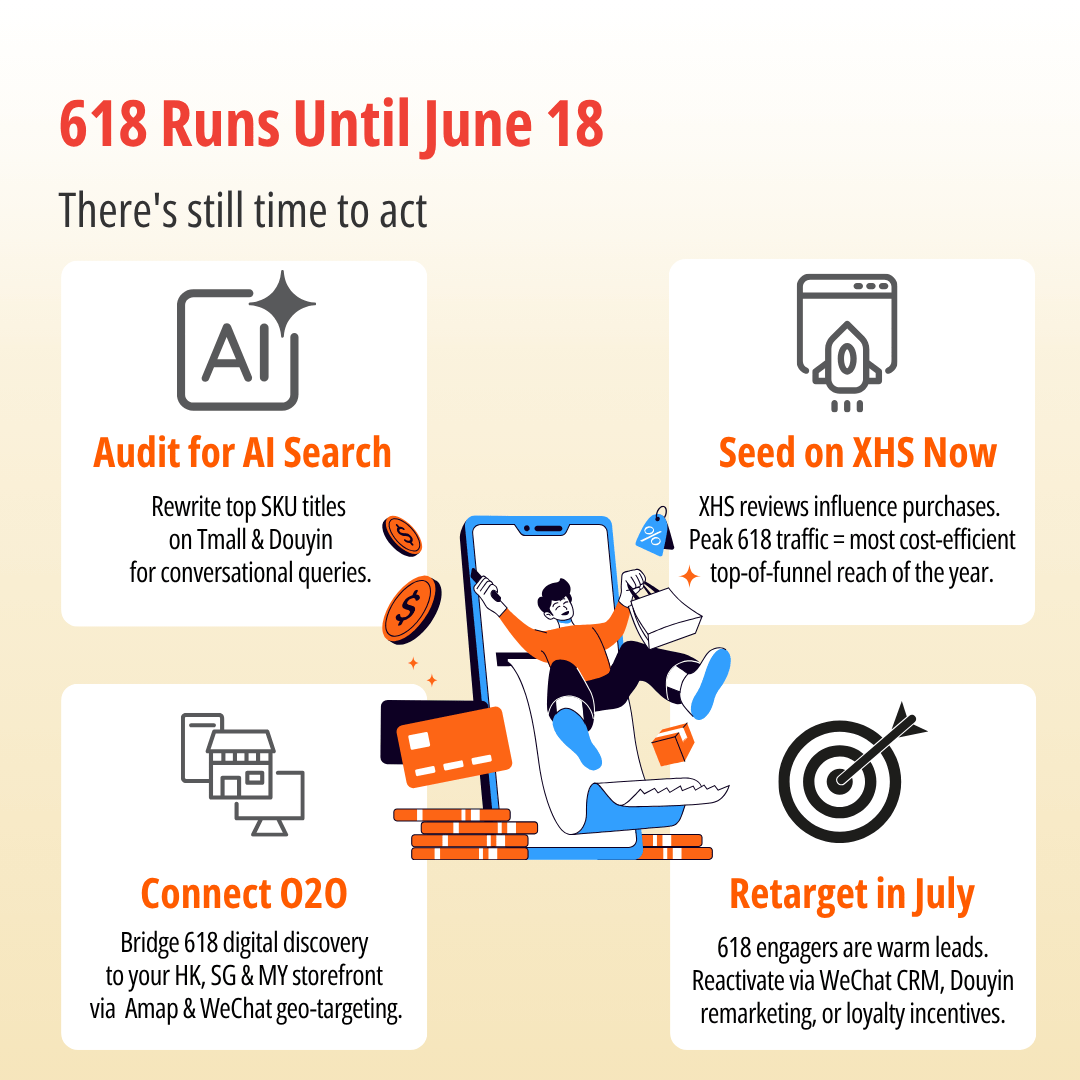
618 runs until June 18. There is still time to act.
1. Audit your Tmall and Douyin product content for AI discoverability.
With Qwen AI replacing keyword search, brands need product descriptions that answer natural-language consumer questions. Review your top-performing SKUs first and rewrite for conversational queries.
2. Activate XHS seeding to feed the 618 discovery funnel.
Chinese consumers cross-reference XHS reviews before purchasing on Tmall or Douyin. Seeding campaigns on Xiaohongshu during 618 are one of the most cost-effective top-of-funnel investments available, as platform traffic is at peak.
3. Bridge 618 digital visibility to your overseas physical presence.
Chinese travelers inspired by brands during 618 actively seek those brands when traveling outbound to Hong Kong, Singapore, or Malaysia. O2O bridge campaigns — linking China digital activity to overseas in-store or hospitality touchpoints — offer the highest ROI for the summer season. Gaode Map, WeChat geo-targeting, and outbound travel platform placements are the key connecting channels.
4. Plan your post-618 retargeting for July.
Consumers who engaged with your brand during 618 are warm leads. A structured July re-engagement programme — via WeChat CRM, Douyin remarketing, or loyalty incentives — can convert 618 awareness into summer season sales.
The Bottom Line
618 2026 is not just China's biggest shopping event. It is the opening of China's summer consumer cycle — the moment when travel decisions crystallise, brand preferences are set, and spending intent converts into purchases. For international brands targeting Chinese consumers, it is the single most important month to be visible, credible, and strategically positioned.
The brands that treat June as a passive observation period will be playing catch-up for the rest of the year.
Want to build your brand's China summer strategy around 618 and outbound travel?
Our team works with international brands across retail, luxury, travel, and lifestyle to capture Chinese consumer demand at every touchpoint.
Sources: Douyin 2026 Live Ecosystem Summit; Alibaba FY2026 Q4 results; Tmall 618 pre-sale announcements; WeChat Mini Store merchant policy announcements; Fliggy × XHS Labour Day Joint Report 2026; Qunar May Day Travel Data 2026
More Insights
KOL Marketing in China: Earn Trust Faster by Letting Go
July 14, 2026
What is KOL marketing in China? Discover how it works, KOL vs KOC, platform choice, and how global brands build a winning China influencer strategy.
KOC行銷是什麼?KOC KOL差別、合作流程&成功案例分享
July 10, 2026
KOC是什麼?當消費者對廣告與KOL日漸麻木,KOC行銷成為品牌新解方。本文說明KOC意思、成為行銷趨勢原因,解析KOC、KOL差別,拆解4步驟合作流程與知名案例,讓KOC行銷公司iClick為品牌放大中國市場口碑。
海外品牌中国数字营销常见误区与避坑指南
July 8, 2026
海外品牌进入中国数字营销时最常踩的八类误区,包括照搬海外打法、忽视本地平台生态、只投放不做私域、内容不本地化、忽视合规与ICP等,逐条给出成因与正确做法,并附自查清单。
跨境品牌在中国如何搭建私域与会员运营
July 8, 2026
跨境品牌在中国做私域,是把公域获取的用户沉淀为可反复触达的一方数据,并通过公众号、企业微信、社群、小程序会员与 CRM 做分层运营。本文给出从引流到会员生命周期的搭建路线图与合规要点。
中国 MarTech 平台如何选型?标准与清单
July 8, 2026
选择中国 MarTech 平台的核心是五项标准:本地生态适配、数据合规与部署、与投放/CRM/私域的打通、可扩展性与成本、服务与实施支持。本文给出评分维度、五步选型流程与可直接套用的评估清单。
中国数字营销预算怎么分配与优先级
July 8, 2026
中国数字营销预算分配没有统一公式,关键是按营销目标、漏斗阶段和市场进入阶段来切分。本文给出公域、搜索、信息流、私域、内容与 KOL 的分配逻辑、常见比例区间、分步方法与一份可套用的分配清单。
中国数字营销的内容策略怎么做?公域、私域与 AI 搜索的协同方法
July 8, 2026
中国数字营销的内容策略,是围绕内容支柱与主题簇,把不同内容类型分配到公域与私域平台,并用一套核心内容跨平台改写复用。本文给出内容矩阵表与可执行的分步方法。
中国数字营销效果怎么衡量
July 8, 2026
衡量中国数字营销效果,需要把指标按曝光、互动、线索、转化、留存五个漏斗阶段拆开,配合适合各平台数据不互通的归因方法,并沉淀到一个统一的数据看板。本文给出指标框架、归因思路与看板搭建步骤。
How to Choose the Right China Social Media Platforms: A 2026 Market-Entry Playbook for Global Brands
July 6, 2026
Planning to enter China? This 2026 market-entry playbook shows global brands how to choose, sequence, budget and measure the social media used in China — WeChat, Douyin, Xiaohongshu and Weibo.