


We use cookies to give you the best digital experience. By continuing to browse this site, you give consent for cookies to be used. To learn more information about the use of cookies, please visit our cookie policy.
China's outbound travel market is in full momentum — and this summer, the defining traveller is not the solo explorer or the millennial couple, but the family. New data from Trip.com Group confirms a shift that destination marketers have long anticipated: hotel bookings for families with children under 12 more than doubled year-on-year [1], while short outbound trips of four days or fewer surged more than 40% [1]. For brands across travel, hospitality, retail, and tourism, this data is not merely encouraging — it signals a structural change in China's outbound spending behaviour that demands immediate commercial attention.
The Numbers at a Glance
Trip.com Group's mid-summer 2026 data paints a compelling picture of a market in confident expansion [1]:
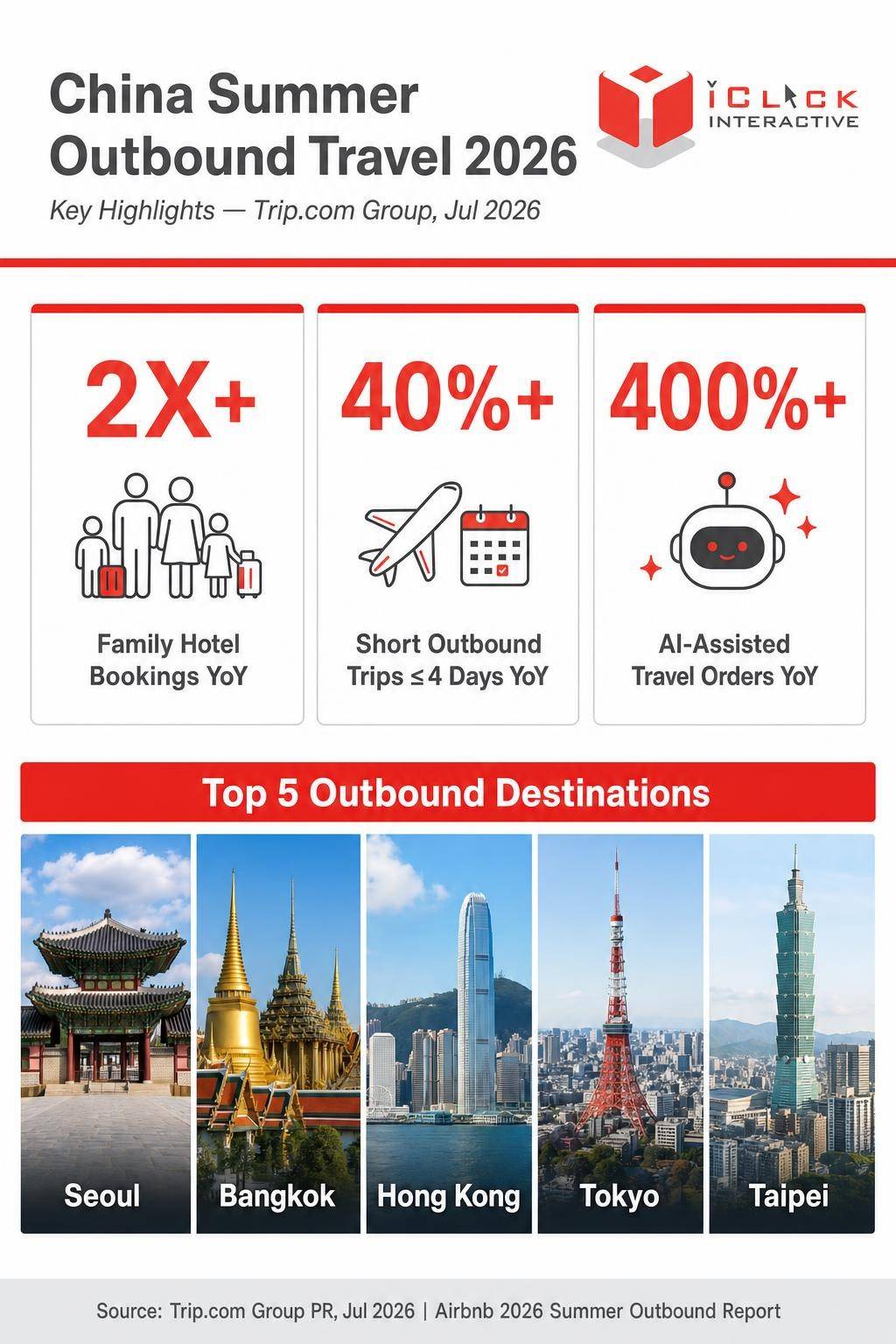
- Family hotel bookings (children under 12): more than doubled year-on-year
- Short outbound trips (four days or fewer): up more than 40% year-on-year
- AI-assisted travel orders: approximately 400% year-on-year growth
- Top five outbound destinations: Seoul, Bangkok, Hong Kong, Tokyo, and Taipei
These figures do not stand alone. Airbnb's 2026 Summer Outbound Report corroborates the trend, noting strong growth in family-oriented accommodation bookings across Southeast and Northeast Asia [2]. Together, these data points confirm a clear behavioural pattern: Chinese families are choosing short, high-frequency international trips over single long-haul holidays — a shift with significant implications for destination marketing strategy.
Where Are They Going? Asia's Top Five Destinations
The geography of China's family travel boom is shaped by proximity, direct air connectivity, and cultural familiarity. Seoul and Taipei lead in Northeast Asia, drawing families through a combination of K-pop cultural appeal, world-class infrastructure, and highly accessible family attractions. Bangkok and Singapore anchor Southeast Asia, offering a blend of affordable luxury, theme parks, and a culinary landscape welcoming to travellers of all ages. Hong Kong retains its perennial appeal as a dual-market destination — a gateway to both international retail brands and one of Asia's most dynamic entertainment environments [1].
- Seoul — K-pop cultural pull, world-class infrastructure, family-friendly attractions
- Bangkok — Affordable luxury, theme parks, accessible culinary experiences
- Hong Kong — Gateway to international retail brands and entertainment
- Tokyo — Premium experiences, theme parks, iconic food culture
- Taipei — Cultural familiarity, accessible luxury, vibrant street food scene
For destination marketers and hospitality brands in these five cities, the implication is direct: the highest-value traveller arriving this season is travelling with a family group, with children in tow, and a budget that prioritises experience, convenience, and quality accommodation over price-driven trade-offs.
The AI-Powered Booking Journey
One of the most significant findings in Trip.com's summer report is the approximately 400% year-on-year growth in AI-assisted travel orders [1]. Chinese consumers are now routinely using AI tools — embedded in super apps including Ctrip, WeChat, and Baidu — to research destinations, compare hotels, build family itineraries, and complete bookings within a single session. This compression of the discovery-to-booking funnel has material consequences for how travel brands manage their digital presence.
A family in Shanghai can now identify a family resort in Bangkok, compare room categories, check flight schedules, and confirm a booking in under twenty minutes — guided at every step by an AI assistant that synthesises content from OTA platforms, social media, and authoritative search results. Brands that are not discoverable and accurately described within these AI-powered interfaces risk being bypassed — not by a competitor's advertisement, but simply by absence from the information layer.
The Family Spending Profile
Chinese family travellers are not budget travellers. The data consistently shows that outbound family trips skew towards premium accommodation, organised experiences, and high-frequency retail spending [1]. At the destination, families visit theme parks, waterfront attractions, food trails, and flagship retail stores — often within the same day. Duty-free and airport retail capture a meaningful share of outbound family expenditure, with pre-departure shopping intent particularly high among parents purchasing beauty products, fashion accessories, and specialty gifts for family members who did not travel.
Chinese family outbound travelers skew heavily premium:
- Accommodation — Premium hotels; families with children under 12 led the booking surge [1]
- Experiences — Theme parks, waterfront attractions, organized tours, dining trails
- Retail — Flagship brand stores, duty-free, specialty food gifts for family at home
- Gifting — Parents frequently purchase beauty, fashion, and accessories for relatives who did not travel
The family traveler is simultaneously a hospitality consumer, an experiential retail customer, and a gifting purchaser — making them among the highest-value, most multi-faceted segments in the Chinese outbound market.
The Golden Week Multiplier
With Golden Week (1–10 October) now within the planning horizon, the current summer travel season is serving a second function: it is qualifying the next wave of Golden Week bookings. Research consistently shows that Chinese consumers begin researching major holiday travel six to eight weeks in advance. Families who travel abroad this summer are statistically the most likely to travel again in October — returning to familiar destinations, seeking out brands and venues that made a strong impression on their previous trip, and booking earlier with greater intent [1].
For brands in travel and retail, loyalty earned during the summer peak season compounds into Golden Week revenue. The summer traveller who discovers your hotel, restaurant, or retail brand in August is a high-probability Golden Week convert in October.
How Brands Can Activate
Translating this data into commercial outcomes requires a coordinated, multi-channel approach aligned to the platforms Chinese family travellers use across every stage of their journey.
- Xiaohongshu (RedNote) — Primary family travel discovery platform; KOC partnerships and sponsored destination guides reach families at the inspiration stage, before competitor brands enter consideration
- Ctrip (Trip.com) — Dominant outbound booking platform [1]; targeted in-app campaigns by destination, travel dates, and family composition; sponsored placement at peak booking windows
- Amap — Launched Chinese-language ride-hailing in 1,000+ overseas cities (Jul 2026); brands must verify and optimize Amap listings before Golden Week influx
- Alipay+ — Active in 65+ countries including all top 5 outbound destinations; enables seamless in-destination retail conversion
Conclusion
China's summer family travel boom is not a seasonal anomaly — it is the leading edge of a structural transformation in outbound consumer behaviour. The families booking short trips to Seoul, Bangkok, and Hong Kong today are the Golden Week travellers of October. For hospitality brands, destination marketers, travel retailers, and luxury operators, the commercial window is open now. The brands that invest in Chinese-language digital presence, family-relevant content, and cross-platform activation this summer will be best positioned to capture the full value of the H2 travel cycle.
References
[1] Trip.com Group PR, Jul 2026
[2] Airbnb 2026 Summer Outbound Report, Jun 2026