


We use cookies to give you the best digital experience. By continuing to browse this site, you give consent for cookies to be used. To learn more information about the use of cookies, please visit our cookie policy.
China's social media ecosystem is unlike any other market. Global platforms are absent, replaced by a small number of domestic super-apps that combine content, community, and commerce in a single experience. For brands targeting Chinese consumers in 2026, a clear, platform-specific strategy is the baseline for effective digital marketing. This guide covers the five platforms that matter most and how to use them strategically.
Why 2026 Demands a Platform-First Approach
The defining shift this year is the collapse of the boundary between content and commerce. Consumers now discover, evaluate, and purchase products within a single app session — which means every platform touchpoint should map to a specific role in the purchase funnel. Awareness-only spend is increasingly difficult to justify when the same investment, on the right platform, can drive measurable purchase outcomes in the same session.
Two additional forces are reshaping China social media strategy in 2026. First, AI-powered recommendation algorithms on every major platform now personalise content feeds at a granular level, rewarding brands that publish high-quality, relevant content consistently with disproportionate organic reach. Second, cross-platform data linkage — through shared device IDs and login ecosystems — means that consumer behaviour signals on one platform increasingly influence ad targeting on another. A coordinated multi-platform presence is no longer optional; it is the architecture of effective brand building in China.
WeChat: Retention and CRM
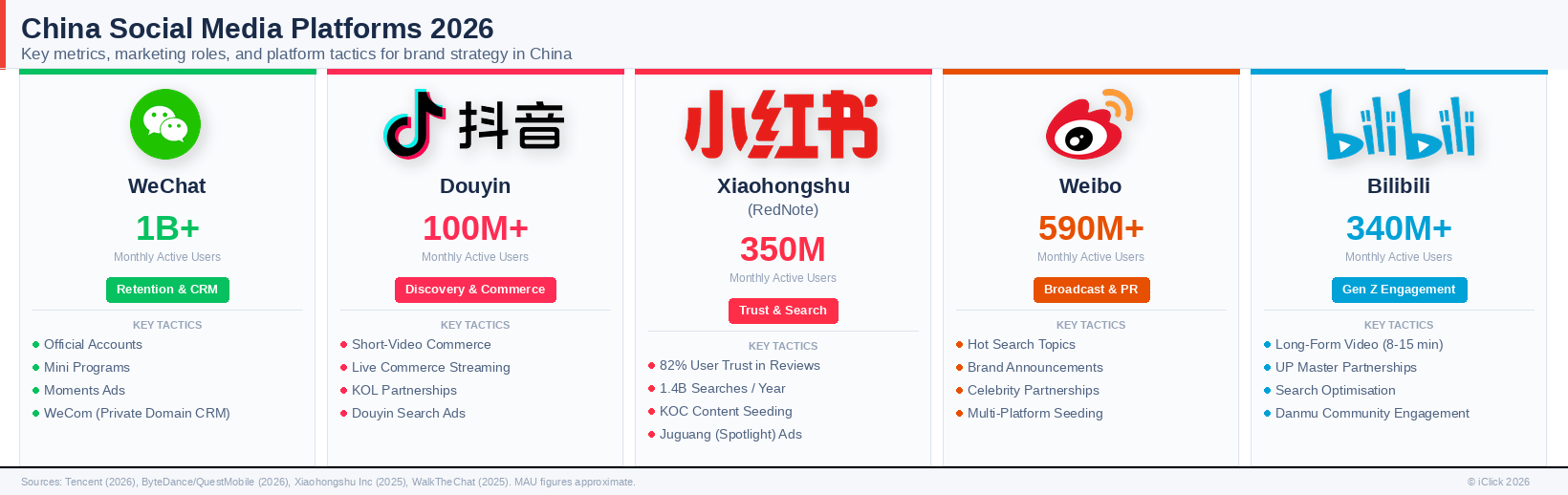
With over one billion users, WeChat is the digital backbone of Chinese daily life — payments, messaging, government services, and brand CRM all flow through it.¹
Key tools for brands:
-
- Official Accounts: The primary direct-to-consumer push channel. Use Subscription Accounts for editorial and educational content; Service Accounts for order notifications, loyalty updates, and transactional messages (limited to four pushes per month). Segmenting by account type ensures message relevance and avoids unsubscribe pressure.
-
- Mini Programs: Lightweight apps inside WeChat for e-commerce stores, loyalty schemes, and bookings — over one billion daily active users recorded in 2024.² Build a Mini Program loyalty program before scaling paid acquisition; the lifetime value uplift from retained customers consistently outperforms cold-audience spend.
-
- Moments Ads: Highly targeted paid placements that appear in the social feed, blending with organic posts. Most effective for retargeting users who already know the brand. Cold-audience Moments Ads carry a high CPM relative to conversion — reserve this format for lower-funnel remarketing audiences.
-
- WeCom (Enterprise WeChat): Increasingly used for one-to-one customer service and private-domain CRM. A WeCom QR code on packaging or in post-purchase emails converts buyers into long-term CRM contacts that brands own directly — unlike platform followers, which the platform controls and can deprioritize at any time.
Douyin: Discovery and Live Commerce
Douyin — ByteDance's China-only short-video platform, entirely separate from TikTok — commands the largest share of daily video time among Chinese consumers under 45, with hundreds of millions of monthly active users. ³
Key opportunities:
-
- Closed-loop commerce: Consumers tap a product tag in a short video and complete a purchase without leaving the app — reducing friction at the moment of peak purchase intent.
-
- Live commerce: Top-tier and mid-tier creators regularly generate significant sales volumes during streamed product sessions. This is a competitive necessity in beauty, fashion, FMCG, and consumer electronics. Brand-operated live rooms are now viable for established players willing to invest in hosting talent and production quality.
-
- KOL partnerships: Commerce-enabled influencer content consistently outperforms standard display advertising on conversion metrics. When briefing creators, specify outcomes — GMV, add-to-cart rate, coupon redemptions — rather than vanity metrics like views alone.
Xiaohongshu: Trust and Purchase-Intent Search
Xiaohongshu (RedNote) has 350 million monthly active users, skewing toward young, urban women — primary decision-makers for beauty, lifestyle, dining, and travel.⁴
What makes it unique:
-
- 82% of users trust product reviews on the platform — significantly higher than Douyin or WeChat⁵
-
- 1.4 billion purchase-intent searches recorded annually — a genuine product search engine for its audience⁶
-
- Algorithm rewards authentic, experience-based content. Overtly promotional posts are penalised in reach and perform poorly with an audience that has grown skilled at identifying sponsored content.
Recommended approach: seed genuine content through micro-KOLs and KOCs for at least four weeks before activating paid Juguang (Spotlight) advertising. Brands that build an organic foundation first consistently outperform those running paid-only campaigns, often achieving significantly lower cost-per-engagement once the algorithm has indexed the brand positively.
Additional tactics:
-
- Keyword seeding: publish posts using the exact phrases your target audience searches — such as [product category] + "review" or [product name] + "worth buying?". These posts build a searchable corpus that pays dividends for months.
-
- Optimise your Official Brand Account: ensure it links directly to your Tmall store or WeChat Mini Program so users who discover the brand through notes can convert immediately without leaving the platform ecosystem.
-
- Monitor note comments: the comment section is an unfiltered, high-signal source of genuine consumer feedback — tracking recurring themes informs both product development and future content strategy.
Weibo: Reach and Brand Announcements
Weibo operates as China's public broadcast network — where brand announcements land, trends are amplified, and campaigns gain public visibility. Its content is openly indexed and spreads across the Chinese internet, making it valuable for PR and major launches.
-
- Best used as the first stage in a multi-platform content chain: a Weibo announcement seeds conversation that are subsequently picked up in Xiaohongshu note sections or Douyin comment threads, multiplying earned reach.
-
- Hot Search (#話題#): Securing placement on Weibo's trending topics list is a brand credibility signal visible to the entire platform. Allocate budget for trending-topic buys during campaign launch moments and major product milestones to maximise visibility at peak attention.
-
- Weibo is like a broadcast amplifier. Pair every major announcement with a dedicated Mini Program link or landing page to capture the downstream intent the broadcast generates — without it, awareness created on Weibo dissipates without measurable outcome.
Bilibili: Gen Z Engagement
Bilibili is China's dominant long-form video platform for consumers born after 1995 — educated, urban, and entering peak spending years. Its users are unusually discerning; obvious promotional content is publicly called out in the platform's live bullet-comment (danmu) system, and poor-quality branded content generates visible negative earned media.
-
- Format content for 8–15-minute watch time. Tutorial content, honest in-depth product comparisons, and "is it worth it?" review formats perform best. Bilibili audiences reward thoroughness and penalise brevity that reads as superficial or promotional.
-
- Sponsored content from established content creators consistently outperforms standard ad formats. Avoid heavy scripting — Bilibili audiences value creator authenticity and quickly identify content that deviates from a creator's usual tone.
-
- Bilibili's search function is now a primary research tool for Gen Z consumers making considered purchases. Organic search-optimised content, combined with Bilibili keyword advertising, is significantly underutilised by international brands — representing a real competitive opportunity in 2026.
-
- Priority categories: technology, automotive, financial products, gaming, and any category where purchase decisions benefit from detailed education or peer-to-peer comparison before committing.
Platform Quick Summary
Check out iClick's China marketing Solutions
Building a Connected 2026 Strategy
The brands achieving the strongest results are those that build a connected content ecosystem across platforms. The brands achieving the strongest results in China are those that build a connected content ecosystem across platforms — not isolated campaigns that treat each channel as a standalone activity. The distinction matters: a connected strategy compounds platform-native strength into a single, continuous purchase journey. An isolated campaign creates temporary noise that dissipates without a clear downstream path.

Here is how a connected strategy plays out in practice.
Scenario: L’Oréal’s China strategy
In 2021, L’Oréal launched Douyin operations from a zero base. By applying a connected, platform-native strategy, the group built to approximately ¥2 billion RMB in annual Douyin GMV — while simultaneously cementing China as its second-largest market globally. 7
Stage 1 — Awareness: Weibo + Douyin
L’Oréal used Weibo for celebrity ambassador partnerships and brand-level moments. A Women’s Day campaign using the hashtag #我的选择我值得拥有 (“My Choice, I Deserve It”) generated approximately 24.8 million reads and 470,000 discussions in a single activation. 8 On Douyin, the brand entered an Anchor Period — publishing science-led short-form videos through carefully selected KOLs screened against three criteria: aesthetic match with the brand, professional authority to explain product science, and emotional resonance with the target audience. This credibility-first approach established brand authority before commercial activation began.
Stage 2 — Consideration: Xiaohongshu (RedNote)
In parallel, KOC seeding on Xiaohongshu built an organic search corpus around L’Oréal’s product categories. Peer-authored reviews and routine content primed audiences ahead of paid placements — a sequence applied consistently across sub-brands including Lancôme, YSL Beauté, and Kiehl’s. This organic foundation reduced cost-per-engagement on subsequent Juguang paid placements, as the algorithm rewarded content reaching audiences that were already warm to the brand.
Stage 3 — Conversion: Douyin Live Commerce
After the credibility foundation was established, L’Oréal activated Douyin Mall integration and live-streaming — entering what the brand describes internally as the Closed-Loop phase: the synergy of organic content, paid traffic amplification, and live-stream conversion in a single session. Critically, live-stream decision-making was delegated to Gen Z digital natives within the organisation — a structural change the brand attributed directly to its conversion performance. The resulting architecture — short video driving discovery, search validating intent, live-stream closing the purchase — became the repeatable model behind its Douyin GMV growth.
Stage 4 — Retention: WeChat
WeChat anchored retention. Branded Mini Programs across sub-brands — including YSL Beauté, Maybelline, and Giorgio Armani Beauty — managed loyalty programmes and repeat-purchase flows. Maybelline’s loyalty scheme integrated points across Tmall, its direct-to-consumer channel, and offline retail — ensuring that consumers acquired on Douyin or Xiaohongshu re-entered the brand ecosystem via WeChat rather than defaulting to third-party platforms on their next purchase.
The result is a self-reinforcing system: Weibo broadcasts amplify cultural moments, Douyin creates discovery and drives first purchase, Xiaohongshu builds the peer-review layer that sustains consideration, and WeChat converts one-time buyers into long-term brand relationships. Each platform contributes its native strength to a continuous purchase journey — and the outcome is measurably greater than any single channel alone. From a standing start in 2021, L’Oréal reached approximately ¥2 billion RMB in annual Douyin GMV and established China as its second-largest market globally.
Each platform contributes its native strength to a single, uninterrupted purchase journey. The result is not just a successful launch — it is a connected system that compounds over time. That is what a genuine connected China social strategy looks like in practice.
How iClick Helps Brands Win on China Social Media?
As a leading digital marketing partner with direct integrations across WeChat, Douyin, Xiaohongshu, Weibo, and Bilibili, iClick combines proprietary data intelligence with platform-native expertise to help brands build connected, results-driven social strategies in China.
Ready to build your 2026 China social media strategy? Contact iClick today.
Sources
-
- Tencent Official Data (2026). WeChat/Weixin monthly active users. Tencent Holdings. https://www.tencent.com
-
- Tencent WeChat Open Class PRO (2024). WeChat Mini Programs annual report. Tencent Holdings.
-
- ByteDance / QuestMobile (2026). Douyin monthly active user data and daily video consumption research.
-
- Xiaohongshu Official Data (2025). Platform monthly active user statistics. Xiaohongshu Inc.
-
- Xiaohongshu Internal Consumer Trust Research (2025), cited in industry reports including Marketing-Interactive. https://www.marketing-interactive.com
-
- WalkTheChat (2025). Xiaohongshu records 1.4 billion purchase-intent searches a year. https://walkthechat.com/xiaohongshu-records-1-4-billion-purchase-intent-searches-a-year-and-4-other-news
-
- BINGO Digital (2024). The L’Oréal Playbook in China: Decoding the Leap to 2 Billion GMV on Douyin. https://www.bingo-digi.com/blog-list/digital-marketing/loreal-douyin-growth-strategy
-
- Daxue Consulting (2023). L’Oréal in China: 6 marketing tools to succeed. https://daxueconsulting.com/loreal-china
-
- BINGO Digital (2024). The L’Oréal Playbook in China: Decoding the Leap to 2 Billion GMV on Douyin. https://www.bingo-digi.com/blog-list/digital-marketing/loreal-douyin-growth-strategy
-
- Daxue Consulting (2023). L’Oréal in China: 6 marketing tools to succeed. https://daxueconsulting.com/loreal-china