We use cookies to give you the best digital experience. By continuing to browse this site, you give consent for cookies to be used. To learn more information about the use of cookies, please visit our cookie policy.

China outbound travel marketing has entered a new phase. With cross-border departures on course for a record year in 2026 and a generation of mobile-first travelers who research, book and navigate entirely within Chinese apps, reaching mainland tourists requires a fundamentally different playbook — one that extends far beyond trip-planning portals and into the social feeds, map searches and retail moments that shape decisions in real time. This guide sets out where the opportunities are, why they exist and how brands can act on them.
The 2026 Chinese Outbound Traveler Opportunity
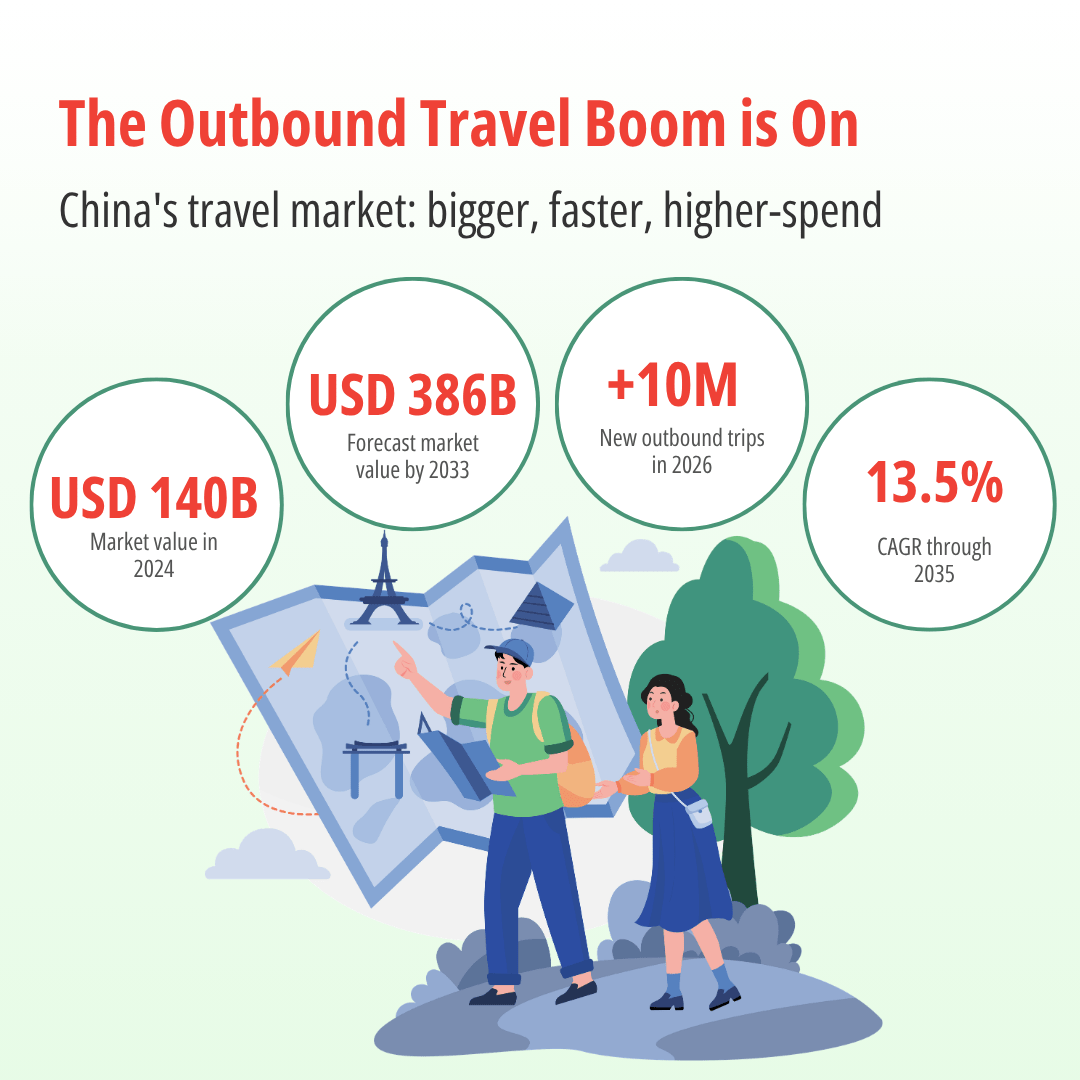
China's outbound travel recovery has moved decisively beyond a post-pandemic bounce. Industry reporting projects that the volume of cross-border trips from mainland China will rise by roughly 10 million in 2026 compared with 2025, driven by yuan appreciation, a fast-expanding network of visa-free agreements and sustained pent-up demand for international experiences. [3]
Market value and spending power
The China outbound travel market was valued at approximately USD 140 billion in 2024 and is forecast to grow at a compound annual rate of 13.5% through 2033, reaching an estimated USD 386 billion. [7] Chinese visitors already spend more per night in destination markets than travelers from most other major source markets, creating disproportionate value for retail, hospitality and F&B brands that can capture their attention at the right moment.
Top destinations and the Greater Bay Area corridor
South Korea, Vietnam and Thailand lead the 2026 destination rankings by trip volume, but the Greater Bay Area (GBA) corridor, connecting Shenzhen, Guangzhou and the wider Pearl River Delta to Hong Kong and Macau, represents the highest-frequency, highest-intent travel flow in the world. GBA travelers are disproportionately repeat visitors: they plan less, spend more per trip and respond strongly to in-destination prompts over pre-trip advertising. [3]
Why Travel Decisions Now Happen Across Search, Social and Maps
The single most important shift in China outbound travel marketing over the past two years is the collapse of the linear funnel. Mainland travelers no longer move cleanly from awareness to research to booking to in-destination action. Instead, all four stages run in parallel, mediated by the same small set of super-apps and platforms.
The platform stack
-
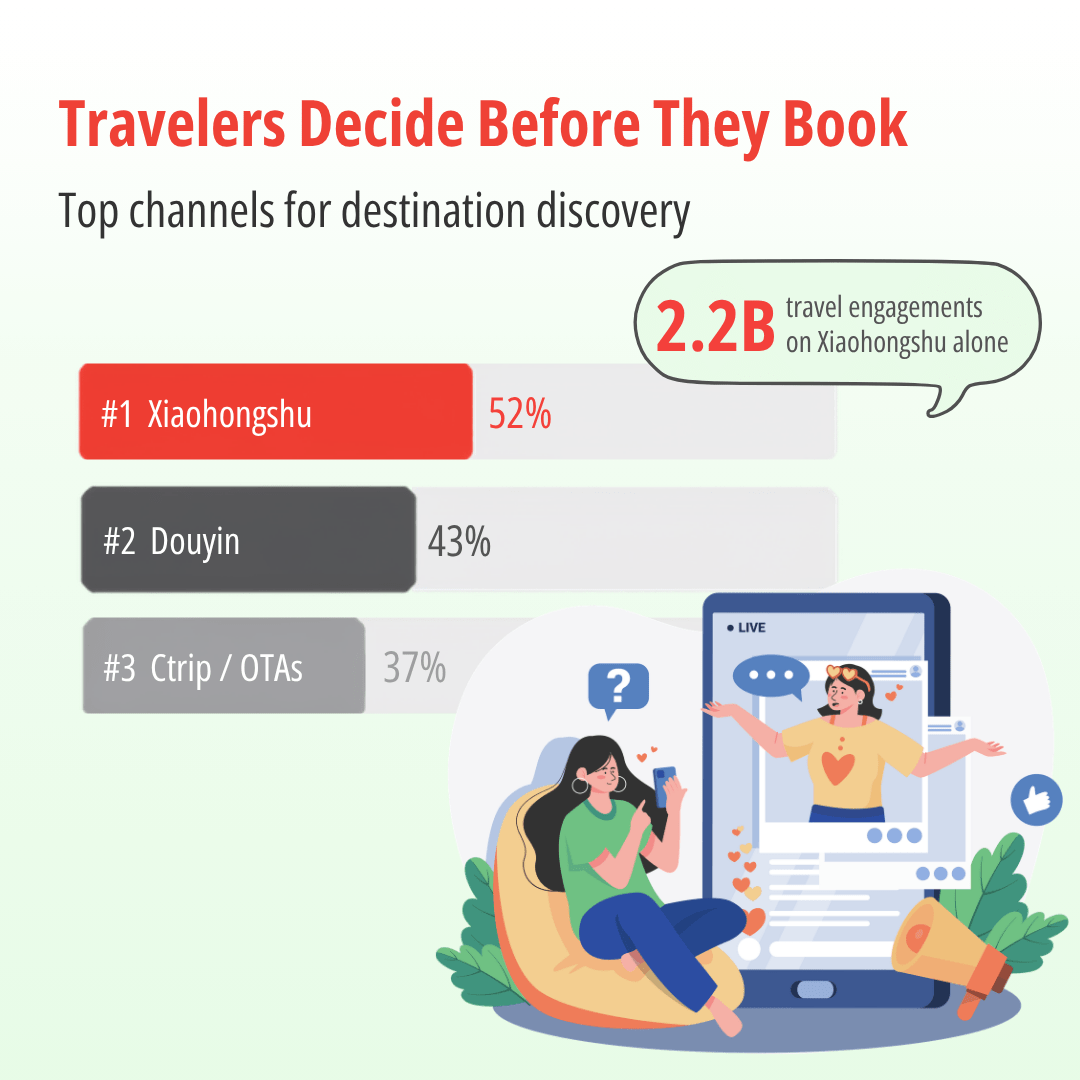
- Xiaohongshu (RedNote) is ranked #1 for destination research, consulted by 52% of outbound travelers [5] ahead of personal networks, travel agents and every OTA. Its 2.2 billion travel-related engagements illustrate the scale of content demand on the platform. [4]
-
- Douyin drives aspiration and impulse: as the second most impactful destination marketing platform, [5] short-video content converts browsing attention into concrete destination intent — with cuisine, scenery and culture performing consistently as top content categories.
-
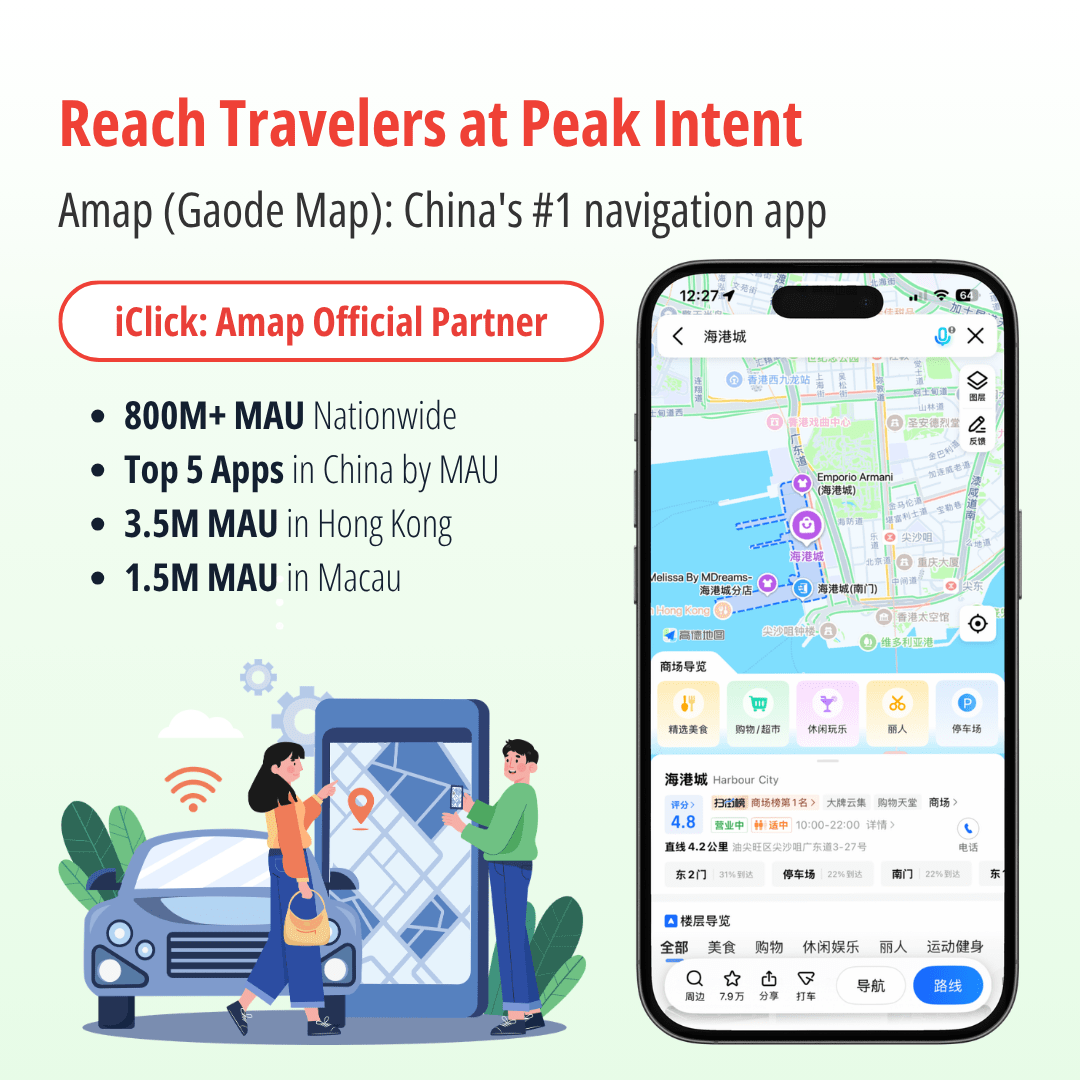
- Amap (Gaode Map) closes the loop on search-to-store: with more than 100 million daily active users and 800 million monthly active users nationwide, it is the navigation and local-discovery layer that turns digital awareness into a physical visit. [6]
-
- OTAs such as Ctrip anchor booking, consulted by 37% of travelers, but their influence is increasingly downstream of inspiration that originated on social or map platforms. [5]
For marketers, the implication is clear: a campaign that only buys OTA banner space or hands out leaflets at arrival halls is targeting the end of a journey that was already decided elsewhere. Winning in China outbound travel marketing means owning moments across the entire connected stack.
| Platform | Role | Traveler Intent |
| Xiaohongshu (RedNote) | Pre-trip, Post-trip | Conducts Destination research |
| Douyin | Pre-trip, In-trip | Drives aspiration and impulse |
| Amap (Gaode Map) | In-trip, Post-trip | Closes the loop on search-to-store |
Holiday Demand Signals from Hong Kong and Asia
Public holiday periods remain the most concentrated windows of demand for brands targeting mainland Chinese tourists, particularly for the Hong Kong and GBA corridor.
Labour Day Golden Week 2026: the data
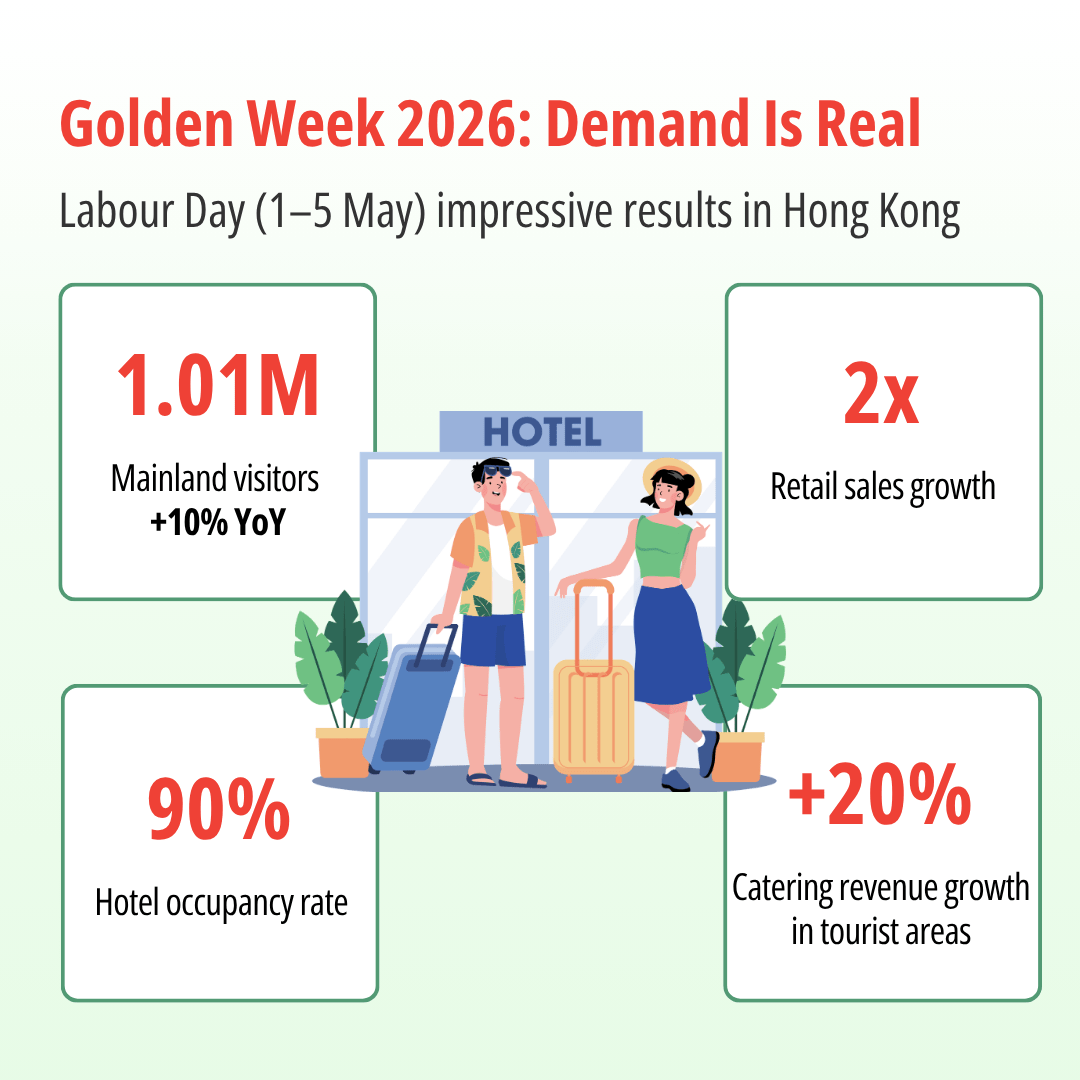
Over Labour Day Golden Week (1–5 May 2026), Hong Kong received approximately 1.19 million visitors in total, an 8% year-on-year increase. [1] [9] Mainland visitors accounted for 1.01 million of those arrivals (+10% year-on-year), [2] averaging approximately 200,000 per day and peaking at around 260,000 on 2 May. The Lok Ma Chau Spur Line was the busiest control point. [1]
Hotel occupancy reached 90%, up slightly on the prior year, while room prices climbed 10% compared with past long holidays. [2] Shopping malls reported double-digit year-on-year increases across retail categories, and catering revenues in tourist districts rose approximately 20% over the same period. [2] [10]
What the numbers tell marketers
A 10% uplift in mainland arrivals combined with double-digit retail growth signals that the volume-to-spend ratio is improving: this cohort is not only arriving in greater numbers but spending more per trip. Critically, roughly 60% of inbound tour groups opted for overnight itineraries — extending the window of commercial exposure well beyond a single afternoon of shopping. [1]
The Chinese New Year, Labour Day and National Day windows collectively generate the majority of annual inbound volume. Planning campaign investment around these peaks — with pre-holiday social seeding, in-market map and retail activation, and post-trip retargeting — maximises return on every marketing dollar.
Pre-Trip, In-Market and Post-Trip Media Moments
Effective China outbound travel marketing maps media spend to the three phases of the traveler journey. Each phase has distinct platforms, mindsets and conversion levers.
Phase 1 — Pre-trip (weeks to days before departure)
This is where brand and destination preference is formed. Xiaohongshu UGC, Douyin short video and KOL content drive awareness and intent. Search on Baidu and within Xiaohongshu captures active planners. OTA listing optimisation and Gaode Map POI (point-of-interest) setup ensure the brand appears when searches shift from inspirational to transactional.
Key pre-trip actions:
-
- Seed Xiaohongshu with destination content aligned to 旅游攻略 (travel guide) and 旅游 (travel) hashtags — topics generating tens of billions of engagements annually.
-
- Run Douyin video campaigns timed 4–6 weeks ahead of major holiday windows.
-
- Claim and fully optimise Gaode Map POI listings before peak travel periods.
Phase 2 — In-market (the trip itself)
Once the traveler has arrived, decision-making is hyperlocal and time-sensitive. Gaode Map's 推廣通 (Tui Guang Tong) ad format surfaces brand listings in nearby search results and recommendations — reaching consumers at the exact moment they are deciding where to eat, shop or spend time. Travel retail environments — airports, cross-border hubs and duty-free zones — are secondary conversion points, particularly for luxury and beauty categories. [6]
Key in-market actions:
-
- Activate Gaode Map 推廣通 keyword and proximity targeting during peak travel windows.
-
- Deploy WeChat Moments and Mini Programme ads to users geo-located within destination areas.
-
- Coordinate in-store staff and point-of-sale messaging with digital campaign creative.
Phase 3 — Post-trip (retargeting and advocacy)
Post-trip audiences have high commercial value: they are proven spenders and active content creators on Xiaohongshu. Retargeting them with loyalty incentives or next-trip prompts extends lifetime value. UGC generated during their trip — if seeded by brand collaborations — continues to influence future travelers, compounding organic reach long after the holiday window closes.
Xiaohongshu, Douyin and OTAs in Destination Discovery
Understanding how mainland Chinese tourists use each platform is essential to allocating budget and creative resources in any China outbound travel marketing strategy.
Xiaohongshu: the discovery engine
Xiaohongshu's position as the #1 destination research channel — consulted by 52% of outbound travelers, versus 43% for Douyin and 37% for Ctrip — reflects its unique combination of trusted peer reviews, visual inspiration and searchable content. [5] Hong Kong ranks 4th globally in Xiaohongshu destination engagement with 36.3 million engagements, trailing only Japan, the USA and Italy. [4]
The platform's audience skews young and affluent: approximately 80% of travel-engaged users are under 35, with the 25–34 cohort the single largest age segment. Scenic and cultural content (22% of notes) and travel guides (18.5%) dominate engagement, while shopping spot content (5%) punches well above its weight in commercial influence. [4]
Douyin: aspiration and reach
Douyin functions as the aspiration layer. Its short-video and live-streaming formats rank as the second most impactful medium for destination marketing among Chinese outbound travelers. [5] Its reach among the 18–34 cohort mirrors Xiaohongshu's, making it a natural complement for brands looking to maximise pre-trip awareness ahead of holiday windows. For travel retail and cross-border shopping categories in particular, Douyin's format lends itself to product demonstration content that primes purchase intent before the traveler even reaches the departure terminal.
OTAs: conversion layer, not discovery layer
Ctrip, Fliggy and Qunar remain essential for bookings but play a diminishing role in inspiration. Brands that treat OTA listing optimisation as a complete China outbound travel marketing strategy are capturing demand they did not generate — leaving significant value on the table for competitors with a fuller-funnel approach.
Gaode Map and High-Intent Local Search
No discussion of China outbound travel marketing in 2026 is complete without Gaode Map (Amap). As Alibaba's flagship navigation and local-services platform, it is the app that mainland Chinese tourists open when they want to find something specific — a restaurant, a mall, a pharmacy, a beauty counter — within the destination they are already visiting.
Scale and reach
Gaode Map reported more than 800 million monthly active users across China in 2025, ranking it among China's top five apps by MAU — alongside Alipay, WeChat, Douyin and Taobao. [6] With over 100 million daily active users nationally, the platform's advertising inventory is accessed by a population of travelers that dwarfs any other location-based channel in the market. In Hong Kong specifically, Gaode Map reaches approximately 3.5 million monthly active users; in Macau, approximately 1.5 million. [6]
Why Gaode Map matters for destination marketers
Unlike social or display advertising — where brand visibility is incidental to the user's primary activity — Gaode Map captures users who are actively searching for something to do, eat or buy within a defined geographic radius. This is the highest-intent moment in the entire traveler journey. A brand that appears prominently in Gaode Map search results during Golden Week is positioned at the exact decision point that determines foot traffic.
iClick holds Amap Brand Pioneer Partner status — an accreditation that provides access to premium placement formats, priority POI optimisation and performance data not available through standard channels. For brands targeting GBA travelers and inbound tourists to Hong Kong, this partnership is a material competitive advantage. [8]
For a full breakdown of available ad formats and targeting options, see iClick's Gaode Map Marketing 2026 guide.
Southbound Travel Scheme and GBA opportunity
Gaode Map's Southbound Travel Scheme features — designed specifically for GBA residents planning cross-border trips — represent a high-value targeting layer for Hong Kong and Macau destination brands. GBA travelers are typically younger, higher-income and higher-frequency than average mainland visitors. Reaching them within Gaode Map's travel planning and navigation context, while they are actively deciding where to go, what to buy and how to move around, is one of the most efficient forms of location-based marketing available in the region today. [8]
Gaode Map campaign performance benchmark
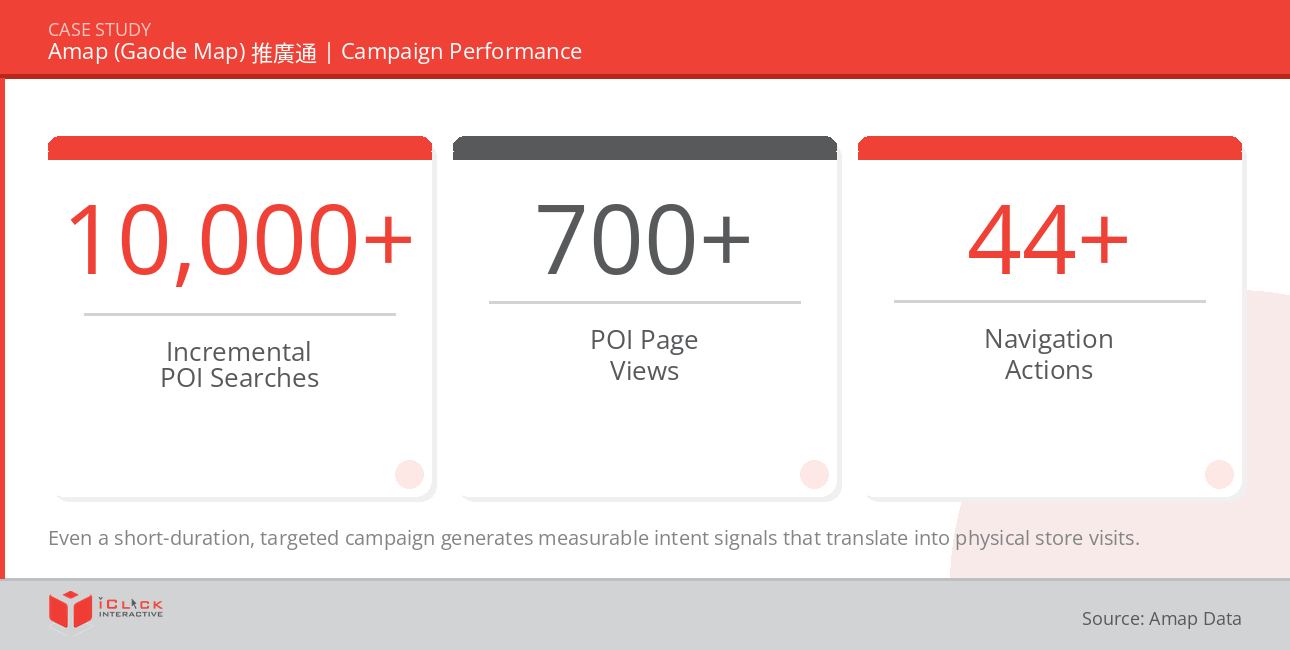
A health supplement brand that activated Gaode Map 推廣通 within weeks recorded more than 10,000 incremental POI searches, over 700 POI page views and 44+ navigation actions — demonstrating that even a short-duration, targeted campaign generates measurable intent signals that translate into physical store visits. [6]
Travel Retail and Cross-Border Retail Use Cases
Travel retail is one of the highest-margin commercial environments for destination brands — and mainland Chinese travelers are its most commercially significant audience. The China outbound travel market's projected 13.5% CAGR through 2033 means that investment in travel retail marketing made today will compound in value as outbound volumes continue to grow. [4]
The social-to-store connection
Social platforms play a measurable role in priming travel retail purchase intent. Xiaohongshu's shopping-spot content category and Douyin product demonstration videos collectively reach millions of travelers before departure, building brand familiarity that is activated at the duty-free counter. For luxury, beauty, spirits and skincare brands, the pre-trip social layer is not optional but the mechanism by which in-store conversion is made possible.
Key travel retail moments
-
- Airport departure halls: the highest-dwell, highest-intent environment where travelers have cleared security and are in a buying mindset.
-
- Cross-border land checkpoints (Lok Ma Chau, Shenzhen Bay, Heung Yuen Wai): high-frequency GBA traveler footfall, especially on weekends and public holidays.
-
- Duty-free shopping in destination: hotel retail, mall flagships and experiential pop-ups that extend purchase opportunity beyond the departure terminal.
Digital-to-offline conversion
The most effective travel retail programmes integrate digital campaign creative with in-store messaging — ensuring that the Xiaohongshu or Douyin content a traveler saw before departure is reinforced at point of sale. QR-code redemption, WeChat Mini Programme vouchers and geo-targeted push notifications bridge the gap between screen and shelf.
For iClick's full travel retail marketing capabilities, visit the iClick Travel Retail Marketing page.
Audience Segmentation for Mainland Travelers
Not all mainland Chinese outbound travelers are the same. Effective China outbound travel marketing requires segmenting by behavioral intent, origin geography and platform affinity — not just demographics.
By origin and frequency
GBA residents (Guangzhou, Shenzhen, Foshan, Dongguan and surrounding cities) are the highest-frequency cross-border travelers to Hong Kong and Macau. They are digital-native, value-conscious but high-spending, and disproportionately active on Xiaohongshu and Gaode Map. Tier-1 city residents from Beijing and Shanghai typically travel less frequently to Hong Kong but spend more per trip and over-index on luxury categories.
By travel purpose
-
- Leisure and experiential travelers — the dominant and fastest-growing segment — prioritise dining, culture, entertainment and social-content-worthy experiences.
-
- Shopping-focused travelers remain commercially significant but have diversified spend from luxury goods toward F&B, wellness and unique local products.
-
- Business and MICE travelers are smaller in volume but higher in average spend per trip and more likely to return on a regular basis.
By platform affinity
Xiaohongshu's travel audience skews strongly female (86%) and under 35, making it the primary channel for beauty, fashion, F&B and lifestyle brands targeting younger female mainland travelers. [4] Douyin's travel audience is more gender-balanced and extends further into the 25–44 bracket, broadening its utility for mass-market consumer categories. Gaode Map reaches across all segments but is particularly dominant for in-trip, high-intent local searches. Effective segmentation layers platform selection over audience type: Xiaohongshu for brand building with younger female travelers; Douyin for broader awareness; Gaode Map for in-market conversion across all segments. [6]
Measurement: From Impressions to Store Visits
One of the most persistent gaps in China outbound travel marketing is measurement. Brands frequently invest in social or display awareness without a clear line of sight to commercial outcomes. Closing this loop requires connecting online touchpoints to offline conversions.
The O2O measurement stack
-
- Impression-to-click metrics: standard across Xiaohongshu, Douyin and Gaode Map ad placements.
-
- Keyword search lift: Gaode Map's 推廣通 reports incremental keyword searches and POI page views triggered by paid exposure — the bridge between awareness spend and navigation intent. [6]
-
- Navigation actions: Gaode Map tracks the number of users who triggered route navigation to a POI after ad exposure — a direct proxy for incremental foot traffic. [6]
-
- In-store conversion: QR-code redemption, WeChat Mini Programme purchases and coupon validation provide closure on the full funnel.
Attribution across the funnel
The most sophisticated programmes unify data across pre-trip social, in-market map and retail conversion into a single measurement framework. This requires a partner with access to data across Xiaohongshu, Douyin, Gaode Map and retail point-of-sale systems — a capability that distinguishes specialist China marketing partners from general digital agencies.
iClick Activation Framework for Travel Brands
iClick Interactive is a data-driven digital marketing platform with specialist capabilities across the full China outbound travel marketing stack. As an accredited Gaode Map Brand Pioneer Partner and a platform with deep access to Xiaohongshu, Douyin and WeChat inventory, iClick connects the pre-trip social layer to in-market map discovery and travel retail conversion. [8]
The three-layer activation model
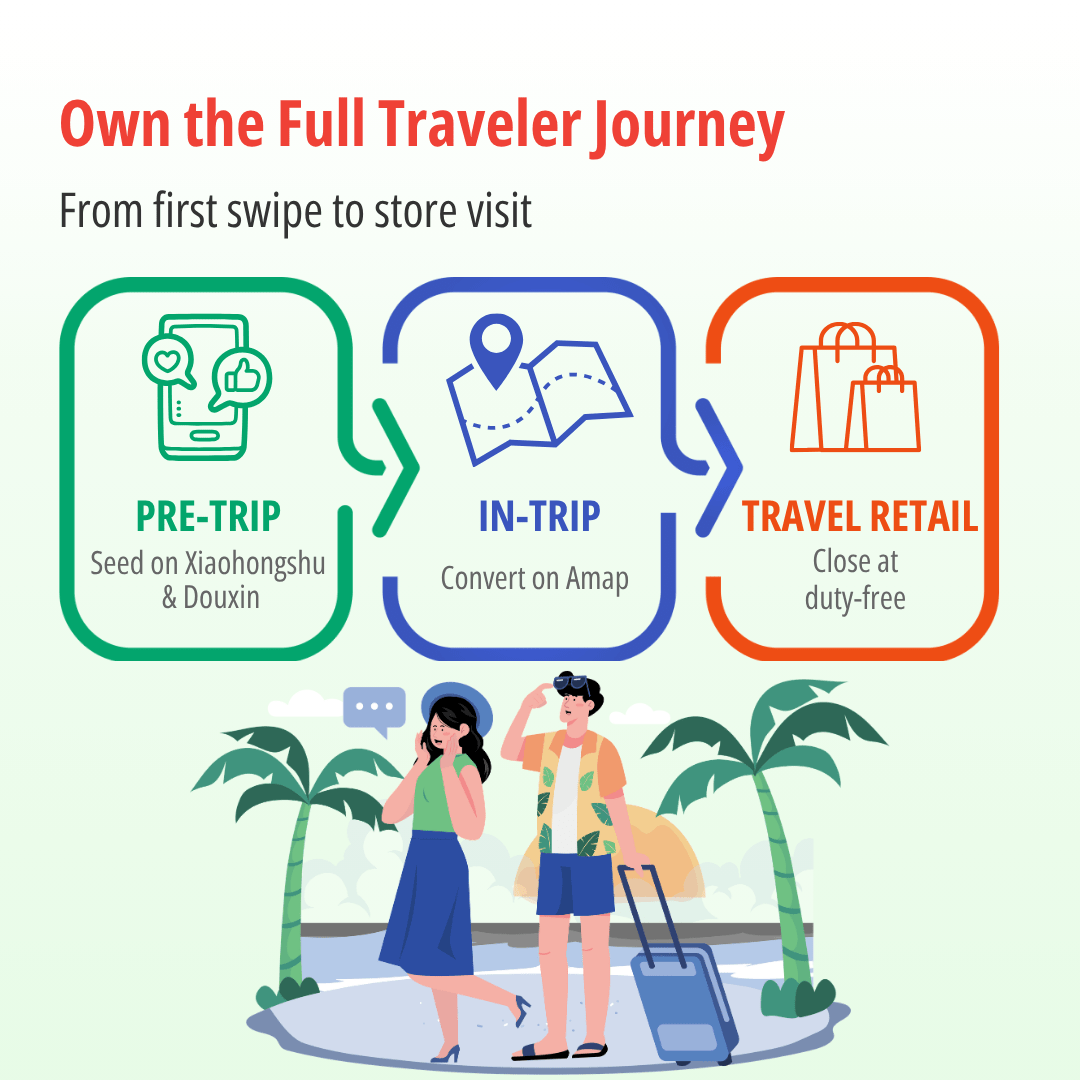
Layer 1 — Pre-trip social seeding
Xiaohongshu brand content and KOL partnerships build destination preference in the weeks before a holiday window. Douyin video placements extend reach to aspiration-stage audiences. Paid search on OTAs and within Xiaohongshu captures travelers who have moved from inspiration to active planning.
Layer 2 — In-market map and local discovery
iClick's Gaode Map Marketing capabilities activate 推廣通 keyword targeting, nearby-recommendation formats and POI page optimisation to surface brands to travelers at the moment of maximum local intent. This is particularly powerful during Golden Week, when mainland visitors are actively navigating unfamiliar destinations and relying on Gaode Map for real-time local discovery.
Layer 3 — Travel retail and conversion
iClick's travel retail marketing solutions coordinate digital campaign creative with airport and cross-border retail environments — ensuring that the social content a traveler saw before departure is reinforced at the duty-free counter. Post-purchase retargeting and loyalty activation extend the relationship beyond the trip.
Why an integrated approach outperforms channel-by-channel buying
Each platform in the China outbound travel ecosystem has specialist agencies that operate within it. But the opportunity for brands targeting mainland travelers is to own the journey — not individual moments. A coordinated campaign that seeds on Xiaohongshu, converts on Gaode Map and closes in travel retail consistently outperforms the same budget split across channel-specific buys, because each layer amplifies the others.
Ready to Reach Mainland Travelers in 2026?
The window to plan and activate ahead of National Day Golden Week (October 2026) is now. Whether your priority is building brand preference among GBA residents on Xiaohongshu, capturing in-market search intent on Gaode Map, or driving conversion in travel retail environments, iClick has the platform access, data partnerships and activation expertise to deliver measurable results.
Sources
-
- [1] news.gov.hk – Golden Week visitors reach 1.19m (May 2026) — https://www.news.gov.hk/eng/2026/05/20260506/20260506_184149_719.html
-
- [2] HKSAR Gov – Increase in visitor arrivals during Golden Week — https://www.info.gov.hk/gia/general/202605/06/P2026050600707.htm
-
- [3] South China Morning Post – China's outbound travel set to soar by 10 million trips in 2026 — https://www.scmp.com/economy/china-economy/article/3339348/chinas-outbound-travel-set-soar-10-million-trips-2026-halve-japan
-
- [4] iClick – China Outbound Travel Market Trends and Insights — https://www.i-click.com/resources/isuite-insight-chinas-outbound-travel-market-trends-and-insights-in-2025
-
- [5] TTG Asia – Xiaohongshu is most consulted by Chinese travellers — https://www.ttgasia.com/2024/05/14/xiaohongshu-is-most-consulted-by-chinese-travellers-whose-travel-sentiments-are-improving
-
- [6] iClick – Gaode Map Marketing 2026: Capturing High-Intent Travelers — https://www.i-click.com/resources/gaode-map-marketing-2026-iclick
-
- [7] Market Research.com – China Outbound Tourism Market and Forecast 2025 – 2033 – https://www.marketresearch.com/DPI-Research-Marketing-Solutions-v4091/China-Outbound-Tourism-Forecast-42475185/
-
- [8] iClick – Gaode Map Southbound Travel Scheme & GBA Opportunities — https://www.i-click.com/resources/gaode-map-southbound-travel-scheme-gba-opportunities
-
- [9] RTHK – Visitor arrivals hit 1.19m over Golden Week — https://gbcode.rthk.hk/TuniS/news.rthk.hk/rthk/en/component/k2/1853776-20260506.htm
-
- [10] Hong Kong Business – Golden Week visitors rise 8% to 1.19 million — https://hongkongbusiness.hk/hotels-tourism/news/golden-week-visitors-rise-8-119-million