


We use cookies to give you the best digital experience. By continuing to browse this site, you give consent for cookies to be used. To learn more information about the use of cookies, please visit our cookie policy.
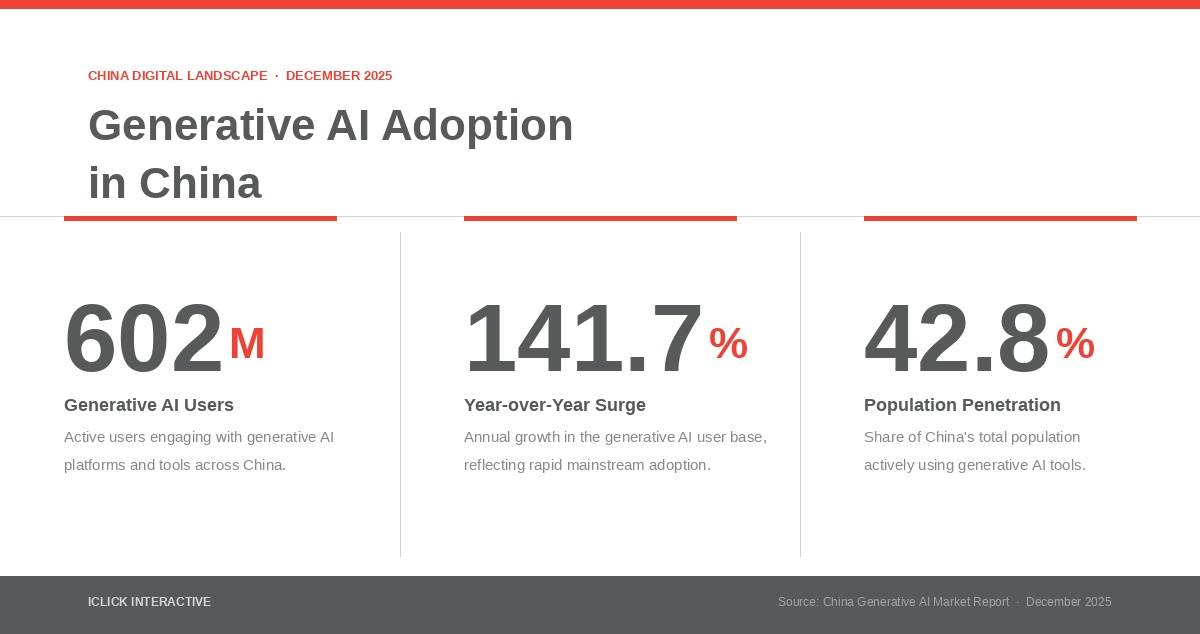
China's search landscape has crossed a turning point. More than 602 million people in mainland China were using generative AI tools as of December 2025 — a 141.7% year-on-year surge that represents 42.8% of the entire population (CNNIC, 57th Statistical Report on China's Internet Development, 2026). When a Chinese consumer or B2B buyer asks Doubao 'which international skincare brand is best for sensitive skin' or asks DeepSeek 'recommend a cross-border logistics provider,' they are not clicking ten blue links. They are reading a synthesised answer — and that answer cites sources.
If your brand is not one of those sources, you are invisible at the moment of highest intent.
This guide explains how to structure your China marketing content so that Chinese AI engines — Doubao, DeepSeek, Baidu ERNIE, Qwen, and Kimi — select it as a trusted citation. You will learn the content signals that matter, the technical fixes that unlock crawlability, the off-site ecosystem moves that build authority, and the measurement framework that proves it is working.
This is AI search optimization China as it must be practised in 2026: different rules, different platforms, and a very different content architecture from what traditional SEO taught you.
What It Means to Be Cited by AI Search
Traditional SEO earns a ranking. Generative engine optimization China (GEO) earns a citation — a named reference inside an AI-generated answer. The distinction matters because the mechanics are entirely different.
When Doubao or DeepSeek constructs a response, it draws on training data and, increasingly, live retrieval. It selects passages that are authoritative, clearly structured, and corroborated by sources the model has seen before. A page buried on page three of Baidu can still be cited by DeepSeek if its content matches the model's trust signals. Conversely, a page ranking #1 on Baidu may never appear in an AI answer if its content is vague, uncited, or hosted in a way that Chinese crawlers struggle to access.
The key shift in mindset: move from on-site keyword optimisation to ecosystem authority seeding.
Chinese AI models do not centre on your corporate domain the way Google Search does. According to research across DeepSeek, Qwen, and Baidu ERNIE, these engines weight content published inside walled-garden platforms — Zhihu, WeChat Public Accounts, Baidu Baike — far above standalone brand websites. For international brands entering China, this means your authoritative presence must be built inside the ecosystems where Chinese AI was trained.
In short: AI search optimization in China means making your brand's knowledge findable, structured, and credibly referenced in the Chinese-language platforms that feed Chinese LLMs — not just optimising your own website.
Start with a Single Clear Answer per Section
Chinese AI engines extract passage-level answers, not page-level summaries. If your article buries the main point across three paragraphs of preamble, an AI will either skip it or hallucinate a summary that misrepresents your brand.
The fix is structural: open every section with a direct, complete statement that answers the implied question of that heading. Think of it as writing the sentence you want Doubao to quote.
Before (AI-unfriendly):
"There are many factors to consider when choosing a cross-border e-commerce platform in China, and different businesses have different needs depending on their product category, target demographic, and budget constraints…"
After (AI-citation ready):
"Tmall Global and JD Worldwide are the two dominant cross-border e-commerce platforms in China for international brands, each suited to different product categories and investment thresholds."
The second version can be lifted verbatim into an AI response. The first cannot.
Apply this pattern at every H2 and H3. Write the answer first, then provide the evidence and nuance. This is particularly important for Doubao search optimization, where ByteDance's model favours concise definitional statements backed by quantified claims. According to QuestMobile's 2025 Annual Report, China had 722 million mobile AI users as of December 2025, making AI-native platforms like Doubao the highest-reach surfaces for brand citation.
Use Verified Statistics and Named Sources
Chinese AI models apply a trust hierarchy when selecting citations. Vague assertions are filtered out; quantified claims with named sources are prioritised.
This matters because the source ecosystem in China is entirely distinct from Western markets. A reference to Gartner, G2, or Forbes carries minimal weight with DeepSeek or Qwen — these are largely absent from their training data. The sources that carry weight are shown below.
| Source Type | Examples | Why It Works |
| State and industry reports | MIIT, CNNIC | Official status signals authority |
| Academic databases | CNKI, WanFang | Models trained on academic Chinese web |
| Expert Q&A platforms | Zhihu | High-voted answers treated as verified expertise |
| B2B tech media | 36Kr, Huxiu, Leiphone | Indexed, authoritative Chinese-language sources |
| Encyclopedia | Baidu Baike | Foundational entity knowledge for major Chinese LLMs |
For context, China's internet user base reached 1.125 billion as of December 2025, with an internet penetration rate of 80.1% (CNNIC, 57th Statistical Report on China's Internet Development, 2026). Any claim about 'Chinese consumers' should be grounded in figures from CNNIC, official government statistics, or major research firms such as QuestMobile — these are the citation types that build credibility with both human readers and AI training pipelines.
Practical rule: Name every source inline in the body copy — not just in footnotes. Write 'according to CNNIC' in the text itself. AI models parse inline attribution as a quality signal.
Create Passage-Level Headings
Your heading structure directly controls which passages Chinese AI engines can locate and extract. A heading like 'Our Services' gives an AI nothing to work with. A heading like 'What Does Cross-Border E-Commerce Fulfilment Cost in China?' is an exact match for a user query — and the section beneath it becomes extractable.
Principles for passage-level headings in China AI SEO:
-
- Use question or definition formats. 'What is DeepSeek?' outperforms 'Overview.'
-
- Include the keyword in the heading. AI engines use heading text as a relevance signal.
-
- Keep headings under 12 Chinese characters (or ~70 English characters). Longer headings are truncated in AI extraction windows.
-
- Avoid headings that only make sense in context — each should be interpretable as a standalone question.
For AI SEO China content specifically, consider mirroring the question phrasing that users type into Doubao and DeepSeek. CNNIC's 2025 Report on the Development of Generative AI Applications identifies Q&A and information retrieval as the primary use cases for Chinese GenAI users — meaning your headings should match the interrogative structure of those queries.
Add Comparison Tables and Definitions
Structured elements — tables, definition lists, numbered steps — are disproportionately cited by AI engines because they are pre-formatted for extraction: the model can quote a table row without restructuring anything.
China AI Platform Comparison
| Platform | Primary Use Case | MAU (Dec 2025) | Best For |
| Doubao (ByteDance) | Consumer Q&A, brand discovery | 227 million | Brand awareness, consumer campaigns |
| DeepSeek | Research, technical queries | 136 million | B2B, technical product positioning |
| Yuanbao (Tencent) | Broad search, daily assistant | 41 million | General brand presence |
| Qwen (Alibaba) | Procurement, vendor research | 25 million | Supplier comparison, B2B credibility |
MAU Source from Questmobile 2025.
Definition Boxes
When your content defines 'generative engine optimization China' clearly in a single paragraph, that definition becomes the AI's default answer to 'what is GEO in China?' — with your brand as the source. Add definitions for: AI Share of Voice, entity authority, Baiduspider, passage retrieval, citation frequency.
Use Schema and Clean Crawl Paths
Content that Chinese AI engines cannot crawl will never be cited, regardless of its quality.
1. Unblock Baiduspider.
Unblock Baiduspider. Many Western-hosted sites block Baiduspider through CDN default security rules. Check your robots.txt and CDN firewall rules. Allow Baiduspider, Baiduspider-render, and Sogou Spider explicitly.
2. Reduce latency for Chinese routing.
Reduce latency for Chinese routing. Sites hosted in the US or Europe face 5–10x higher latency from mainland China. Options range from a China CDN node to a Hong Kong-hosted mirror.
3. Implement schema markup in Simplified Chinese.
Implement schema markup in Simplified Chinese. Organization, Product, FAQ, and Article schema provide structure signals that Chinese AI models read during retrieval. Write schema content in Simplified Chinese, not Traditional Chinese.
Build Third-Party Corroboration
A single well-optimised page on your brand domain is not enough. Chinese AI models establish entity trust through corroboration across multiple independent sources — the same concept as E-E-A-T, applied to a completely different source ecosystem.
Tier 1 — Foundational Entity Presence
-
- Baidu Baike entry: Functions as the Wikipedia equivalent for Chinese LLMs. Most Western brands have no Baike entry, meaning they start from zero on entity authority.
-
- Zhihu Q&A content: Answers with high vote counts are treated as expert testimony by DeepSeek, Qwen, and Baidu ERNIE.
Tier 2 — Media Coverage in Indexed Chinese Sources
-
- 36Kr, Huxiu, and Leiphone: A 200-word brand mention in a 36Kr piece carries more AI citation weight than a 2,000-word brand article on your own domain.
-
- WeChat Public Account articles: Indexed by Sogou Search and fed into several LLM training sets. A verified WeChat account creates a permanent, citeable archive.
Tier 3 — Regulatory and Partnership Signals
If your brand holds SAMR registration, ICP licence, CFDA/NMPA approval, or state-enterprise partnerships, reference these prominently in all content — they function as the Chinese AI equivalent of Gartner Magic Quadrant placement.
Note on Western authority signals: A Gartner placement, G2 review count, or Forbes feature is effectively invisible as a citation source in Chinese AI systems. Build the Chinese corroboration stack independently.
Measure AI Referral Quality
Tracking China AI search visibility requires a different measurement model than traditional SEO — because the standard referral data you rely on for Google simply does not exist here.
The Attribution Gap
Research by Loamly (2026) found that globally, 70.6% of all AI-assisted website visits are hidden inside 'direct' traffic. For Chinese AI platforms, this problem is more acute: DeepSeek no longer passes referral headers from its citation links at all — every click registers as direct. Doubao passes referral tags inconsistently. Baidu ERNIE Bot's mobile app strips headers entirely.
This measurement gap matters even more given the quality at stake: independent analysis by ppc.land (2025) found that AI search visitors are worth 4.4x more than traditional organic visitors by conversion rate. Underinvesting because referral data is invisible means ceding the highest-value traffic channel to competitors who are actively measuring it.
What to Measure Instead
Track four prompt-based metrics, assessed separately per platform:
| Metric | What It Measures |
| Citation Penetration Rate | % of test prompts where your brand is cited at all |
| AI Share of Voice (SOV) | Your citations as a share of all brand mentions across a topic |
| Prompt Mention Rate | How frequently your brand appears unprompted across a keyword set |
| AI Recommendation Frequency | How often the AI actively recommends your brand vs. merely mentions it |
Why Platform Separation Matters
A brand can hold dominant SOV on Doubao while having zero presence on Baidu ERNIE. Run your test prompt set across DeepSeek, Doubao, Qwen, and Baidu ERNIE independently, on the same day, every month.
GA4 Partial Capture
Create a custom channel group labelled 'AI Referral — China' with regex matching for: deepseek.com, doubao.com, yiyan.baidu.com, tongyi.aliyun.com, kimi.moonshot.cn. Where you control the source, append UTM parameters (utm_source=deepseek, utm_medium=ai_citation) to destination URLs.
Checklist for Your Next SEO Article
Use this before publishing any China-facing content intended to earn AI citations.
Content Structure
-
- ☐ Each H2 opens with a standalone, direct answer sentence
-
- ☐ Every factual claim names its source inline (not just in footnotes)
-
- ☐ At least one comparison table present
-
- ☐ Key terms defined in a dedicated paragraph or definition box
-
- ☐ Headings use question or definition format, under 12 Chinese characters / 70 English characters
Language and Localisation
-
- ☐ Body copy written in Simplified Chinese (not translated from English)
-
- ☐ Schema markup (Article, FAQ, Organization) implemented in Simplified Chinese
-
- ☐ Terminology matches how Chinese buyers phrase the question
Technical Crawlability
-
- ☐ Baiduspider unblocked in robots.txt and CDN firewall rules
-
- ☐ Page title and meta description in Simplified Chinese, containing primary keyword
-
- ☐ Page load time from China < 3 seconds
Off-Site Ecosystem
-
- ☐ Baidu Baike entry exists and is accurate
-
- ☐ At least one Zhihu answer addresses a buyer query in this topic area
-
- ☐ WeChat Public Account article published covering the same topic
-
- ☐ Coverage in at least one indexed Chinese media outlet (36Kr, Huxiu, or equivalent)
Measurement
-
- ☐ GA4 channel grouping rule active for Chinese AI referral domains
-
- ☐ Baseline citation audit completed for DeepSeek, Doubao, Qwen
-
- ☐ Target metric defined: citation frequency, entity accuracy, or AI Share of Voice
Start Building Your China AI Search Visibility Today
AI search optimization in China is not a future consideration — with 602 million generative AI users already active as of December 2025 and AIGC usage time growing at 176.7% year-on-year (QuestMobile, 2025), the citeable content race is already underway. The brands establishing Baidu Baike presence, seeding Zhihu authority, and unblocking Baiduspider today will compound their AI Share of Voice for years. Those waiting for 'more clarity' are watching their competitors get cited in their place.
iClick works with international and regional brands to build end-to-end China AI search visibility: from technical audits and ecosystem seeding to citation tracking across Doubao, DeepSeek, Qwen, and Baidu ERNIE.
Connect with iClick for China AI Search Visibility Consultation
Sources
-
- CNNIC, 第57次中国互联网络发展状况统计报告 (57th Statistical Report on China's Internet Development), February 2026 — https://www.cnnic.net.cn/NMediaFile/2026/0304/MAIN1772588317069TUXN3827X8.pdf
-
- CNNIC, 生成式人工智能应用发展报告(2025)(Report on the Development of Generative AI Applications, 2025), October 2025 — https://www.cnnic.net.cn/NMediaFile/2025/1021/MAIN1761038973801E6DI0GFPDE.pdf
-
- QuestMobile, 2025 Annual Report on China's Mobile Internet, 2025 — https://mp.weixin.qq.com/s/Ojdcsw9-7m2-19ZAuh3U9A
-
- QuestMobile, 2025年AI应用层发展核心报告 — https://mp.weixin.qq.com/s/xrWZypT22In3VCTkthVIrQ
-
- ppc.land, 'AI Search Visitors Worth 4.4x More Than Traditional Organic Traffic', 2025 — https://ppc.land/ai-search-visitors-worth-4-4x-more-than-traditional-organic-traffic/
-
- Loamly, 'State of AI Traffic 2026: Industry Benchmark Report', 2026 — https://www.loamly.ai/blog/state-of-ai-traffic-2026-benchmark-report