


We use cookies to give you the best digital experience. By continuing to browse this site, you give consent for cookies to be used. To learn more information about the use of cookies, please visit our cookie policy.

Multi-Destination Travel: A Growing Trend in China Outbound Travel Market
China outbound travel is evolving as Chinese outbound tourists increasingly plan multi-destination itineraries, combining several cities or countries within a single trip. Instead of focusing on one destination, travelers are maximizing the value of international journeys by exploring multiple locations along the same route.
Booking insights from Trip.com Group illustrate this shift. During the 2025 May Labour Day holiday period, bookings for trips covering two or more cities increased by 60% YoY1, indicating rising demand for multi-city travel planning among Chinese tourists.
This trend aligns with broader shifts in China outbound travel behavior, where longer international trips and improved transportation connectivity are encouraging travelers to extend their itineraries across regional clusters.
Four Travel Behaviors Driving Multi-Destination Travel Among Chinese Tourists
Trend 1: Multi-City Travel and Regional Travel Clusters in Asia
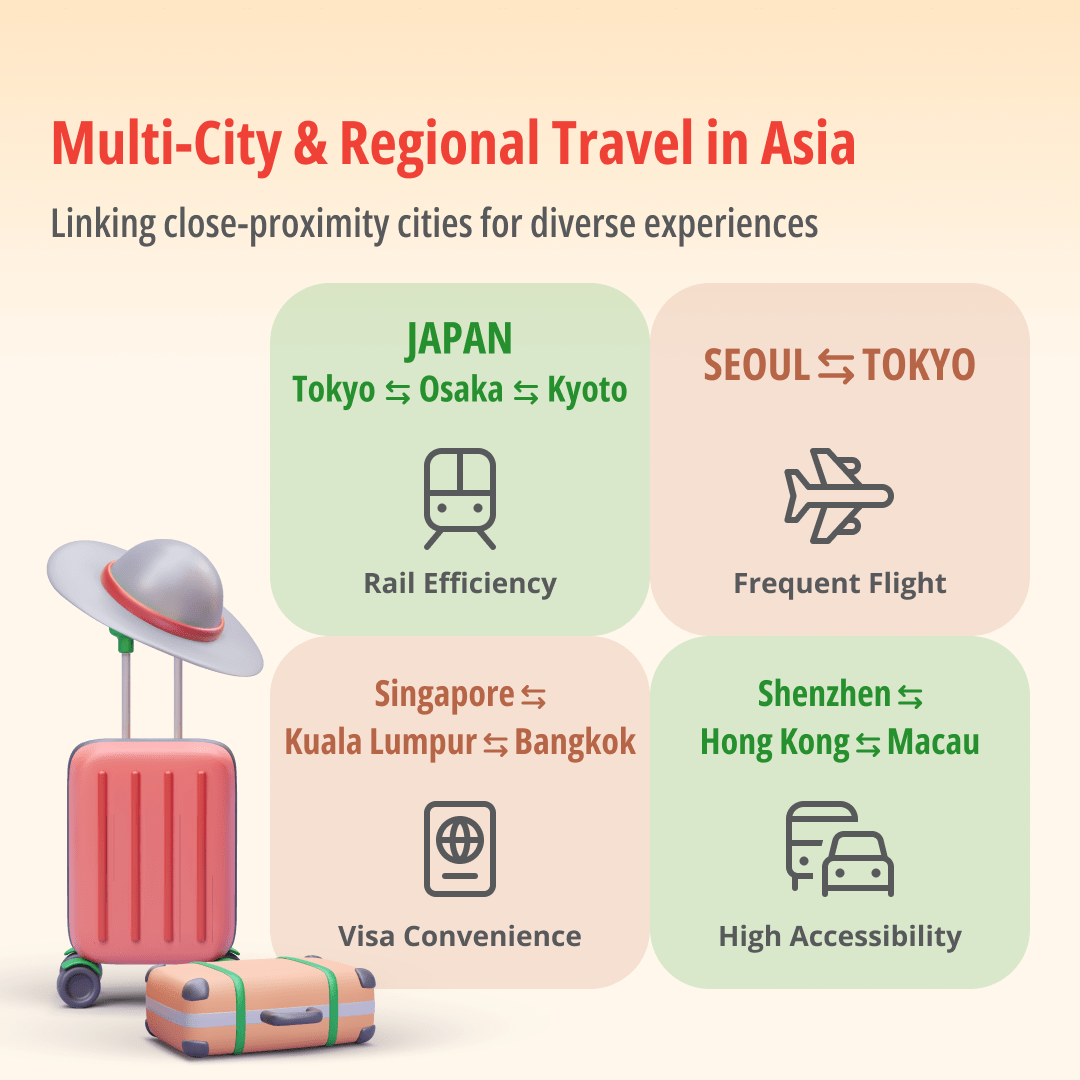
Chinese outbound tourists are increasingly visiting multiple cities within the same country during a single trip or following established regional travel corridors in Asia, where cities are geographically close and easily connected by flights or high-speed rail networks. This allows for diverse cultural experiences within a single journey.
Common Multi-destination Routes in Asia:
| Travel Region | Typical Multi-Destination Route1, 2 | Key Appeal |
| Northeast Asia | Japan (Tokyo – Osaka– Kyoto) | Efficient rail networks |
| Northeast Asia | Seoul – Tokyo | Frequent flight |
| Southeast Asia | Singapore – Kuala Lumpur – Bangkok | Visa convenience, short flights |
| Greater China | Shenzhen – Hong Kong – Macau | High accessibility and frequent transits |
These routes allow travelers to experience different cultural, historical, and urban environments while maximizing the value of long-distance travel.
Trend 2: Longer Holidays Encourage Multi-Destination Itineraries
Longer holiday periods are also boosting demand for multi-city package tours.
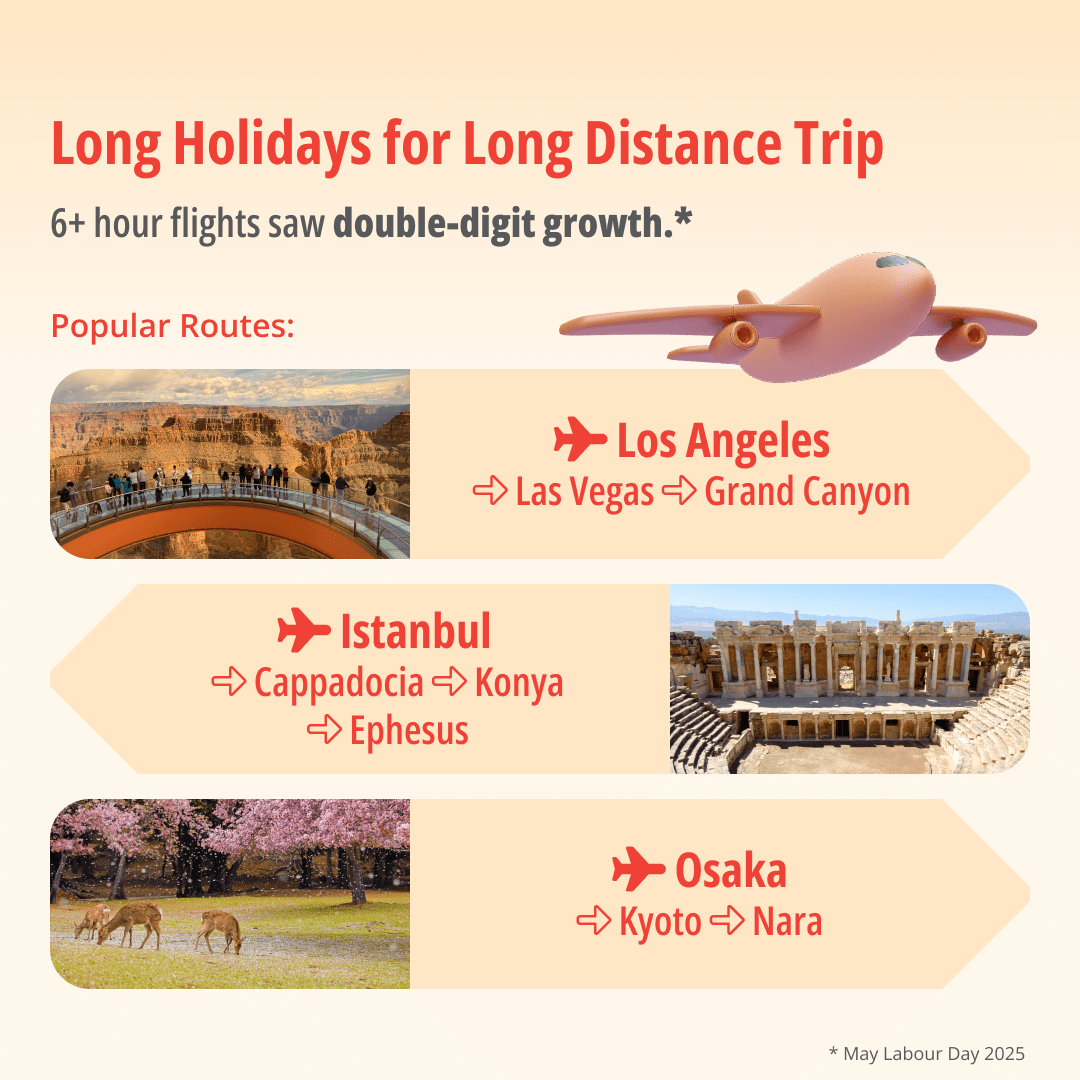
Flights exceeding six hours are the fastest-growing flight segment, with Chinese travelers seeing strong double-digit growth in long-distance trips during 2025 May Labour Day holiday1.
According to Trip.com Group’s 2026 Lunar New Year travel forecast, many popular outbound package tours now frequently bundle several destinations..
Popular Multi-Destination Itineraries::
| Destination | Example Multi-Destination Itinerary |
| Turkey | Istanbul → Cappadocia → Konya → Ephesus |
| United States | Los Angeles → Las Vegas → Grand Canyon |
| Japan | Osaka → Kyoto with Amanohashidate, Ine, Arashiyama, and Nara |
Trend 3: Transit Travel Creates Additional Destinations
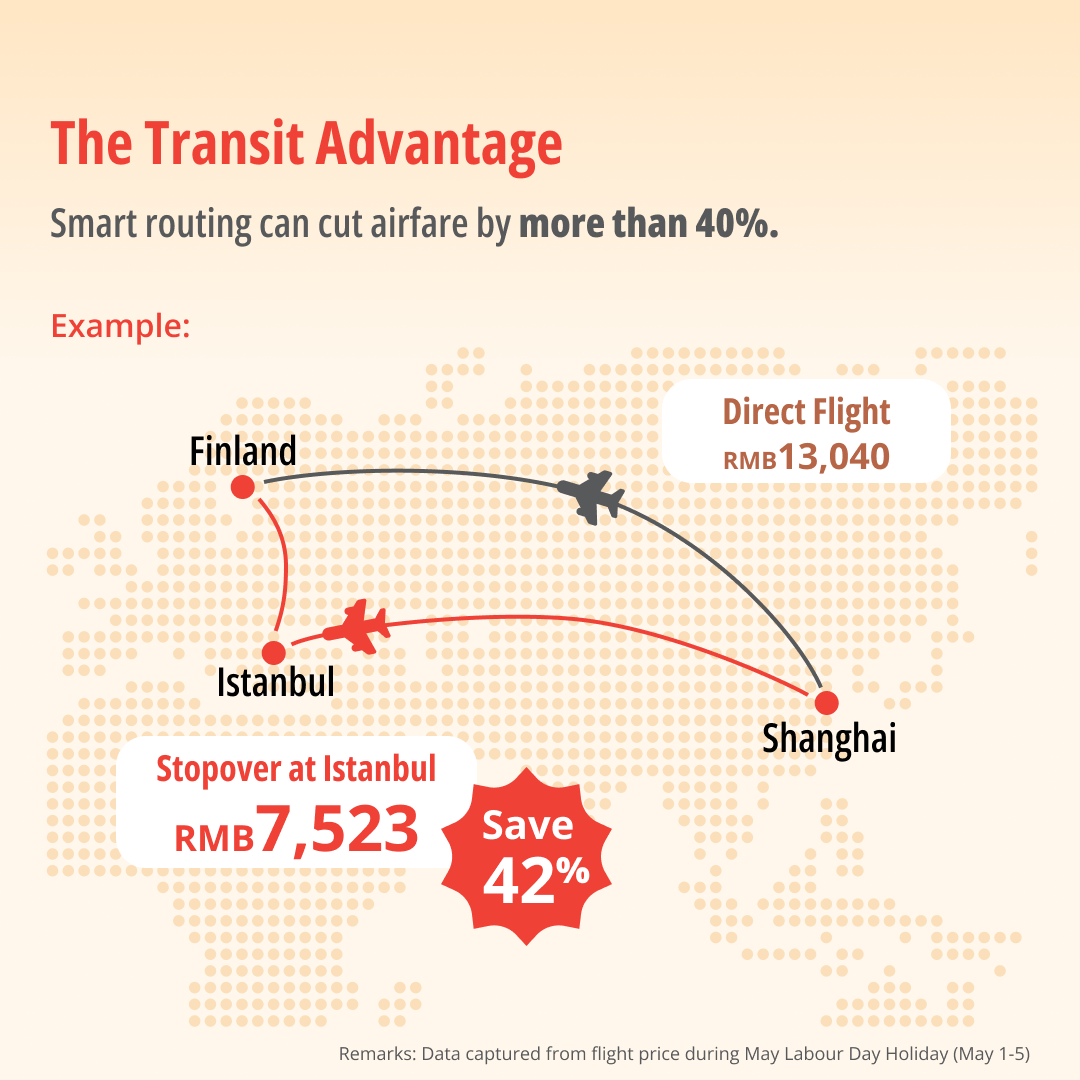
Some Chinese outbound travelers are also adding extra destinations through transit travel strategies. According to the Tongcheng Travel 2025 Spring Festival Travel Report highlights how travelers choose cross-border transit routes to visit an extra city while significantly reducing airfare costs.
Illustration of Transit Travel3:
-
- Direct Route: Sanya to Guangzhou (Peak period) = RMB 6,000
-
- Transit Route: Sanya => Hong Kong (Stopover) => Guangzhou = RMB 2,600 total
Cities such as Hong Kong, Seoul, and Singapore have become popular transit hubs. When transit options offer more than 40% savings compared to direct flights, the volume of travelers choosing these routes increases significantly3.
Trend 4: Cruise Travel Enables Multi-Destination Experiences
Beyond aviation, cruise tourism is also a major contributor to this trend.
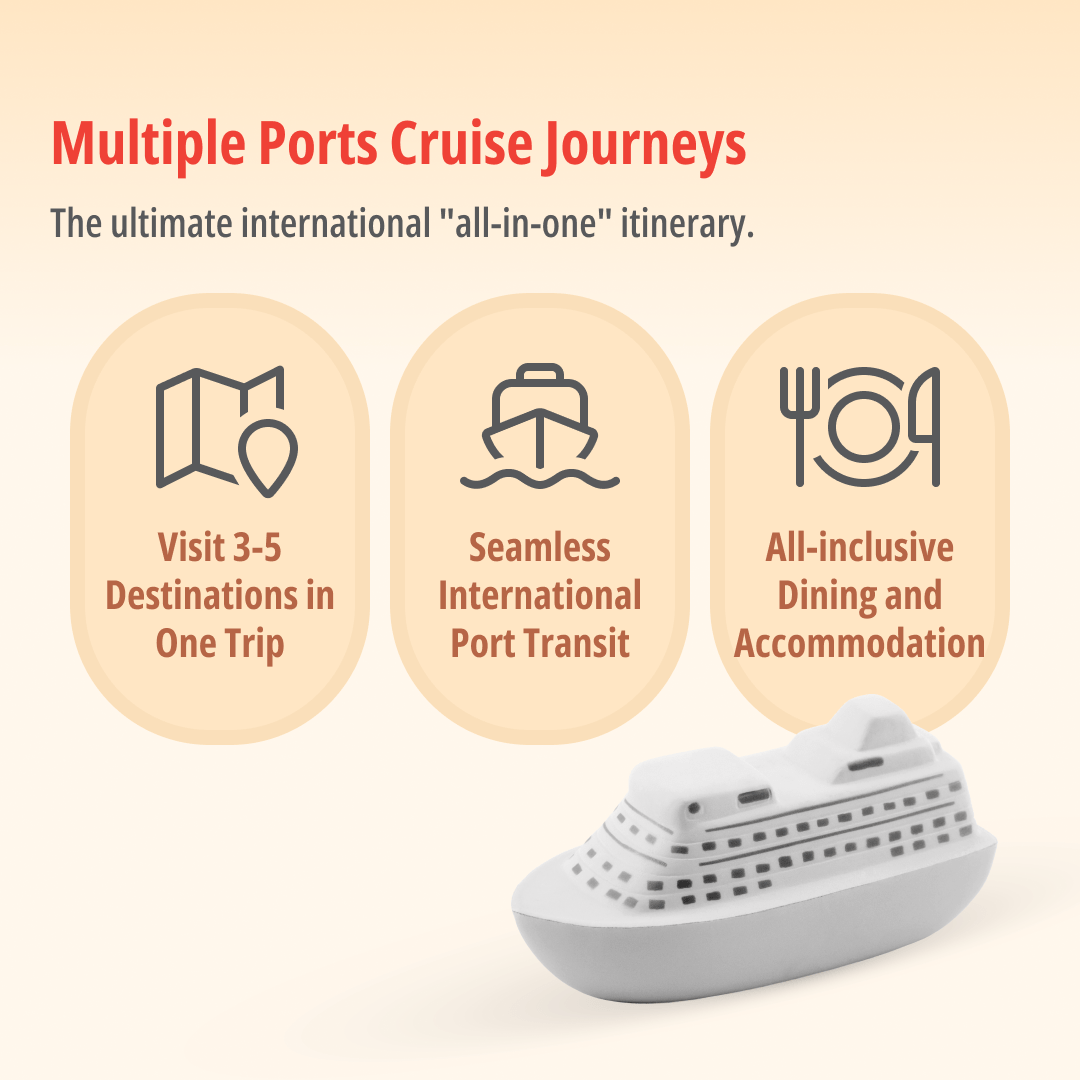
According to the Trip.com Group Momentum 2025 report, cruise travel is gaining popularity because they offer a seamless way to visit multiple ports with the convenience of all-inclusive dining and accommodation.4.
Cruises provide travelers with:
-
- Scenic sea journeys between international ports
-
- Simplified logistics for visiting 3-5 destinations in one trip
-
- Integrated travel experiences combining accommodation, dining, and entertainment that appeal to family groups
Multi-Destination Travel Creates New Opportunities
The rise of multi-destination travel has important implications for tourism boards and travel brands seeking to attract Chinese outbound tourists.
Key strategic opportunities include:
-
- Position destinations as part of regional travel routes rather than standalone locations
-
- Collaborate with nearby cities or countries to create unified marketing campaigns
-
- Produce travel content highlighting route inspiration (e.g., The Ultimate 48-hour Tokyo–Osaka travel guide) to influence the planning phase
-
- Partner with OTAs and digital platforms during the complex multi-city booking journey
Turning China Outbound Travel Insights into Growth
As Chinese outbound tourists increasingly adopt multi-destination travel, brands must adapt to a more sophisticated digital ecosystem.
At iClick, we help your brand to turn insights into measurable growth through data-driven marketing strategies, social listening, and performance campaigns targeting Chinese travelers worldwide.
Connect with iClick to unlock your next China outbound travel opportunity.
Source:
1: Trip.com Group Witnesses Double-digit Cross-border Growth for May Labour Day Holiday
2: Trip.com Group's 2026 Lunar New Year Forecast: Longer Journeys and Premium Travel Gain Momentum in the Year of the Horse
3: 同程旅行发布春节旅行报告:返乡客流带火县城酒店,部分县城中高端酒店热度涨四成
4: Trip.com Group Momentum 2025 report Travel's Next Big Trends
Related Insights: Explore more on China’s Outbound Travel
-
- iSuite Insight Issue #22: Tapping into the Rebound of China’s Outbound Travel Market: Trends and Insights in 2025
Explore 2025 China outbound travel trends and insights for 2026 on Xiaohongshu with iClick iFans, including top destinations, traveler behaviors and brand storytelling strategies.
- iSuite Insight Issue #22: Tapping into the Rebound of China’s Outbound Travel Market: Trends and Insights in 2025
-
- Unlocking the 2025 Chinese Luxury Travel Boom: Insights for Global Brands
Discover how Chinese high-net-worth travelers are shaping luxury and travel trends in 2025—and what brands must do to capture their attention.
- Unlocking the 2025 Chinese Luxury Travel Boom: Insights for Global Brands
-
- Interest-Led Journeys: How Cultural Travel Trends Are Shaping China’s Outbound Travel on Xiaohongshu
Explore how China outbound travel is reshaped by cultural travel on Xiaohongshu. Discover 2026 key trends, insights, and strategies for marketers with iClick.
- Interest-Led Journeys: How Cultural Travel Trends Are Shaping China’s Outbound Travel on Xiaohongshu
More Insights
China Social Commerce in 2026: How B2B Brands Win on Douyin and Xiaohongshu
August 13, 2026
B2B brands in China are discovering that Douyin and Xiaohongshu drive pipeline, not just awareness. Learn how to build a B2B social commerce strategy on China's leading platforms in 2026.
Programmatic Advertising in China: A Complete Platform Guide for Global Brands (2026)
August 4, 2026
A complete guide to programmatic advertising in China: key DSP platforms, audience targeting, and campaign strategies for global brands in 2026.
China Travel Retail 2026: Outbound Shoppers & Peak Season
August 3, 2026
Mainland retail fell 0.6% YoY, yet Chinese outbound shoppers drove CNY 1.32T cross-border. Capture travel retail demand this summer and Golden Week.
China Beauty Market 2026: 8 Trends Reshaping the Industry
August 3, 2026
Domestic brands hold 57.4% of China's CNY 1T beauty market. Explore 8 trends — science-led skincare, biotech longevity, Gen Z habits and AI personalisation.
China 618 2026: CNY 934B GMV & Double 11 Playbook
August 3, 2026
China's 618 hit a CNY 934B GMV record as the first AI-native shopping festival. Key strategies for international brands preparing for Double 11 2026.
China Family Outbound Travel 2026: Short Trips Up 40%
July 30, 2026
Family hotel bookings doubled and short trips surged 40%+ in China's summer 2026. Reach high-intent families via Xiaohongshu, Ctrip and Amap.
China Creator Economy Explained: KOL, Wang Hong, Bo Zhu & Live-Streaming Hosts
July 30, 2026
Learn the difference between KOLs, Wang Hong, Bo Zhu, and live-streaming hosts in China’s creator economy — and how each role drives trust, awareness, and sales.
Baidu AI Search 2026: How International Brands Win China's AI-Driven Decision-Making Chain
July 24, 2026
With 602 million AI users in China, Baidu GEO is now essential. Discover how international brands can appear in AI answers and shape purchasing decisions before competitors do.
KOL Marketing in China: Earn Trust Faster by Letting Go
July 14, 2026
What is KOL marketing in China? Discover how it works, KOL vs KOC, platform choice, and how global brands build a winning China influencer strategy.