


We use cookies to give you the best digital experience. By continuing to browse this site, you give consent for cookies to be used. To learn more information about the use of cookies, please visit our cookie policy.
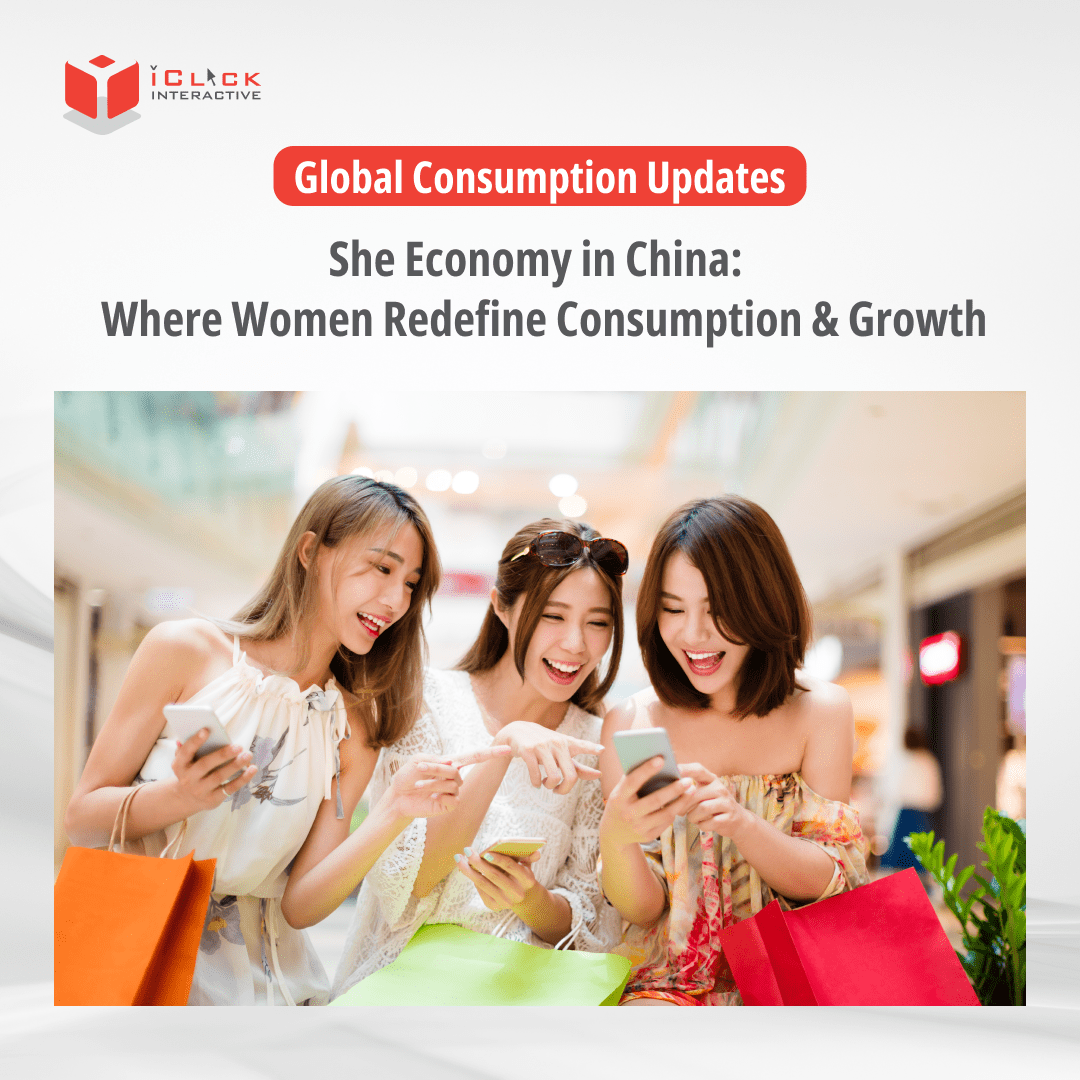
She Economy in China: Redefining Identity Through Consumption this 3.8 International Women’s Day 2026
The She Economy is more than just a trend but a structural force reshaping China’s consumer landscape. As Chinese women continues to gain economic independence, digital fluency, and cultural influence, they are redefining what consumption means: less about ownership, more about identity, well-being, and self-expression.
Digital-First, High-Value Chinese Women Consumers Are Rising
According to QuestMobile1, as of January 2025, China’s active female internet users reached 624 million, up 2.6% year-on-year, accounting for nearly 49.6% of all internet users. Millennials, Gen Z, and the rising Gen Alpha together make up almost half of this audience, with post-2000s users growing the fastest.
Compared with the overall market, female users consistently demonstrate stronger high-spending capacity on online consumption1:
-
- 33.1% of female users have monthly online spending power above RMB 2,000
-
- Core purchase drivers: brand credibility, price transparency, product quality, and health value
This scale, combined with strong purchasing power, positions women as the most influential growth engine for brands operating in China.
Key Consumption Trend: Leverage Social Media Platform for Product Research
Women engage deeply on platforms such as Xiaohongshu, WeChat, and Weibo, following beauty, parenting, and health KOLs.
-
- Weibo female MAU: 281 million1
-
- Xiaohongshu female MAU: 158 million1
Here, “social currency” directly influences purchase decisions through trust and peer validation. Women are seeking both product appearance, price, quality and durability:
-
- Strong interest in skincare, cosmetics, sportswear, and premium maternal products
-
- Preference for functional yet fashionable designs
-
- Rising attention to sustainability and resale platforms
International brands continue to perform well, especially when combining innovation with emotional relevance.
Key Travel Consumption Trend: Travel as A Form of Self-Investment
According to Tongcheng Travel’s She Economy report in 20252, women dominate high-value travel scenarios:
| Travel Category | Female User Share |
|---|---|
| Visa services | 53%+ |
| Outbound travel | 55%+ |
| Customized Travel | 55%+ |
Top destinations include Seoul, Bangkok, Singapore, and Tokyo. Preferred experiences center on2:
-
- Heritage sites (30%+)
-
- Natural landscapes (27%+)
-
- Museums, temples, islands, and coastal getaways
For China’s Women, travel is no longer leisure but an investment in emotional renewal and identity building.
Beyond Spending: The New Form of Aspiration
The She Economy reflects a deeper shift in values. From Gen Z digital natives to silver-age women embracing livestream commerce and wearable tech, women spend differently because they seek meaning, wellness, and self-definition. With women projected to account for 75% of global discretionary spending by 2030 by NielsenIQ3, Chinese women will leave a decisive imprint on global markets.
In China, International Women’s Day has now evolved into Goddess Day (女神节) and Queen’s Day (女王节)—a symbol of women’s cultural and commercial power. Platforms like Tmall and Xiaohongshu amplify these voices, turning informed consumers into brand advocates.
Capture the Growth of the She Economy with iClick
Winning the hearts of Chinese women goes beyond generic campaigns. It requires data-driven insights into their values, emotional triggers, and digital journeys.
At iClick, we help brands decode female consumer insights, activate social influence, and build emotionally resonant growth strategies in China.
Let’s refine your she-marketing strategy. Connect with us today.
Source:
1: QuestMobile: 2025 “她经济”洞察报告
2: 同程旅行:“她经济”报告
3: China Daily: 'She economy' a new momentum of good life
Related Insights: Explore more on Chinese Luxury Consumers
-
- Unlocking the 2025 Chinese Luxury Travel Boom: Insights for Global Brands
Discover how Chinese high-net-worth travelers are shaping luxury and travel trends in 2025—and what brands must do to capture their attention.
- Unlocking the 2025 Chinese Luxury Travel Boom: Insights for Global Brands
-
- From Festive Motifs to Cultural Immersion: How Luxury Brands Win China in 2026
Explore how luxury brands engage the Chinese luxury consumer in 2026 with cultural immersion and localized storytelling, boosting emotional connection and relevance through year-round engagement strategies.
- From Festive Motifs to Cultural Immersion: How Luxury Brands Win China in 2026
-
- Qixi 2025: How Luxury Brands Win Chinese Consumer on Xiaohongshu
Explore Qixi 2025 trends on Xiaohongshu with iClick. See how luxury brands are winning the hearts of the Chinese luxury consumer through creative campaigns, celebrity influence, and modern gifting narratives.
- Qixi 2025: How Luxury Brands Win Chinese Consumer on Xiaohongshu
Tag :
Chinese eCommerceMore Insights
China Social Commerce in 2026: How B2B Brands Win on Douyin and Xiaohongshu
August 13, 2026
B2B brands in China are discovering that Douyin and Xiaohongshu drive pipeline, not just awareness. Learn how to build a B2B social commerce strategy on China's leading platforms in 2026.
Programmatic Advertising in China: A Complete Platform Guide for Global Brands (2026)
August 4, 2026
A complete guide to programmatic advertising in China: key DSP platforms, audience targeting, and campaign strategies for global brands in 2026.
China Travel Retail 2026: Outbound Shoppers & Peak Season
August 3, 2026
Mainland retail fell 0.6% YoY, yet Chinese outbound shoppers drove CNY 1.32T cross-border. Capture travel retail demand this summer and Golden Week.
China Beauty Market 2026: 8 Trends Reshaping the Industry
August 3, 2026
Domestic brands hold 57.4% of China's CNY 1T beauty market. Explore 8 trends — science-led skincare, biotech longevity, Gen Z habits and AI personalisation.
China 618 2026: CNY 934B GMV & Double 11 Playbook
August 3, 2026
China's 618 hit a CNY 934B GMV record as the first AI-native shopping festival. Key strategies for international brands preparing for Double 11 2026.
China Family Outbound Travel 2026: Short Trips Up 40%
July 30, 2026
Family hotel bookings doubled and short trips surged 40%+ in China's summer 2026. Reach high-intent families via Xiaohongshu, Ctrip and Amap.
China Creator Economy Explained: KOL, Wang Hong, Bo Zhu & Live-Streaming Hosts
July 30, 2026
Learn the difference between KOLs, Wang Hong, Bo Zhu, and live-streaming hosts in China’s creator economy — and how each role drives trust, awareness, and sales.
Baidu AI Search 2026: How International Brands Win China's AI-Driven Decision-Making Chain
July 24, 2026
With 602 million AI users in China, Baidu GEO is now essential. Discover how international brands can appear in AI answers and shape purchasing decisions before competitors do.
KOL Marketing in China: Earn Trust Faster by Letting Go
July 14, 2026
What is KOL marketing in China? Discover how it works, KOL vs KOC, platform choice, and how global brands build a winning China influencer strategy.